
La Merced
La Merced sits at 750 meters, which by Peruvian standards is almost at sea level. Drive up out of Tarma - the Pearl of the Andes, 3,000 meters higher - and within a few hours the pines give way to banana trees, the chill burns off, and you arrive in a town that smells faintly of coffee roasting and diesel exhaust. This is where the Andes surrender to the selva alta, the high jungle. La Merced is the capital of Chanchamayo Province in the Junín Region, and its role in central Peru is essentially a hinge: travelers heading from the highlands into the Amazon basin pass through this way, and so do the coffee beans, cacao, and tropical fruit flowing in the other direction.
Where the Bus Drops You
The four-hour ride from Huancayo arrives at the multi-company terminal on Av. Ferrocarril, and most visitors are immediately surrounded by tour hawkers in the central plaza - the morning rush lasts until about ten. The town center is compact enough to walk across in a quarter hour. Mototaxis - Peru's adapted motorcycles with rear bench seats - get you anywhere else in town for a sol, a little more after dark. The Plaza de Armas is the obvious center, ringed by benches and a few small cafes, and in the mornings it is also a hiring hall for jungle tours. Agents will promise you waterfalls, native villages, coffee processors, boat rides, and swimming holes. Most of them offer roughly the same circuit; prices hover around thirty-five soles.
The Indiana Jones Tour
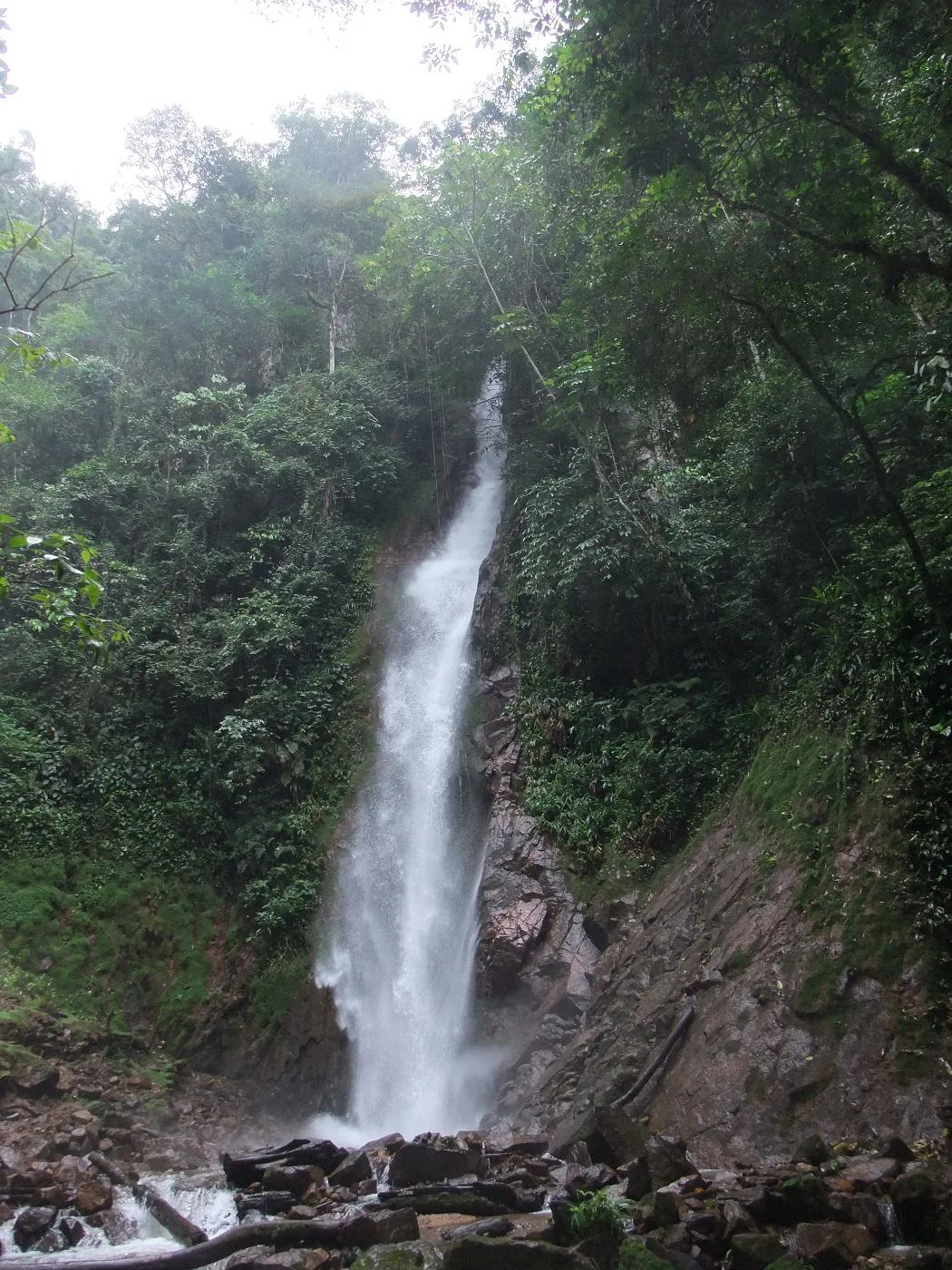
Nobody calls it the Indiana Jones Tour, but if you ask for that name, you will end up on a trip into a creek bed where you climb a series of waterfalls with ropes - and in places, without them. The route winds up wet slippery rock. Some groups carry two guides specifically to help climbers through the harder pitches. It is not for the poorly conditioned. What it is, for those who can manage it, is one of the purer expressions of what the high jungle has to offer: water falling out of granite, overhanging vegetation, the distinct smell of wet moss warming in the afternoon. Down closer to town, Puente Kimiri is an easier walk - forty-five minutes from the center, and beyond the bridge a well-marked trail to three waterfalls named Las Reinas, Hanuman, and Gondika.
Coffee, Cocoa, and the Ashaninka
The Chanchamayo Valley is one of Peru's main coffee-producing regions, and cacao grows alongside it on the slopes around town. La Merced's market sells beans from small farms that most visitors will never see. Fruit stacks high on the tables - pineapples, mangoes, papaya, starfruit, maracuyá - and the rhythm of the town is shaped by what is coming in from the fincas. The Ashaninka are one of the largest indigenous groups in the Peruvian Amazon, and their territory includes parts of the Chanchamayo region. Craftwork - woven bags, bead necklaces, wooden carvings - appears in La Merced's shops. Some tours visit communities advertised as Ashaninka villages; the honest versions offer a real encounter, the exploitative ones treat the visit as a zoo stop. Ask what the community actually receives from the tour before signing up.
Eating the Selva
La Merced sits between two food traditions - the highland cuisine of Tarma and Huancayo and the lowland cuisine of the rainforest further east. Restaurants around town serve both. You can find Peruvian set meals for a few soles and more elaborate plates of freshwater fish from local rivers. Casa de Allen, a bit out of the center along Av. Peru, does burgers in three sizes and flaming crepes with ice cream, and Allen himself is a reliable source of information about what is safe on the river and which tours are running honestly. One menu item the guidebooks warn against: bush meat. Zamaño, cutpe, sajino, venado, doncella, and zungaro are all either wild pigs, deer, or fish species under pressure from overhunting and overfishing. Skip them. Order coffee instead - it will be fresh, local, and often some of the best you drink in Peru.
The Roads That Continue
La Merced is a junction. Buses from here reach Atalaya - the Emerald of Ucayali - where boats head downstream on the Ucayali toward Pucallpa and the broader Amazon system. To the east lies Satipo. To the north, Oxapampa, a town with a strong German and Austrian colonial heritage, an hour and forty minutes away for ten soles. West is Tarma, the pass back into the highlands. Pichanaki is a shorter ride along the valley floor. For travelers, La Merced is rarely a destination on its own. It is what you move through to reach places further in - the jungle proper, the coffee country, the river system. But spend a few nights, and it reveals itself: a small, working Peruvian town doing exactly what small working Peruvian towns do, quietly, most of the time, in a landscape that happens to be extraordinary.
From the Air
La Merced sits at 11.06°S, 75.34°W at the eastern foot of the central Peruvian Andes, in the Chanchamayo Valley at about 750 meters. This is the transition zone where the cordillera falls away toward the Amazon basin - east of Tarma (which is at 3,000 m) and northwest of Satipo. Francisco Carle Airport (JAU/SPJJ) in Jauja, about 90 km west, serves the central highlands; Lima's Jorge Chávez International (SPJC) is 305 km west. The valley is humid and green year-round, with rainfall heaviest November through April. Approach via the valley corridor - the surrounding ridges rise steeply to 3,500+ meters. Best flying conditions are the dry season (May to September) when cloud cover over the cordillera is lightest.
Nearby Stories
- Oxapampa 16 km away
- Battle of Junin 26 km away
- Gran Pajonal 77 km away
- La Cantuta massacre 114 km away
- Klaus Barbie 164 km away
- Putis massacre 164 km away
- Pucallpa 263 km away