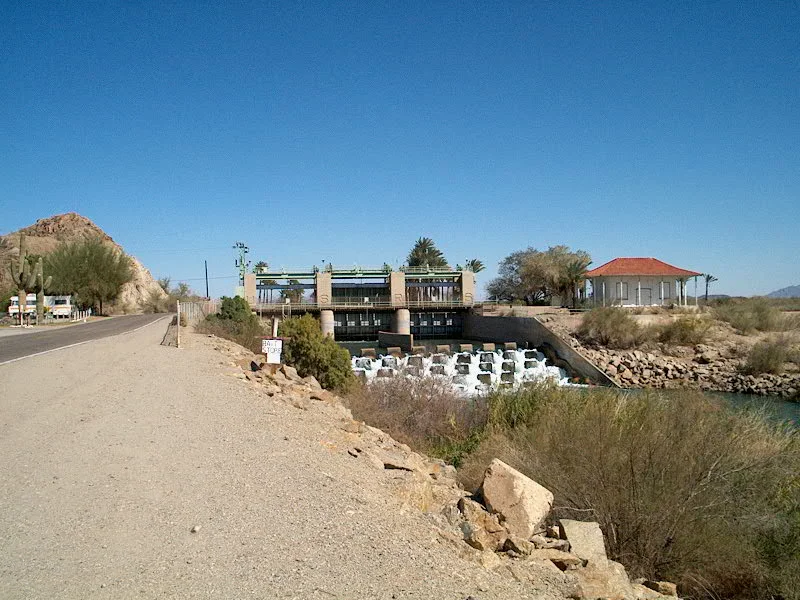

Laguna Diversion Dam
The contract to build the first dam on the Colorado River was awarded to J.G. White and Company on July 6, 1905. The Bureau of Reclamation took over the project in 1907. The dam was completed in 1909. When it was finished, the era of steamboat travel on the lower Colorado River was over — the shallow-draft vessels that had supplied military posts, mining camps, and frontier settlements up and down the river for decades could no longer pass. The Laguna Diversion Dam was modest in scale but absolute in consequence.
The First Dam on the Colorado
The Colorado River had been running to the sea without artificial obstruction since the last ice age. In 1909, that changed. The Laguna Diversion Dam, built at a location called Laguna approximately 13 miles northeast of Yuma, was not the towering structure that Hoover Dam would later be — it was a relatively low diversion structure, designed to raise water levels enough to direct river flow into the irrigation canals of the Yuma Project, one of the Bureau of Reclamation's early large-scale water management initiatives.
The contract was awarded in 1905, the year after the Alamo Canal's failed headgates sent Colorado River water flooding into the Salton Sink and began creating the Salton Sea. The Bureau of Reclamation took control of the project in 1907 when the initial contractor encountered difficulties, and the dam was completed two years later. It was the first structure built across the entire length of the Colorado River — the beginning of the transformation of one of North America's great rivers into a managed water delivery system.
The End of the Steamboats
Colorado River steamboats had operated since the 1850s. They were the supply line for Fort Yuma and the military posts of the Southwest, the transport system for mining operations up and down the river, the connection between the Pacific Coast and the desert interior in an era before roads and railroads covered every route. Small, shallow-draft vessels navigated the river's sandbars and seasonal variations in flow, carrying cargo and passengers through the desert.
The Laguna Diversion Dam ended that era. A dam across the river, even a relatively low one, is an impassable obstacle for a watercraft. The steamboats that had been serving the lower Colorado for more than fifty years could not pass the dam. By 1909, the railroad had already reduced the steamboats' commercial significance, but the dam eliminated what remained. The river that had been a highway became a reservoir and a diversion channel.
Mittry Lake, created by the dam's impoundment, is a notable unintended consequence of the structure. The lake, about 4 miles long, became an important wildlife area — a reservoir in the desert that provides habitat for birds and other wildlife, now managed as part of a network of wildlife refuges along the lower Colorado.
The Workers and the Bridge
The Laguna Diversion Dam was built by a labor force that included Mexican-American workers and some Native American workers — the population available and willing to take the dangerous, low-paid work of dam construction in a desert climate. Their presence in the historical record is noted without the individual names that the engineers and contractors received; they are documented as a category rather than as individuals.
The Laguna Bridge, which carries highway traffic across the dam structure, features decorative elements that require historical context: swastikas in the ironwork. The bridge was built before the Nazi adoption of the swastika as their symbol — in 1909, the swastika was an ancient symbol of good fortune used across many cultures, including Native American traditions. It appeared in decorative ironwork and architectural ornament without the associations it would later carry.
The same decorative motif appears in other structures of that era. The Laguna Bridge's swastikas mean what they meant in 1909, which is not what they came to mean after 1933.
A Structure That Shaped the River
The Laguna Diversion Dam served the Yuma Project's irrigation system for decades, diverting water from the Colorado into the canals that made the Imperial Valley and the Yuma area agriculturally productive. It was eventually supplemented and in some functions replaced by other infrastructure — the Imperial Dam further upstream became the primary diversion point for both US and Mexican irrigation systems — but the Laguna Dam remains in place.
From the air, the dam is visible as a structure across the river, creating the still water of Mittry Lake to its north and a controlled release to its south. The lake's irregular shoreline is a contrast to the surrounding desert terrain — a pool of green and blue where the river was backed up more than a century ago, now a permanent feature of the lower Colorado landscape.
From the Air
Located at approximately 32.87°N, 114.47°W, approximately 13 miles northeast of Yuma on the Colorado River. Mittry Lake, created by the dam's impoundment, is visible from the air as a distinctive body of water north of the dam structure. The Laguna Bridge carrying highway traffic is identifiable. Nearest airport: Yuma International Airport (KNYL), approximately 15 miles to the southwest.
Nearby Stories
- Arizona State Prison Complex – Yuma 20 km away
- Holtville, California 39 km away
- Chocolate Mountain Aerial Gunnery Range 45 km away
- Battle of Stanwix Station 51 km away
- Laguna Salada 68 km away
- Slab City: The Last Free Place in America 97 km away
- Gillespie Dam Bridge 108 km away
- 2000 Marana V-22 Crash 253 km away