.jpg)
Holtville, California
Bugs Bunny mentioned Holtville in the 1953 cartoon "Bully for Bugs." The animator Chuck Jones placed it there, presumably for comic effect — the punchline being that a place called Holtville was where the cartoon rabbit was trying to go when he accidentally surfaced in a bullfighting arena. It is perhaps the most unexpected celebrity endorsement an Imperial Valley city has ever received. But Holtville has its own story, one involving Swiss-German settlers, an annual festival devoted to carrots, a congressman, a linguist who went to the Amazon, and a founding father who named the town for himself.
W.F. Holt Builds a Town
W.F. Holt founded the community in 1903, initially calling it Holton — then settling on Holtville, apparently on the theory that a place named after yourself deserves at least two attempts at the name. Holt was a developer who understood that the Imperial Valley's future lay in irrigation, and he positioned the community accordingly. Swiss-German immigrants were among the early settlers who came to farm the desert land made arable by the new canal systems, bringing agricultural expertise and, eventually, a distinctive community character. Holtville incorporated on June 20, 1908, establishing itself as an independent city rather than a company town or unincorporated community. It has remained a small, close-knit agricultural city ever since.
The Carrot Capital
Holtville bills itself as the Carrot Capital of the World, a designation it has defended with considerable enthusiasm since 1947 when the Imperial Valley Carrot Festival began — an annual celebration that has continued with only brief interruptions for decades. The Imperial Valley's climate and irrigation infrastructure make it well-suited to carrot production: the warm winters, reliable sunshine, and fertile soil produce carrots that are harvested and shipped across the country. The festival draws visitors with a carrot cook-off, parade, and carnival. It is the kind of local celebration that turns a single agricultural product into a community identity — and in Holtville's case, that identity has held for generations.
Notable Sons
Two figures born in Holtville made their marks in very different fields. George E. Brown Jr. represented California in the US House of Representatives for decades, serving from 1963 to 1999 with a brief interruption, becoming one of the most influential voices on science and technology policy in Congress. His advocacy for research funding and environmental protection left a legacy well beyond the Imperial Valley. Daniel Everett came from a different world entirely: a linguist who went to the Amazon to work with the Pirahã people of Brazil and returned with findings that challenged foundational assumptions in linguistics — specifically, Noam Chomsky's theory that certain linguistic structures are universal to all human languages. Holtville produced a congressman and a revolutionary linguist. Not a bad return for a carrot town.
The Weight of One Morning
On March 2, 2021, a SUV carrying 25 people — mostly farmworkers — collided with a semi-truck at a railroad crossing near Holtville. Thirteen people died, making it one of the deadliest crashes in Imperial County history. The victims were largely undocumented migrants, and the tragedy drew national attention to the conditions facing agricultural workers in the valley: long distances traveled to reach fields, crowded transport, and the invisible labor that sustains American food production. Holtville, a city that had known itself as the Carrot Capital, suddenly had to hold a different kind of grief alongside its agricultural identity. The memorial that followed honored people whose names most of the country had never known.
From the Air
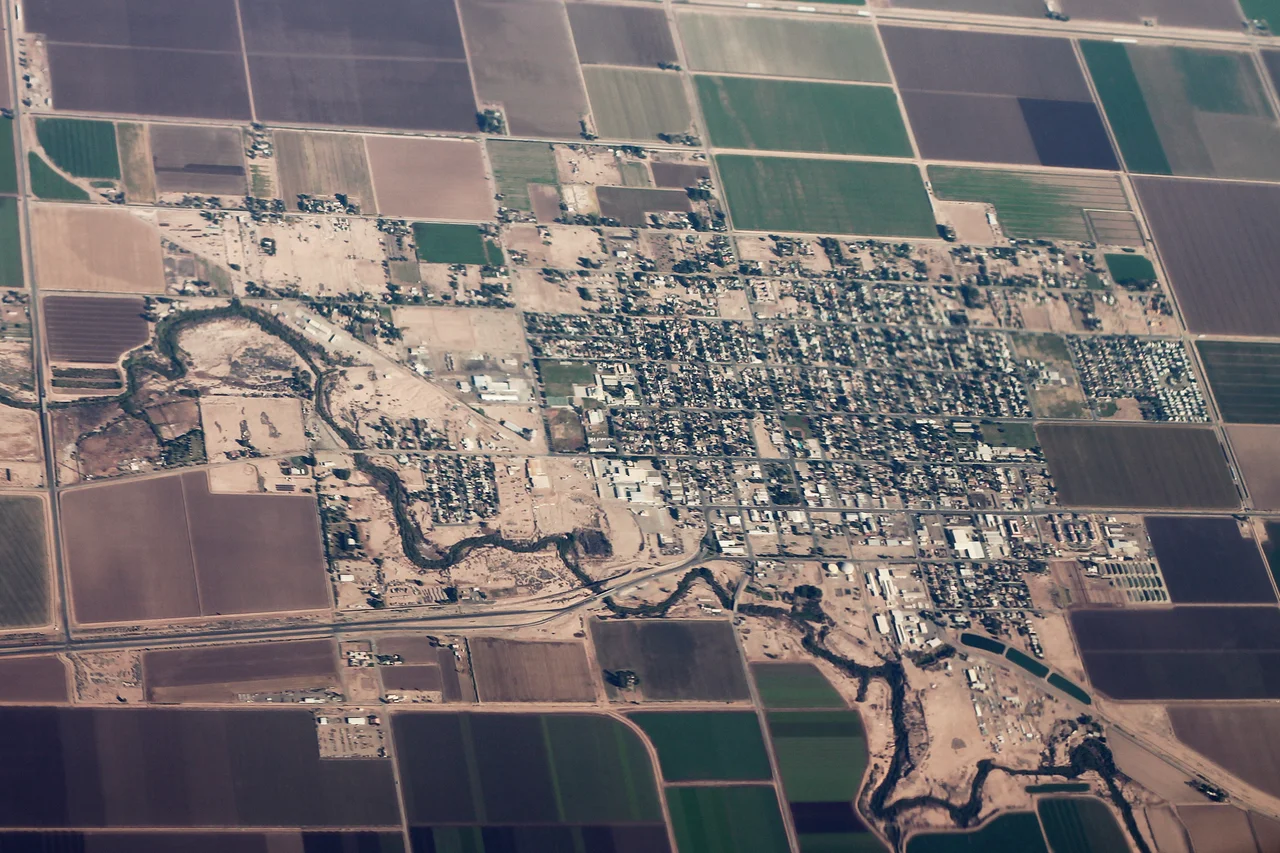
Holtville sits at approximately 20 feet elevation at 32.811°N, 115.380°W in the eastern Imperial Valley, about 8 miles east of El Centro. From the air, agricultural fields surround the small city center, with visible carrot and other vegetable fields in season. The All-American Canal is visible to the south. Nearest airports include Imperial County Airport (KIPL) about 7 miles west and Yuma MCAS/Yuma International (KYUM) approximately 50 miles east. The Mexican border lies about 12 miles south. The valley's flat terrain provides clear visibility in all directions on good weather days.
Nearby Stories
- Coyote Mountains 6.2 km away
- Calipatria, California 9.1 km away
- Old Plank Road 13 km away
- Ocotillo Wells, California 15 km away
- Hualapai Smith's 16 km away
- El Vallecito 22 km away
- Laguna Salada 24 km away
- Poston War Relocation Center 117 km away