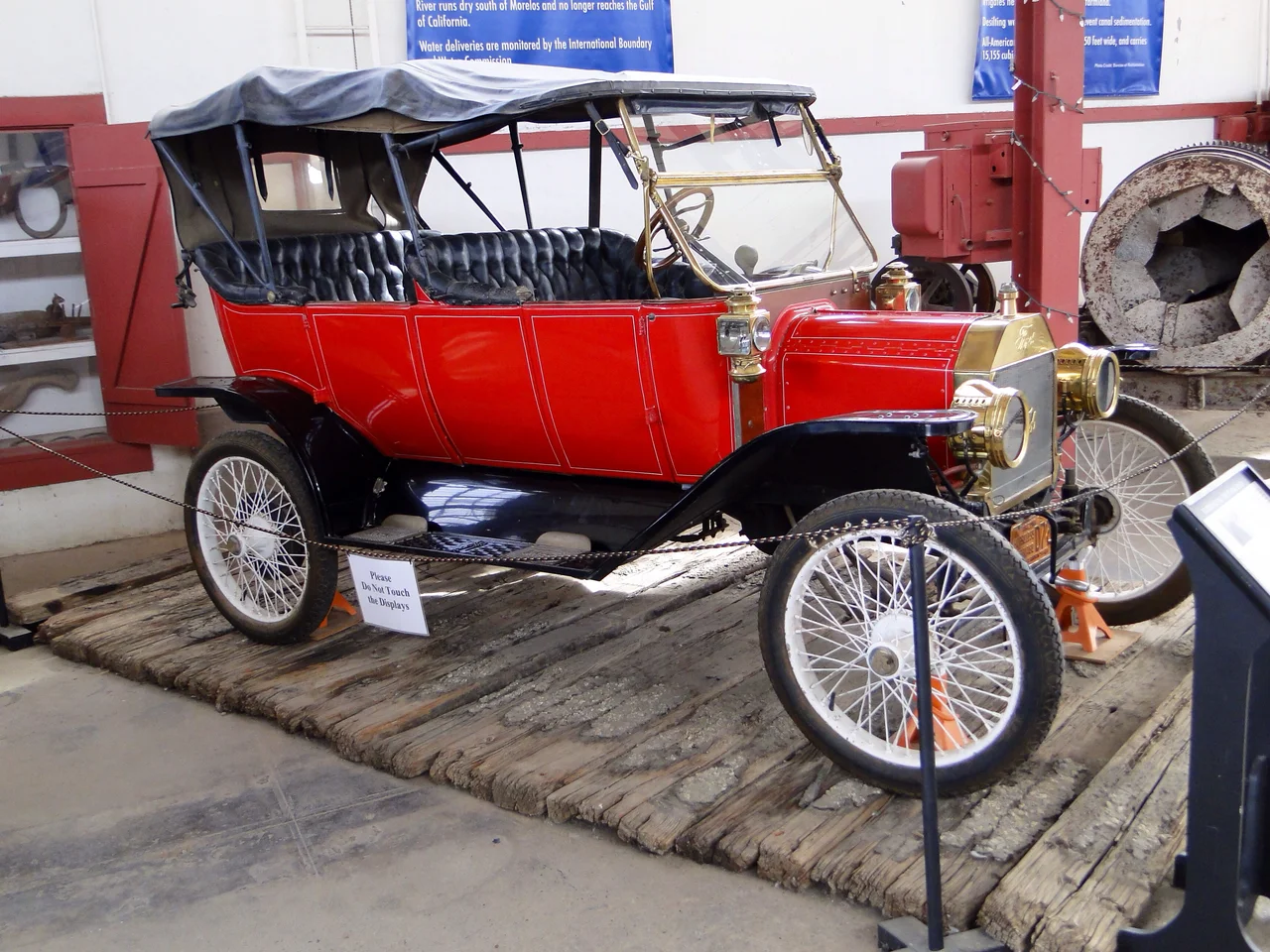

Old Plank Road
In 1912, a man called 'Colonel' Ed Fletcher drove from San Diego to Yuma to prove it could be done. It took 19.5 hours. The hardest part was the Algodones Dunes — a band of shifting sand in Imperial County that cars simply could not cross without something solid to drive on. Three years later, that something was built: 13,000 interlocking wooden planks laid across 6.5 miles of desert dunes, creating a road that was, by any measure, better than no road at all.
The Problem with the Dunes
The Algodones Dunes occupy a strip of Imperial County along the California-Arizona border — the largest dune system in California, a stretch of fine sand that has blocked east-west travel since the first overland routes were attempted across the region. The Southern Emigrant Trail skirted the northern edge of the dunes. Early automobile travelers faced the same obstacle: no surface, no traction, no way through.
Ed Fletcher's 1912 race from San Diego to Yuma — covering the route in 19.5 hours — helped demonstrate both that the journey was possible and that the dunes were the decisive obstacle. The winning argument for building a proper crossing came from the cumulative evidence of drivers trying and failing to cross sand that swallowed wheels and defeated engines.
Thirteen Thousand Planks
The first plank road was completed in 1915. It ran 6.5 miles across the dunes, using 13,000 interlocking wooden planks — not a continuous surface but a series of portable sections that could theoretically be moved. The design acknowledged its own limitations: the road was only eight feet wide, enough for one car to cross at a time.
When two vehicles met on the road going opposite directions, one driver had to pull their car off the planks, move the relevant section of road out of the way, let the other car pass, replace the planks, and get back on. This was understood to be inconvenient but preferable to the alternative, which was not crossing at all.
A second plank road was commissioned in 1916, also eight feet wide, running parallel to the first. Two roads of that width gave the crossing something approaching a two-lane capacity, though the logistics of passage still required coordination and cooperation between drivers.
Eleven Years and Then Pavement
The plank roads served their purpose for eleven years. On August 12, 1926, a paved highway opened across the Algodones Dunes, and the wooden planks were retired from active use. The transition from planks to pavement represented a genuine improvement in ease of travel — the paved road was faster, more reliable in wind, and did not require drivers to negotiate passage rights.
Fletcher, who had won his 1912 race and had been a persistent advocate for improving the route, was part of the organizational energy that eventually produced both the plank roads and the paved highway. The route became part of US 80, the southern transcontinental highway, and later was incorporated into the Interstate 8 corridor.
What Remains in the Sand
Fragments of the Old Plank Road still exist in the Algodones Dunes. Because the dunes shift with wind, sections of the original wooden planks have been exposed and reburied repeatedly over the past century. The surviving fragments are a California Historical Landmark — number 845 — and the area containing them is designated an Area of Critical Environmental Concern by the Bureau of Land Management, which manages the dunes for a combination of off-highway vehicle use, wildlife protection, and historical preservation.
The planks that remain in the sand are a relic of a brief moment when the solution to an impassable natural obstacle was wood — portable, improvised, sufficient. From the air, the dunes present themselves as they always have: a continuous wave of pale sand that the highway now crosses without apparent difficulty, the plank road's eleven-year struggle invisible beneath the pavement.
From the Air
Located at approximately 32.71°N, 114.85°W in the Algodones Dunes of Imperial County, California. The dunes are unmistakable from the air — a broad band of pale sand crossed by Interstate 8. The preserved fragment area is south of I-8 in the dune system. Nearest airport: Yuma International Airport (KNYL), approximately 15 miles to the east.
Nearby Stories
- Holtville, California 7 km away
- Rolle Airfield 8.1 km away
- Calipatria, California 21 km away
- Laguna Salada 37 km away
- Chocolate Mountain Aerial Gunnery Range 59 km away
- Battle of Stanwix Station 83 km away
- Gillespie Dam Bridge 140 km away
- 2000 Marana V-22 Crash 285 km away