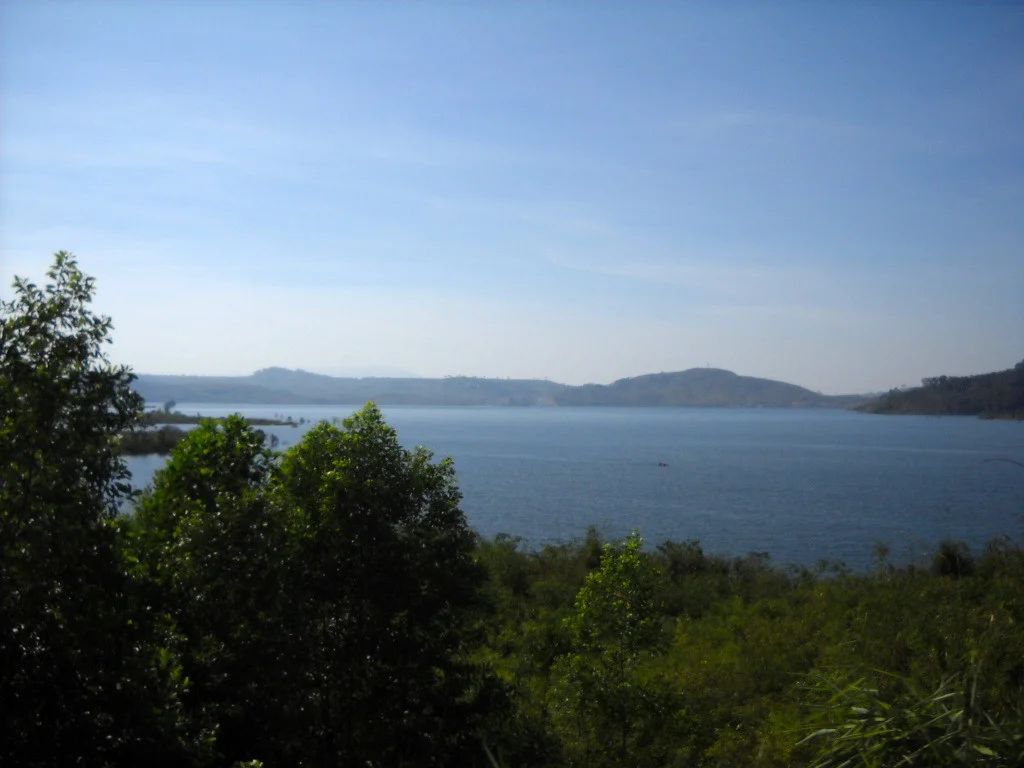

Lak Lake
The Mnong people have a story about why they live beside Lak Lake. Long ago, their legend holds, the god of fire defeated the god of water, bringing a drought so severe that the village could not survive where it stood. The people moved, following the promise of water, and found this lake in the highlands of what is now Đắk Lắk Province. Whether drought drove them or other forces did, the Mnong have been the keepers of this place ever since — farming its shores, fishing its waters, and tending the elephants that have made Lak Lake one of the most distinctive landscapes in Southeast Asia.
A Lake That Doesn't Run Dry
Lak Lake sits in Liên Sơn Township in Lắk District, fed by streams descending from the upper reaches of the Chư Yang Sin Mountains. It is the largest freshwater lake in Vietnam's Central Highlands and the second largest natural freshwater lake in all of Vietnam. What makes it remarkable is its resilience: even in the dry season, when the surrounding highland landscape browns and the rivers drop, Lak Lake holds its water. The ecosystem surrounding it reflects that permanence. Flora and fauna from the lake's catchment include species listed in Vietnam's Red Book of Endangered Wildlife, and the Mnong have long understood this richness not as scenery but as the material basis of their lives — fish from the water, rice from the flooded fields along its margins, and the forest beyond providing the rest.
The Mnong and Their Elephants
The Mnong people have one of the most documented traditions of elephant husbandry in Southeast Asia. For generations, Mnong villages in the Central Highlands kept elephants not as curiosities but as working animals: for hauling timber, carrying loads through terrain no wheeled vehicle could navigate, and as markers of status and wealth within the community. The area around Lak Lake is reported to have the largest concentration of domesticated elephants in Vietnam. The relationship between the Mnong and their elephants is not simply practical — it is woven into ceremony, story, and identity. The elephant catchers and trainers who once led expeditions into the wild to capture and train forest elephants held high social positions. Today, with wild elephant populations critically reduced and traditional capture practices effectively ended, the domesticated herds around Lak Lake represent both a living cultural tradition and a population under pressure from the changing economics of highland life.
The Emperor's Palace on the Hill
Bao Dai, the last emperor of the Nguyen dynasty and Vietnam's final imperial ruler before the upheavals of the mid-twentieth century, chose Lak Lake as a retreat. On a hill overlooking the water, a three-story palace was built for his visits — a modernist structure with wide windows in every room designed to frame the lake views from all angles. Bao Dai came here to hunt and to rest from the complicated politics of being an emperor under French oversight in a country moving toward independence. The palace still stands. It has been converted into a guesthouse, and the rooms with their wide windows remain exactly as described: oriented toward the lake and the mountains beyond it, catching whatever breeze moves across the water in the late afternoon. Bao Dai's presence here is a strange footnote — imperial power choosing this Mnong lake as a place to escape its own weight.
The Lake as Living Ground
Lak Lake is not a protected wilderness or a tourist resort. It is a place where people live. The Mnong villages on its shores continue practices tied to the rice agricultural cycle — planting and harvesting the paddy fields that line the lake's margins, tending their elephants, and maintaining the social structures that have organized highland life for generations. Visitors come on boats, on elephant back, and on foot along the paths between villages. The morning light on the lake — when the mist from the Chư Yang Sin Mountains drifts down across the water and the rice fields are still in shadow — is the kind of thing that photographs never quite capture. It requires the hour of day, the altitude, the smell of the water, and the sound of the village waking up to mean what it means here.
From the Air
Lak Lake lies at 12.42°N, 108.18°E in Lắk District, Đắk Lắk Province, Vietnam. From the air, the lake is one of the most distinctive visual landmarks in the Central Highlands — a broad, irregular body of water sitting in the highland plateau, noticeably larger than the reservoirs and ponds scattered through the surrounding agricultural landscape. The Chư Yang Sin Mountains rise to the southwest, providing a navigational backdrop. Buon Ma Thuot Airport (VVBM) is the nearest airport, approximately 55–60 km to the northwest. The town of Buon Ma Thuot itself is the region's main urban center. At cruising altitude, Lak Lake's reflective surface is visible in clear conditions as a bright landmark set in the green and brown patchwork of the highland plateau — the rare case where a freshwater body this far inland holds enough volume to catch sunlight from above.
Nearby Stories
- Ban Me Thuot East Airfield 2 km away
- Phước Bình National Park 14 km away
- Dak Dam 18 km away
- Tà Đùng National Park 34 km away
- Vietnam Airlines Flight 474 54 km away
- Cát Tiên Archaeological Site 70 km away
- Operation Van Buren 77 km away
- Lake Yeak Laom 134 km away