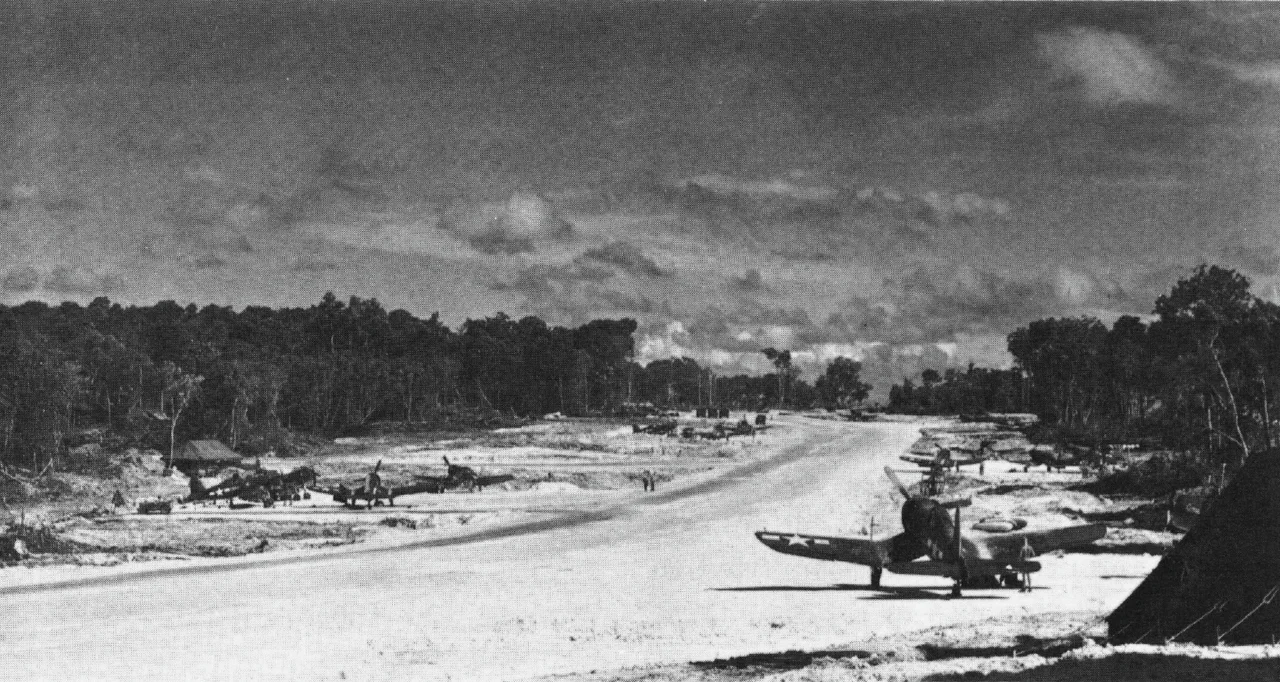

Landing on Emirau
The Marines came ashore ready for a fight that never came. On 20 March 1944, nearly 4,000 men of the 4th Marines landed on Emirau, a sliver of land just eight miles long and two miles wide in the St. Matthias Islands. They expected resistance. They found wooded hills, a tropical quiet, and about 300 islanders who had been watching the war pass them by. The Japanese garrison they had been briefed about did not exist. Within hours, the Marines were no longer assaulting Emirau - they were building on it, hammering together what would become the final steel link in a chain of Allied airbases strangling the great Japanese base at Rabaul.
The Argument in Washington
The whole operation began as a substitute. MacArthur's original plan had called for capturing Kavieng, 90 miles southeast on the tip of New Ireland - an important staging post for Japanese aircraft moving from Truk to Rabaul. His chief of staff, Lieutenant General Richard Sutherland, fought hard to keep Kavieng on the schedule, insisting the island could be seized by 1 April without delaying anything else. Admiral Nimitz pushed back. With Truk about to come under constant attack after the Battle of Eniwetok, why bleed Marines to take Kavieng at all? Admiral William Halsey, who would actually have to execute the operation, summed up his own view drily: "the geography of the area begged for another bypass." On 12 March, the orders came down - scrap Kavieng, take Emirau instead, complete the encirclement with the minimum commitment of forces. Halsey turned to Rear Admiral Theodore Wilkinson and told him to load the ships.
A Regiment Born from Raiders
The 4th Marines landing on Emirau was a regiment with ghosts in its name. The original 4th Marines had been destroyed on Corregidor in May 1942, surrendered to the Japanese in one of the darkest moments of the early Pacific war. On 1 February 1944, the Corps reconstituted the regiment by taking four battalions of Marine Raiders - the elite raiders who had fought at Makin and on Bougainville - and reforging them under the old colors. Emirau would be their first operation as the reborn 4th Marines. Lieutenant Colonel Alan Shapley led them ashore, reinforced by Sherman tanks from the 3rd Tank Battalion, amphibious tractors, and a scratch anti-aircraft battery. Brigadier General Alfred Noble, the Assistant Division Commander of the 3rd Marine Division, commanded the expeditionary force. The landing was meant to announce that the 4th Marines were back - but the island refused to put up the fight the regiment had prepared for.
The Massacre at Kavieng Wharf
The Emirau landing remained peaceful, but the diversion bombardment that covered it carried a terrible weight. A covering force under Rear Admiral Robert Griffin pounded Kavieng with 1,079 rounds of 14-inch battleship fire and more than 12,000 rounds of 5-inch shells - a show of force meant to convince the Japanese that the long-planned Kavieng assault was still coming. It worked too well. Rear Admiral Ryukichi Tamura, commander at Kavieng, became convinced the invasion was imminent and ordered the execution of all European prisoners on the island. At least 25 civilians were killed at the Kavieng Wharf in what became known as the Kavieng Wharf Massacre. After the war, six of the perpetrators were tried and convicted. Tamura himself was sentenced to death and hanged at Stanley Prison in Hong Kong on 16 March 1948. The men ashore on Emirau had no idea at the time that their bloodless landing had precipitated a mass killing a hundred miles away.
Building a Base in the Jungle
By nightfall of the first day, 3,727 Marines and 844 tons of cargo were ashore. Within a month, 18,000 men and 44,000 tons of supplies. The construction battalions went to work on Emirau's inland plateau, and by August two heavy bomber airstrips were complete - Inshore and North Cape, each 7,000 feet long and 300 feet wide. One handled 210 fighters or light bombers. The other took 84 heavy bombers. Three hospitals were raised from the jungle floor. Hamburg Bay on the northwest coast became an anchorage deep enough for five capital ships at once. Forty miles of coral-surfaced road laced the island together. The Seabees even installed eight cranes, 42,000 cubic feet of refrigerated space, and 400,000 square feet of covered storage - port capacity to move 800 tons of cargo a day. Marine Aircraft Group 12 flew from Emirau until December, when it shifted forward to Leyte and the Royal New Zealand Air Force took over. The Australian 8th Infantry Battalion relieved the American garrison in September 1944. By August 1945, everyone was gone.
What the Bypass Meant
Emirau was the last link in MacArthur's chain. With its airfields operating, Rabaul - once the most formidable Japanese base in the Southwest Pacific, home to 100,000 men - became a strategic dead end, its 93,000-strong garrison left to sit out the war. MacArthur could now turn his full attention westward, to Hollandia and the long drive up the New Guinea coast toward the Philippines. The containment strategy, scorned in some quarters as too cautious, had cost almost nothing in lives. Emirau was a rehearsal for a lesson the Allies would apply again and again: you do not have to take every Japanese garrison to win. You only have to cut them off. The Marines who waded ashore expecting a fight got instead a new kind of victory - one measured in cargo tonnage, runway length, and the sudden silence of a once-feared enemy base gone cold.
From the Air
Emirau lies at 1.69 degrees south, 150.00 degrees east, in the St. Matthias Islands of the Bismarck Archipelago. From cruising altitude the island shows as a hilly, forested sliver about 8 miles long and 2 miles wide, with the small harbor of Hamburg Bay on the northwest coast and a prominent inland plateau visible in clear weather. The nearest airports are Kavieng Airport (AYKV) on New Ireland, 90 miles southeast, and Momote Airport (AYMO) on Manus to the west. Tropical climate with high humidity and heavy rainfall - expect frequent cloud buildups.
Nearby Stories
- New Hanover Island 73 km away
- Kavieng 79 km away
- USS ABSD-4 223 km away
- Lombrum Naval Base 231 km away
- Battle of Lone Tree Hill 1176 km away
- 1996 Biak Earthquake 1446 km away
- Kuril Islands 5385 km away