
Lombrum Naval Base
For most of the last fifty years, Lombrum was a backwater. Three patrol boats tied up at a weathered wharf on Manus Island's south coast. A few dozen sailors of the Papua New Guinea Defence Force. A single service building. The base had been founded in 1944 as part of a vast American naval complex that has since dissolved into jungle, and after Australia handed the last of it to PNG in 1974, Lombrum kept doing what small Pacific bases do - repair work, coastal patrols, the occasional ceremonial visit. Then in 2018 Canberra and Port Moresby announced a joint upgrade. In 2021 the second phase was priced at A$175 million. Strategic analysts started writing papers with titles like "Manus Island and the Lombrum Naval Base: Five Options for Australia's Geostrategic Gateway." The backwater, it turned out, was sitting on one of the best harbors north of Australia.
The Lion That Sleeps
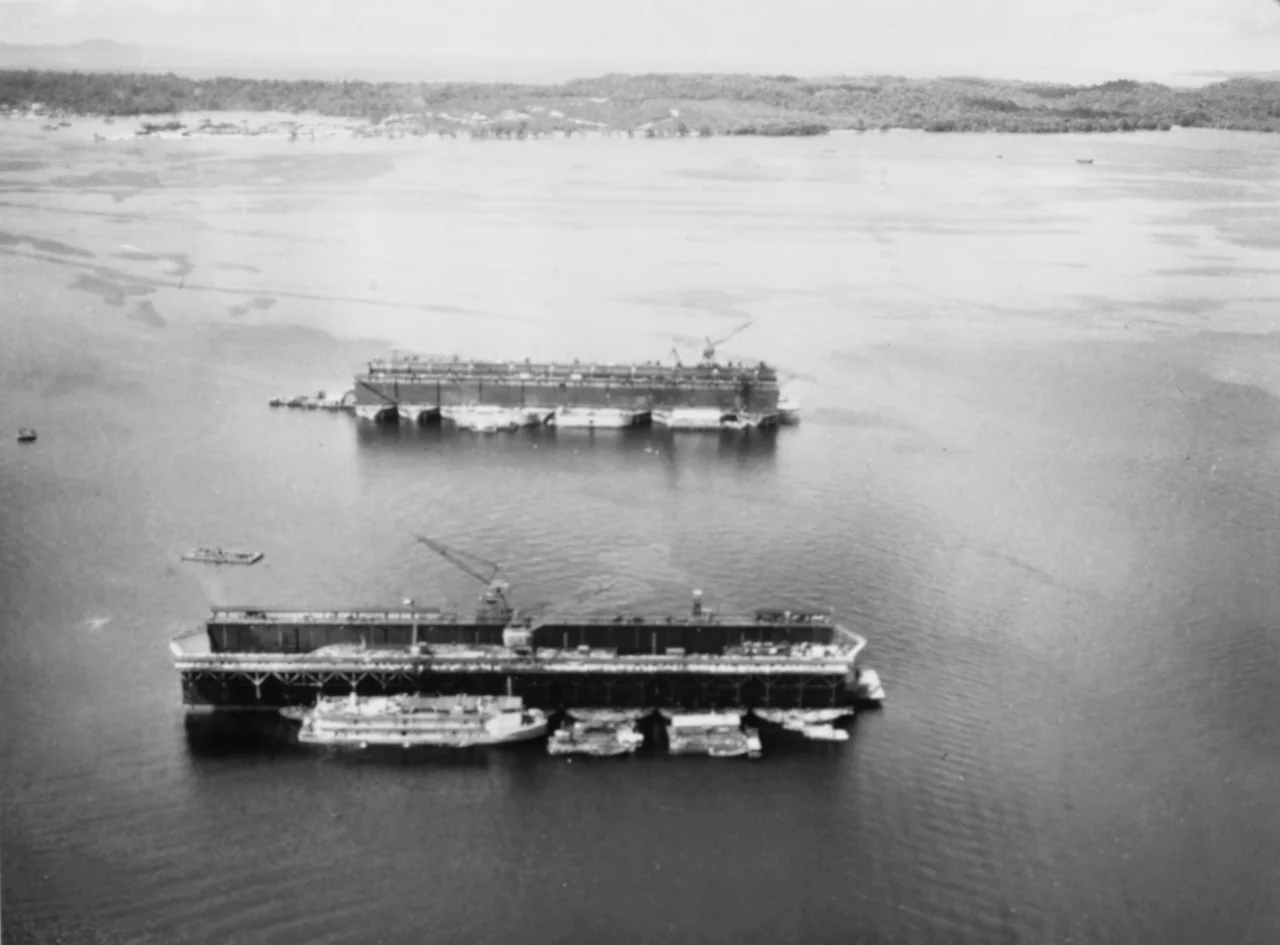
Lombrum began as a "Lion" - Navy code during the Second World War for a major fleet installation. Seabees of Naval Construction Battalions 11, 58, and 71 broke ground in early 1944, and by the end of the year Lombrum Point on Los Negros Island was one of the busiest shipyards in the Pacific. Seaplane ramps, landing-craft repair shops, a ship-repair complex capable of handling destroyers - the base sprawled across the point. After the war most of it was abandoned, but the core facility at Lombrum survived. On 1 January 1950 the Royal Australian Navy commissioned HMAS Tarangau there, taking over where the Americans had left. Tarangau served as Australia's forward-most Pacific base for a generation, refueling ships transiting between Australia and Southeast Asia. It was paid off on 14 November 1974 and transferred to the newly independent Papua New Guinea Defence Force.
The Patrol Boats
For decades Lombrum supported PNG's fleet of Pacific-class patrol boats, a donation-and-loan arrangement from Australia intended to give Pacific nations basic maritime capability. The Pacific-class vessels were 31-meter patrol boats, good for fisheries enforcement and search-and-rescue, not much else. Lombrum's facilities matched the ambition. A slipway and a few workshops sat at the tip of the point, reachable by a causeway from Lorengau. The base's staffing stayed small. PNG's defense budget was never large enough to expand Lombrum, and Australia's interest through most of this period was regional stability rather than basing rights. That began to shift around 2015 as the strategic weather in the Pacific changed.
The New Map
What changed the calculation was China. Beijing's expanding naval presence in the Pacific - including interest in potential basing arrangements with several Pacific Island states - forced Australia and the United States to look harder at the islands chain that shields Australia's northern approaches. The Admiralties sit astride vital sea lanes. Seeadler Harbor is still, as it was in 1944, the best natural anchorage north of Australia and south of the Philippines. In November 2018 Australian Prime Minister Scott Morrison and PNG Prime Minister Peter O'Neill jointly announced a Lombrum redevelopment, with the United States later declaring interest in future access. The scale was modest by great-power standards but enormous by Pacific ones. New wharves capable of handling larger vessels. Upgraded workshops. A hardstand for Guardian-class patrol boats, the replacement for the aging Pacific class.
Quiet Place, Loud Geography
As of 2024, Lombrum remains small - the work of the second upgrade phase is still underway, and the base houses fewer than 100 sailors at any given time. But the geography has not changed since MacArthur's planners looked at it in 1943. Seeadler Harbor can shelter a fleet. Manus sits at a pinch point between the Philippines and the Australian continent. From Lombrum, patrol boats can reach Indonesia's remote Papuan province in under a day. Port visits by RAN and USN ships - once rare - are now common. Strategic papers debate whether Lombrum should become a proper forward operating base or remain what it has been since 1974: a PNG-sovereign facility with Australian support and rotating foreign access. For now it is somewhere between the two. What is clear is that Lombrum's fifty-year obscurity is over. The lion, so to speak, has stopped sleeping.
From the Air
Lombrum Naval Base sits at 2.04 degrees south, 147.37 degrees east, on Los Negros Island in Papua New Guinea's Manus Province. Approach at 3,000 to 5,000 feet to see the base at the tip of Lombrum Point, with Seeadler Harbor opening to the west. Momote Airport (IATA: MAS, ICAO: AYMO) is a few miles south on the same island and serves as the region's only commercial airfield; flights arrive from Port Moresby via Air Niugini. Tropical climate year-round with 154 inches of annual rain; the northwest monsoon runs December to May with frequent thunderstorms. The new wharves and upgraded hardstand from the 2018 redevelopment are visible in recent satellite imagery. The broader strategic significance - the fact that from altitude the harbor and the island chain look exactly the way they did when MacArthur's planners first studied them - is worth noting even if the structures themselves look modest.
Nearby Stories
- Admiralty Islands 8.7 km away
- Landing on Emirau 222 km away
- New Hanover Island 250 km away
- Karkar Island 283 km away
- Kavieng 316 km away
- Vitu Islands 333 km away
- Battle of Lone Tree Hill 905 km away
- Mamberamo River 1065 km away