
Langley Speedway (Virginia)
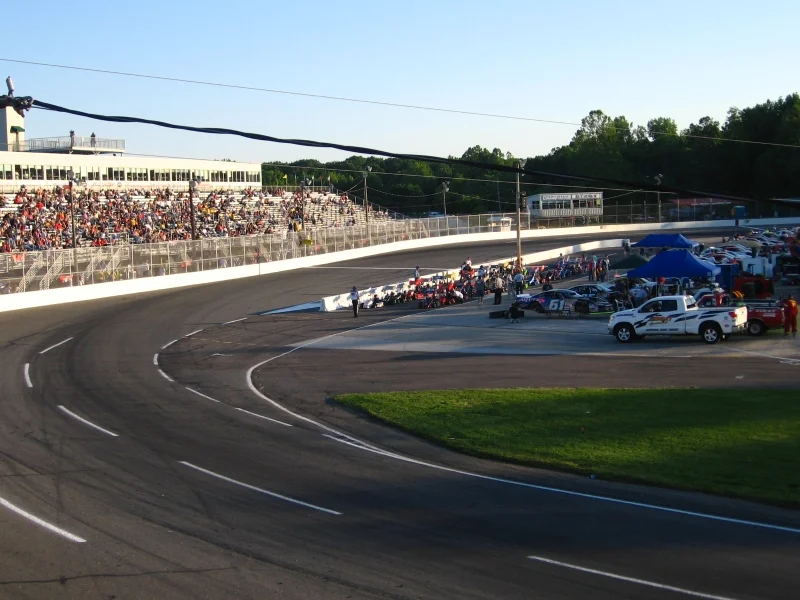
Pull into the parking lot on a Saturday evening in May and the smell hits before the noise does - rubber, hot oil, charcoal grills, the slightly sweet acetone tang of methanol mixed with gasoline. The grandstands at Langley Speedway hold about 6,500 people. They will be mostly full by 7:00 p.m. Pre-race ceremonies begin then; the green flag drops fifteen minutes later. The track is famously flat - six degrees of banking in the corners, two degrees on the straights - one of the flattest paved short ovals in the country. Drivers who came up here learned to set up cars that work without much help from the geometry. Denny Hamlin won here as a teenager. He won the Daytona 500 in 2016.
The Last Grand National
On the afternoon of November 8, 1970, Bobby Allison rolled around the Langley asphalt for 300 laps and took the checkered flag in the Tidewater 300. It was the last race of the NASCAR Grand National season. The next year, the series became the Winston Cup, named for its new title sponsor. R.J. Reynolds wrote a check; the modern NASCAR era began. The Langley race that November afternoon was the final running under the old name. Bobby Isaac won the championship that same day, finishing well enough to clinch the points title. There were nine Grand National events at Langley between 1964 and 1970. The first four ran on dirt; owner Henry Klich paved the track in 1968 for $25,000, and the final five Grand National races ran on asphalt. David Pearson won three of them - two in 1968 and one in 1969, more than any other driver. After the 1970 finale, the top-tier NASCAR series never came back.
Saturday Night Lights
What the track lost in national prestige it kept in local rhythm. Langley is NASCAR-sanctioned and runs the Advance Auto Parts Weekly Series, the national-championship feeder for short tracks. Twelve divisions rotate through the Saturday card: Late Models, Limited Late Models, Modifieds, Legends cars, Super Streets, Enduros, Grand Stocks, Super Trucks, UCARS, Pro Six on Nissan VG30E powerplants, and Hampton Roads Kart Club Pro Winged Champ Karts. The big race of the year is the Hampton Heat 200, a 200-lap Late Model Stock Car event split into two 100-lap halves with a ten-minute break in the middle. Teams can refuel and rotate tires during the break, but they cannot change tires - so the second half is a chess match against rubber that is already cooked. C.E. Falk, Nick Smith, and Woody Howard have all won it in the years since it began in 2008.
Drivers Who Started Here
Denny Hamlin won the 1997 mini stock track championship at Langley as a teenager from Chesterfield, Virginia. He went on to win the Daytona 500 in 2016, 2019, and 2020. Joe Falk - eventually a Cup Series team owner - was the 1976 Winston Racing track champion at Langley and finished second in the Virginia State Late Model Sportsman points the same year. His nephew C.E. Falk is one of the modern Hampton Heat regulars. The track also gave drifting a foothold in Hampton Roads through the Langley Drift Club, and starting in 2023 it hosts Old Dominion SCCA autocross events on weekends when the oval is dark.
The Track That Lost People
Like every grassroots track, Langley carries a roll of names you do not see in the racing press. On April 5, 1980, a spectator named Thomas "Tee" Branch was killed when a car went airborne and struck him in the pit area outside Turn One. On August 28, 2004, driver Dale Lemonds was killed in an INEX Legends car race; three days earlier, he had signed an agreement to purchase the track from owner Wayne Wyatt. His widow Sandy honored the contract, bought the speedway, and renamed victory lane "Dale Lemonds Victory Lane." On the night of July 11, 2020, the winningest driver in the track's modified division, 64-year-old Shawn Balluzzo - the holder of eleven Modified championships - died in a head-on crash into the Turn 2 barrier. The flowers tied to the fence in his memory are still there, weathered now.
In NASA's Shadow
The track sits on Commander Shepard Boulevard - named for Alan Shepard, the first American in space - directly in front of NASA's Langley Research Center. On a clear Saturday afternoon you can sometimes see test crews moving outside the wind tunnels less than a mile away. The juxtaposition is essentially American: hypersonics research on one side of the boulevard, dirt-track stock cars on the other. NASCAR's premier division has not raced here in 55 years. The lights still come on at seven. Late Model cars, on tires that should have been changed two laps ago, still rumble down the front stretch into Turn One. The crowd, smaller now than it once was, still leans forward when the leaders enter the back stretch four wide. Langley Speedway is closed many days of the year. The Saturdays it runs, it is still loud.
From the Air
Langley Speedway is at 37.086N, 76.387W on the Hampton peninsula, directly across Commander Shepard Boulevard from NASA Langley Research Center and just southwest of Langley AFB. From altitude the speedway is a tiny oval, easily lost against the larger NASA campus and the Air Force runways. Nearest airport: Langley AFB (KLFI) immediately northeast; Newport News/Williamsburg International (KPHF) to the northwest. Watch for restricted Joint Base Langley-Eustis airspace; expect heavy military traffic on weekdays.
Nearby Stories
- Battle of Gloucester Point (1861) 3 km away
- Coast Guard Station Cobb Island 3 km away
- Flowerdew Hundred Plantation 11 km away
- Great Dismal Swamp 11 km away
- Cape Charles Lighthouse 14 km away
- False Cape State Park 17 km away
- Cactus Hill 29 km away
- Chowan University 35 km away