.jpg)
Laxey Wheel
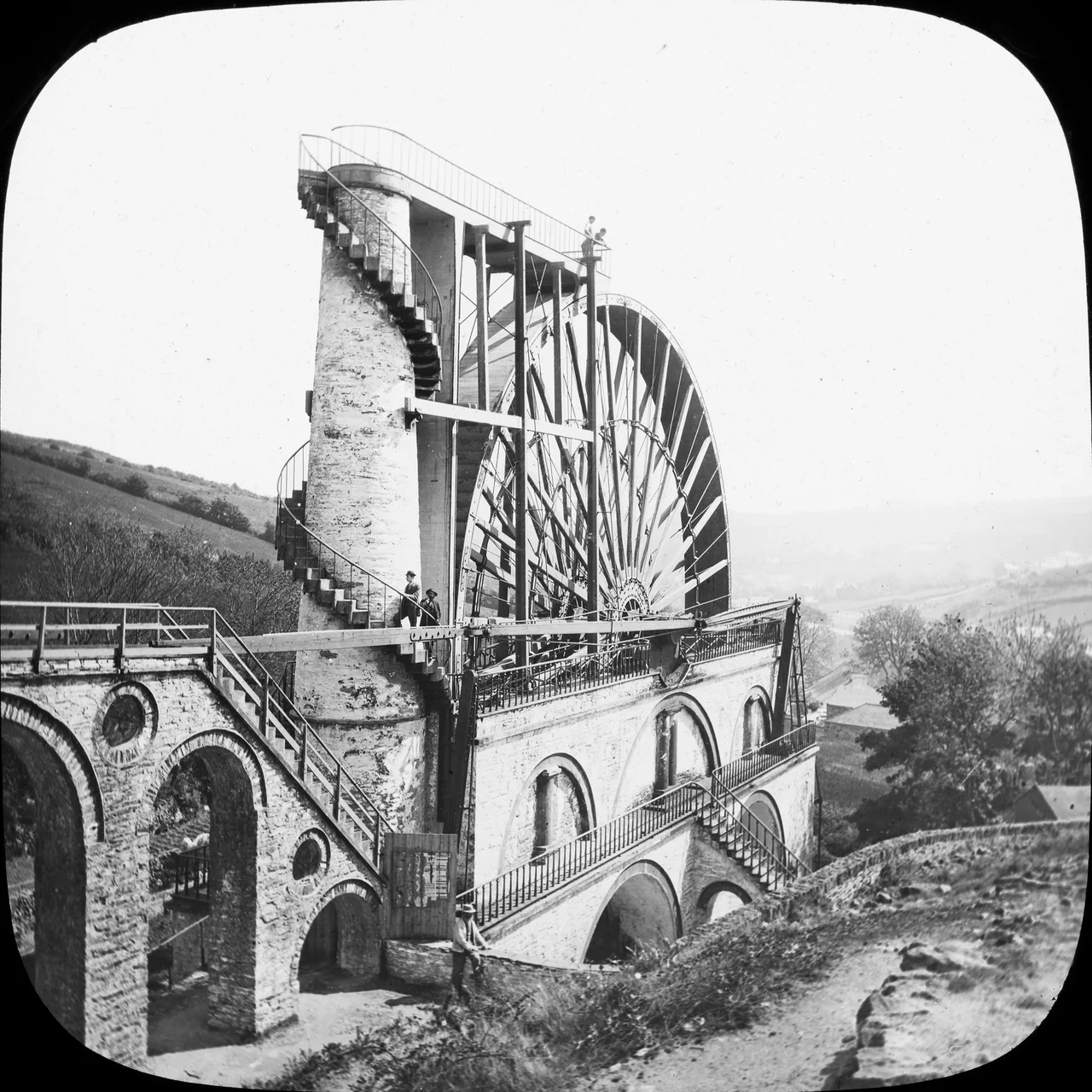
She is enormous. Seventy-two feet six inches across - 22.1 metres - painted Manx red and white, fitted into a stone tower against the hillside above Laxey village like a circular saw blade caught mid-cut in the green. She turns about three times a minute, which is leisurely for a wheel and grand for an enormous one. She is called Lady Isabella, after the wife of Lieutenant Governor Sir Charles Hope, who was running the Isle of Man in 1854 when the wheel was first set in motion. Behind the showmanship is engineering. She is, even today, the largest surviving original working waterwheel in the world. She had a job once, and the engineering exists because the job was hard.
Why a Wheel and Not a Steam Engine
The Isle of Man has no coal. That single geological fact shapes the answer to almost every question about Manx industrial history. When the Great Laxey Mine needed pumping power to keep its deep workings clear of water, the engineers who designed the system in the early 1850s could not simply install the standard Cornish beam engine that would have been the obvious choice anywhere on the British mainland. They needed a power source that did not require fuel imports. They needed water. Rain falls generously on the Manx hills, and the streams pour down out of the high ground around Snaefell with steady force. Robert Casement designed the wheel and the elaborate hydraulic geometry that fed it, completed in 1854, and the choice of water over coal turned an industrial necessity into one of the most distinctive engineering monuments in Europe.
How She Actually Works
The trick is the inverted siphon. Water from local springs and streams is collected in a cistern set on the hillside above the wheel, then carried in a closed pipe up through the central stone tower to a point above the top of the wheel. Because the cistern is higher than the pipe outlet, water flows up the tower as if pulled by suction. It then falls into wooden buckets formed by slats around the circumference of the wheel - and crucially, those buckets are arranged so the wheel rotates 'backwards.' Engineers call this a backshot wheel, as opposed to the more common overshot or undershot designs. The crank on the wheel's axle has a throw of four feet. It connects to a counterweight and to a very long rod that runs across the hillside on a viaduct to the pumping shaft about 200 yards away, where a T-rocker converts the horizontal motion into an eight-foot vertical stroke. Most of the wheel and rod is wood; the key bearing surfaces are metal.
The Numbers
At full operation, Lady Isabella lifted 250 imperial gallons of water per minute - about 1,100 litres - from 1,500 feet below ground, the equivalent of pumping a sizeable creek out of the bottom of a building taller than the Empire State observation deck. The wheel did this continuously for decades, driven only by collected rainwater. At its peak, the Great Laxey Mine employed over 600 miners, producing lead, copper, silver, and zinc; the wheel was the reason any of that work was possible at depth. The mine closed in 1929 as ore prices fell and the pumping costs became unsustainable. The wheel kept its post even after the mine that justified it had been abandoned.
Saved by Purchase
The Manx government bought the wheel and the surrounding site in 1965, when industrial monuments across Britain were being demolished as fast as preservation societies could fail to save them. Restoration followed. In 1989 control passed to Manx National Heritage, which still maintains the wheel today as part of the Great Laxey Wheel and Mines Trail. Visitors can climb the spiral staircase to the viewing platform at the wheel's hub, walk the length of the rod viaduct, and follow the T-rocker to the old mine adit, where they can step a short distance into the dark and feel the temperature drop. The wheel features on the reverse of the £20 note issued by the Isle of Man Government - one of the most recognisable images on Manx currency.
A Mirror Image and Two Songs
The triskelion painted on the front of the wheel - the Three Legs of Mann - is backwards. When the symbol was being transferred onto the wall, whoever applied it forgot to reverse the stencil, and so the wheel carries a mirror image of the national emblem. Nobody has rushed to fix it. The wheel has also inspired two pieces of music, both titled simply The Laxey Wheel, one written by Stuart Slack and the other by Helen Barley. Lady Isabella never named the woman she honoured beyond her first name and a marriage. Stand below the wheel as it turns, listen to the slow groan of the wooden buckets and the steady plash of falling water, and a kind of dignified domesticity creeps over the whole construction. She does a hard job. She has done it for over 170 years. She is doing it now.
From the Air
Located at 54.239 N, 4.407 W in the Glen Mooar valley above Laxey village on the east coast of the Isle of Man. Elevation about 200 feet AMSL at the wheel itself. The wheel is built into the hillside; the Snaefell massif rises to the northwest. Ronaldsway (EGNS) is about 13 nautical miles to the south. The Manx Electric Railway and Snaefell Mountain Railway both connect at Laxey station. Recommended viewing altitude 2,000-3,000 feet AGL gives a clear view of the wheel set against the green hillside, with the bay and Irish Sea to the east. The wheel's distinctive red and white paint and 72-ft diameter make it visible from significant distance in clear weather.
Nearby Stories
- St Bees Lighthouse 15 km away
- Celtic Array 22 km away
- Kirkmaiden 23 km away
- Isle of Whithorn 23 km away
- Seascale Lifeboat Station 31 km away
- German submarine U-1024 36 km away
- SS Georgetown Victory 40 km away
- Blackpool Illuminations 56 km away