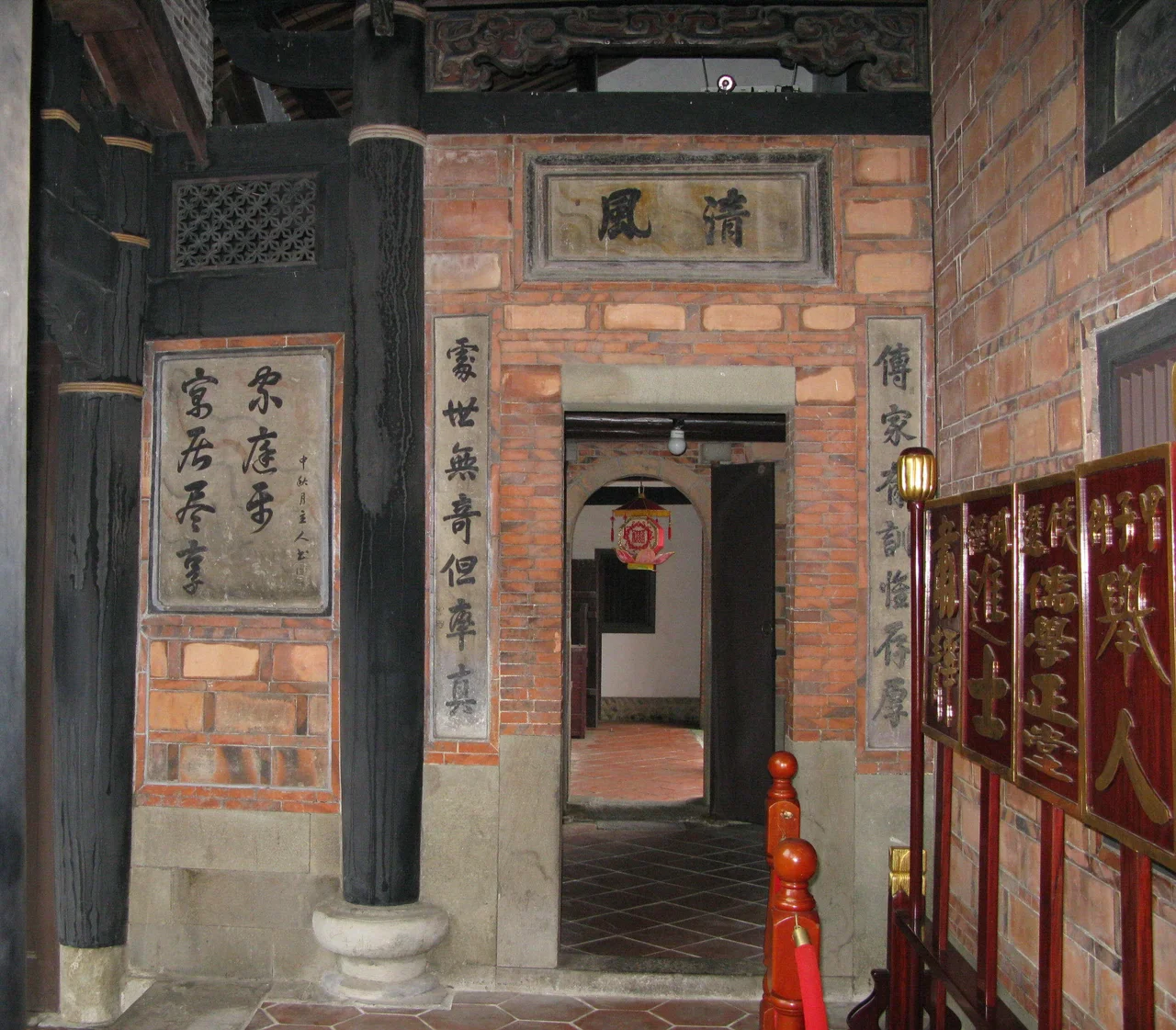

Lee Teng-fan's Ancient Residence
The walls come first. A long, whitewashed barrier of mud brick curves around the property in a gentle semi-circle, enclosing the compound like a cupped hand. Behind it, in Yuemei Village on the edge of Daxi District, the Lee family mansion has stood since 1859 — built not merely as a home but as a statement of arrival. When local officials recommended Lee Teng-fan to Emperor Xianfeng for recognition, the family celebrated by commissioning one of the grandest Hakka residences in northern Taiwan. What they left behind is a building that teaches you how a prosperous nineteenth-century Hakka family organized its world.
An Emperor's Endorsement, a Family's Monument
The year 1859 was significant in this corner of Taiwan. Lee Teng-fan's imperial commendation gave the family both the means and the motivation to build on a scale that matched their new status. The compound they raised — two main halls flanked by four side buildings — follows the classic Hakka sanheyuan courtyard plan, with the central hall elevated slightly above the rest to signal its importance. That hierarchy is legible at a glance: the center main hall's roofline crests above everything around it, the way the head of a household might sit at the tallest chair. The main gate is set slightly back from the ordinary position, a deliberate architectural refinement that frames the approach and creates a sense of threshold before the visitor has even passed inside.
The Logic of the Courtyard
Step through the gate and the compound's organizing principle becomes clear. The reception rooms occupy the center. Side buildings run along both flanks, sheltering an open courtyard between them, with two stone bases anchoring the symmetry. Rooms in those side buildings were assigned to family members according to seniority — a spatial expression of Confucian social order that governed how the household functioned from morning to night. The semi-circular pond in front of the compound was not decorative. In Hakka residential tradition, a crescent-shaped pool in front of the house served practical and symbolic functions alike: it collected rainwater, regulated drainage, and represented good fortune. To see the whitewashed wall curving above the still water is to understand that this compound was designed as a complete system, not a collection of buildings.
Wood, Stone, and the Carver's Hand
What makes the residence remarkable, and what draws visitors through the gate today, is the quality of its decorative work. Woodcarvings cover the interiors — flowers, birds, animals — rendered with the unhurried precision of craftsmen who knew this work would outlast them. The walls hold calligraphy and paintings, a reminder that the Lee family cultivated scholarly as well as material ambitions. Hakka builders in nineteenth-century Taiwan worked with local materials under Chinese classical conventions, and the residence shows what that combination produced when money and skill were both available. Nothing here is showy in a crude sense. The ornamentation is dense but controlled, every surface considered.
From Private Compound to Public Heritage
For most of its history the residence was simply a family home — inhabited, maintained, and gradually aged by the generations that followed Lee Teng-fan. The Taoyuan County Government eventually designated it a Grade 2 historic building, and in 2004 the gates opened to the public for the first time. The residence is now part of the Daxi Wood Art Ecomuseum, a distributed museum concept that treats Daxi's historic buildings as a connected cultural landscape rather than isolated exhibits. Visitors move through a living neighborhood, not a sterile precinct. The mansion sits in Yuemei Village, its walls still enclosing the same courtyard geometry they always did — quieter now, but no less purposeful.
From the Air
Lee Teng-fan's Ancient Residence sits at approximately 24.89°N, 121.30°E in Daxi District, Taoyuan City — about 15 kilometers southeast of Taiwan Taoyuan International Airport (RCTP). At low altitude on approach or departure from RCTP, the Dahan River valley to the south is visible; Daxi's old town sits on the western bank. The residence itself is not distinguishable from the air but the compact historic district of Daxi, with its riverside topography, makes a clear reference point. Recommended observation altitude: 3,000–5,000 feet MSL on a clear day.
Nearby Stories
- Tamsui 4.6 km away
- Hakka Round House 12 km away
- Smangus 14 km away
- Dapu Incident 19 km away
- 2022 Chinese Military Exercises Around Taiwan 47 km away
- Sinking of MV Sewol 1079 km away
- Yellow Sea 1130 km away
- Twin Forts of Romblon 1338 km away