
Leesburg, Virginia
In late August 1814, with British troops marching on Washington, a clerk named Stephen Pleasonton stuffed the Declaration of Independence, the Constitution, and George Washington's correspondence into coarse linen bags, loaded them onto wagons, and drove them west. He kept driving until he reached Leesburg, Virginia, thirty-three miles from the burning capital. The papers spent the next three weeks locked in a brick house belonging to Reverend John Littlejohn while the Capitol smoldered. For the brief span between August 24 and September 17, the founding documents of the United States lived in a Loudoun County county seat. When the British left, Pleasonton drove them back. The house is gone. The town remembers.
Crossroads and Courthouse
Nicholas Minor was a tavern keeper before he was a town founder. Around 1755 he acquired land where the Old Carolina Road - the long Native trail that ran north from the Catawba country in the Carolinas - crossed the Potomac Ridge Road, the path that eventually became Route 7. He set up a tavern at the crossroads and called the cluster of buildings around it George Town, after the reigning King of Great Britain. When the British Colonial Council ordered Loudoun County's new courthouse located there in 1758, the town's prosperity was set. The Virginia General Assembly chartered it on October 12, 1758, on Minor's sixty acres laid out in the traditional Virginia plan of six criss-cross streets. They renamed it Leesburg, after the powerful Lee family of the Northern Neck - the same family that produced Robert E. Lee a generation later. The courthouse Minor built has been replaced. The street grid he laid out has not. You can still walk it.
Eight Times Over
When the Civil War came, Leesburg sat on the front line between Union and Confederate territory and exchanged hands at least eight times. The town's sympathies were mostly Confederate, but the county's western half - settled by German and English Quakers around Waterford - was strongly Unionist. The first major action came in October 1861 at Ball's Bluff, four miles upriver, where Senator-Colonel Edward Baker was killed leading a doomed Federal river crossing. A year later, Robert E. Lee himself rode through town on his way to invade Maryland, planning the campaign that ended at Antietam in a house called Glenfiddich. John Mosby's Rangers used Leesburg as a base of operations throughout 1863 and 1864, riding out at dusk to ambush Federal patrols and disappearing back into farmhouses by dawn. The Loudoun County courthouse survived the war intact - one of only a handful in Virginia that did. The current Greek Revival building dates from 1894, but the bell tower still rings the same hours it did the year Mosby's men buried Ranger Bill McCobb on the green.
Dodona Manor
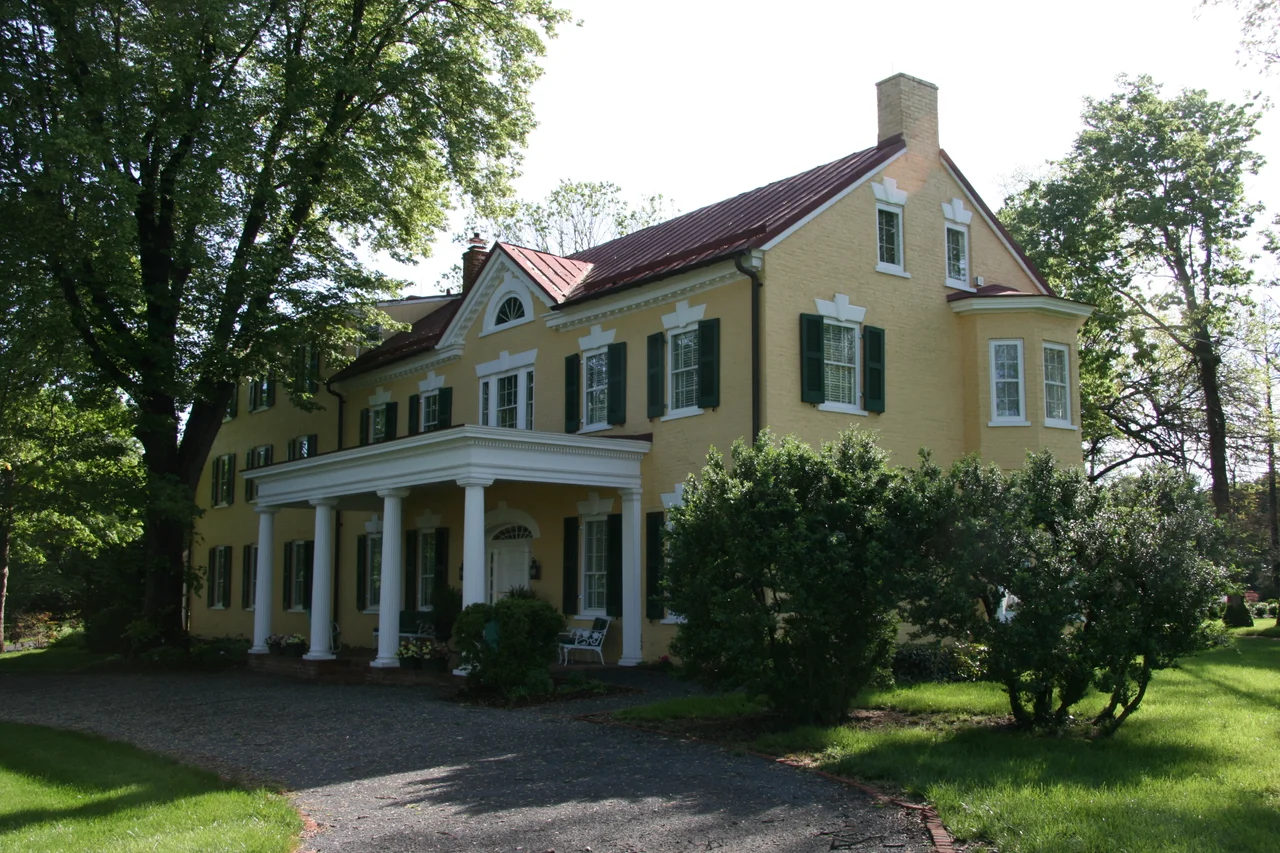
In 1941, with war already raging in Europe and the United States edging toward joining it, General George Catlett Marshall and his wife Katherine bought a Federal-style house at 217 Edwards Ferry Road. They named it Dodona Manor, after the ancient Greek oracle where sacred oaks grew. Marshall served as Army Chief of Staff through the Second World War, then as Secretary of State under Truman, then as Secretary of Defense during Korea. The Marshall Plan that rebuilt postwar Europe carries his name. When he wanted to get away from Washington, he came to Leesburg. He gardened obsessively. He grew prize roses. He raised vegetables that he gave to neighbors. In 1953 he became the only professional soldier ever to win the Nobel Peace Prize. He died at Walter Reed in 1959 and is buried at Arlington. The house remains as he left it, run by the George C. Marshall International Center, with his Nobel medal in a case in the hall and a Plymouth in the garage.
Godfrey's Cow Pasture
In the early 1950s the most popular man on American radio bought a 2,000-acre farm west of Leesburg. Arthur Godfrey ran a CBS variety show that drew 80 million weekly listeners at its peak - one in every two Americans alive. He kept horses, raised cattle, and built his own small airport on the property because he liked to fly. Every Sunday night during the 1950s and 1960s he flew his Douglas DC-3 from Beacon Hill back to New York for the Monday morning broadcast. The DC-3 was so loud over the neighbors that Godfrey eventually funded a new town airport built farther from his land. He sold the original strip - the field he affectionately called the Old Cow Pasture on his show - to pay for it. The new airport, opened in 1964, is still named Leesburg Executive Airport at Godfrey Field. It is now a designated reliever for Dulles International, hosts more than 240 based aircraft, and contributes nearly $78 million a year to the local economy. The Old Cow Pasture is gone. The new field still uses Godfrey's name.
Original Town Center
Loudoun County is the wealthiest county in America by median household income, and most of its growth has come from data centers, biotech corridors, and the planned communities that ring Dulles Airport. Leesburg's downtown merchants now market themselves as Loudoun's Original Town Center, a quiet jab at the newer mixed-use developments to the south. The historic district was placed on the National Register in 1970 and contains twenty-one separately listed properties. James Dickey wrote Deliverance while living at Glenfiddich House between 1966 and 1968. Will Toledo, the songwriter behind Car Seat Headrest, grew up in Leesburg. The Halloween Parade is among the longest-running in the country. And every December the Leesburg Volunteer Fire Company - founded in 1803 - decorates an engine with Christmas lights and drives Santa through neighborhoods at five miles per hour. Reverend Littlejohn's house, where the Declaration spent three weeks in 1814, is gone. The papers it sheltered are back in Washington. The town stayed.
From the Air
Leesburg sits at 39.12 degrees N, 77.56 degrees W, in the rolling Loudoun County Piedmont at the base of Catoctin Mountain. Elevation in town is roughly 350 feet, with Catoctin rising to 670 feet immediately west. Leesburg Executive Airport at Godfrey Field (KJYO) is on the south edge of town with a 5,500-foot runway. The Potomac River runs three miles to the north and east. From 3,000 to 5,000 feet AGL Catoctin Mountain, the historic downtown grid, and the Potomac come together in classic Virginia Piedmont relief. Watch for the Class B veil from Dulles (KIAD) ten miles southeast - coordinate with Potomac TRACON.
Nearby Stories
- The Stone House, Manassas National Battlefield Park 3.3 km away
- Long Branch Plantation 7.7 km away
- Surratt House Museum 12 km away
- National Archives at College Park 13 km away
- The Inn at Little Washington 18 km away
- Antietam: The Day America Lost 23,000 Men 22 km away
- Gravity Hill 84 km away
- Three Mile Island 89 km away