_-_07.jpg)
National Archives at College Park
Behind the doors of a six-story building in suburban Maryland sits the de facto headquarters of the National Archives, even though the Archivist of the United States officially still works out of the columned classical pile downtown on Constitution Avenue. The downtown building - now called Archives I, though it didn't have a number for the first sixty years of its life - had simply run out of space. By the early 1990s, the country was producing federal records faster than the National Archives could find anywhere to put them. The College Park facility opened in 1994 to take the overflow. It quickly became the operational center of the entire agency, holding the bulk of 20th-century federal records and serving as the place where most actual research now happens.
What's in the Vault
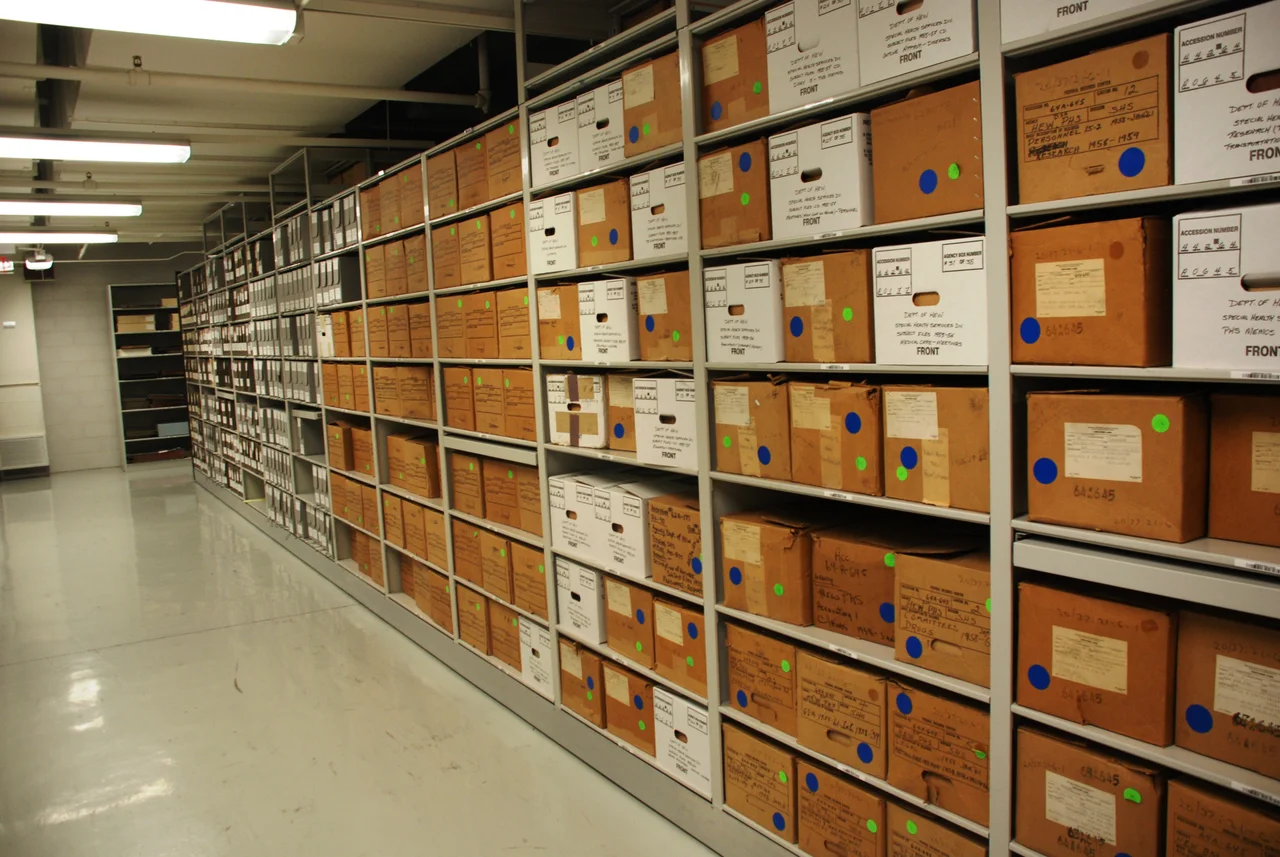
Most of what's at Archives II is exactly what you'd expect: cubic miles of paper records from federal agencies, organized into the largest collection of government documents in the country. Around 80 percent of those records are open to the public. The other 20 percent are classified. Inside the building's security vault are some of the strangest single items in federal custody. There is burned wreckage from the Branch Davidian compound in Waco, Texas, preserved as evidence from the 1993 standoff. There is the last will and testament of Adolf Hitler, signed in the Berlin bunker on April 29, 1945, and seized by U.S. intelligence after the war. The Berlin Document Center transferred microfiche service records of the SS, the SA, and the Nazi Party to College Park in 1995, opening a critical resource for researchers tracing the bureaucratic machinery of the Third Reich. None of this is on display.
Six Floors, Six Research Rooms
The building is organized vertically by what kind of record you came to look at. The first floor is registration and orientation - the badge desk and the introductory briefing for new researchers. The second floor is textual research, the largest single room and the destination for anyone who came looking for paper documents. The third floor handles cartographic records, where you can request original Civil War maps or NASA mission planning charts. The fourth floor splits between microfilm and moving image and sound. The fifth holds the photographic research room, where you can pull original prints from the National Archives' enormous photo collection. The sixth floor is the classified research room, accessible only to researchers with the appropriate clearances. The pull-and-refile team physically retrieves records from the storage stacks and delivers them to the rooms. The system is built around the assumption that researchers will spend hours, sometimes days, with the documents in front of them.
How Records Get Here
Federal records arrive at Archives II in two ways. Annual Move records are transferred automatically every year on a schedule - the predictable feed from agencies that generate huge volumes of routine paperwork. Direct Offer records come in on a case-by-case basis, when an agency decides a particular set of files has historical value and proposes transferring it to the Archives. A small office handles gifted records, the donations from private individuals and institutions whose papers are deemed worth preserving in the federal archive. Once records arrive, the Processing Branch organizes them into something a researcher can actually use - relabeling, reboxing, and entering them into the National Archives Catalog. The Reference Branch responds to written inquiries and consults with on-site researchers. In 2020, these branches were merged into two larger divisions in a reorganization that combined functions but kept the underlying work the same.
Electronic Records, Eventually
Beginning in the early 2000s, the National Archives started building an Electronic Records Division as a mirror of the paper division. The challenges are different in kind. A box of paper records will sit on a shelf for a hundred years and still be readable. A floppy disk of WordPerfect files from 1992 needs active preservation - migration to current formats, emulation of legacy software, hardware refresh, format documentation - to remain accessible at all. The Digital Preservation Service Office at College Park works on the harder, less glamorous problem of keeping records from disappearing into format obsolescence. A growing share of federal output is now born digital. The work of figuring out how to preserve any of it for the long term is being done in this building, alongside the ongoing reception of paper records that will probably outlast the digital ones.
The Twin Buildings
Archives I downtown still receives visitors who come to see the founding documents - the Declaration of Independence, the Constitution, and the Bill of Rights are displayed in the rotunda. Archives II receives the researchers who came to do work. Many of the older building's administrative functions are now actually run out of College Park: the Archives I Research Room, the Archives I Processing Branch, and all reference correspondence from the downtown building are overseen by Archives II's Textual Records Division. The original building still holds the ceremonial center, the Charters of Freedom, and the tourists. College Park holds the records themselves and most of the people who care for them. Together they form a single archive split across the District line, with the headline downtown and the work in the suburbs.
From the Air
The National Archives at College Park is located at 39.0006 N, 76.9594 W, on Adelphi Road in northwest College Park, Maryland. The 1.8-million-square-foot facility sits just outside the inner ring of the Washington Flight Restricted Zone but inside the surrounding Special Flight Rules Area. The closest airports are College Park Airport (KCGS) two miles east and BWI Marshall (KBWI) twenty miles north. From above, the building is identifiable as a large rectangular structure with distinctive light-colored panels and a green-roofed quadrant, set in a wooded campus immediately south of the Capital Beltway (I-495).
Nearby Stories
- Reston, Virginia 1.7 km away
- Thomas Viaduct 9.2 km away
- Monocacy Aqueduct 9.7 km away
- Stafford County, Virginia 26 km away
- Harriet Tubman Underground Railroad 28 km away
- Gunston Hall 30 km away
- Adkins Arboretum 31 km away
- Bombay Hook National Wildlife Refuge 71 km away