_and_the_Silver_Line_of_the_Washington_Metro_from_the_overpass_for_Virginia_State_Route_286_(Fairfax_County_Parkway)_in_Reston,_Fairfax_County,_Virginia.jpg)
Reston, Virginia
Robert E. Simon opened the gates of Reston on his fiftieth birthday - April 10, 1964 - and named the place after his own initials. He had bought 6,750 acres of the Bowman family's whiskey farm in northern Fairfax County and hired a Walter Gropius-trained architect named James Rossant to design what would become one of the most influential planned communities in postwar America. Reston's village centers, walkable paths, manmade lakes, and aggressive preservation of tree canopy were meant to demonstrate that suburbs could be built better. Sixty years later, 63,226 people live in Reston. The trees are still there. Robert E. Simon lived to be 101, watched his town grow up, and died in a Reston apartment overlooking Lake Anne Plaza in 2015.
From Bowman Whiskey to Wiehle's Dream
The land that became Reston was part of the original 1660 Northern Neck Proprietary grant from Charles II to Lord Fairfax - the same massive land claim that produced most of Northern Virginia. The Fairfaxes held it until 1852. In 1886 Carl A. Wiehle and William Dunn bought 6,449 acres along the Washington and Old Dominion Railroad and divided it; Wiehle, a German-born physician and developer, retained everything north of the rail line and dreamed of building a town there with a hotel, parks, and a community center. He died in 1901 having completed only a handful of houses. The Bowman family later bought a large portion of the same farmland and ran their A. Smith Bowman Distillery on it from 1934 forward - the only legal whiskey distillery in Virginia for two decades. Robert Simon bought 6,750 acres of the Bowman land in 1961 and announced his planned community at a press conference. He paid for it partly with proceeds from the sale of Carnegie Hall in Manhattan, which his family had owned.
Lake Anne and the New Town
Simon hired the firm of Whittlesey, Conklin & Rossant to draw the master plan. James Rossant had studied under Walter Gropius at Harvard. His partner William J. Conklin came out of the modernist tradition. They designed Reston not as a subdivision but as a unified town with five planned village centers - Lake Anne, Hunters Woods, Tall Oaks, South Lakes, and eventually North Point - each within walking distance of nearby housing and each containing a school, shops, and gathering space. Lake Anne Plaza, the first to open, sits around a manmade lake with a tall jet fountain and a tower at its center. Charles M. Goodman designed the cubist Hickory Cluster townhouses just up the hill in International Style. The whole concept was radical for 1964: dense urban-style plazas surrounded by curving wooded streets, with car traffic deliberately routed away from front doors and the architecture facing inward toward shared spaces. Reston was the first 20th-century private community in the United States to explicitly incorporate natural preservation as a design principle.
The Gulf Oil Years
Simon's vision was expensive. Townhouses in Reston cost as much as detached single-family houses elsewhere in Fairfax County, and sales were sluggish in the first years. To pay creditors, Simon accepted a $15 million loan from Gulf Oil in 1965. By 1967 Gulf had forced him out and taken over the development through a subsidiary called Gulf Reston, Inc. The Gulf years - 1967 through the mid-1970s - kept much of Simon's master plan intact while adding the Reston International Center, the U.S. Geological Survey headquarters, and a layer of low- and moderate-income housing including the Cedar Ridge, Laurel Glade, and Fox Mill apartment complexes. The original town was meant for 75,000 people; the actual population now sits at 63,226. Boston Properties became the largest commercial owner in 2012, buying the Fountain Square office and retail complex at the center of the newer Reston Town Center, which had been added in the late 1980s as the town's high-rise commercial core.
Reston Virus
In late 1989 an outbreak of hemorrhagic fever began killing crab-eating macaques at a primate quarantine facility operated by Hazleton Research Products at 1946 Isaac Newton Square in Reston. The animals had come from a breeding center in the Philippines. Initial tests at the U.S. Army Medical Research Institute of Infectious Diseases at Fort Detrick identified the pathogen as a filovirus closely related to Ebola virus. The implications were terrifying: an Ebola-class virus in an office park in a Northern Virginia suburb. The Army team led by Colonel C. J. Peters and Lieutenant Colonel Jerry Jaax killed and incinerated approximately 450 monkeys and sterilized the facility. The investigation eventually determined that the virus, while genetically a true ebolavirus, did not appear to cause illness in humans. It was named Reston virus in honor of the community where it was discovered. Richard Preston's 1994 book The Hot Zone dramatized the event. The Hazleton facility was demolished and replaced with a daycare center.
What Reston Looks Like Now
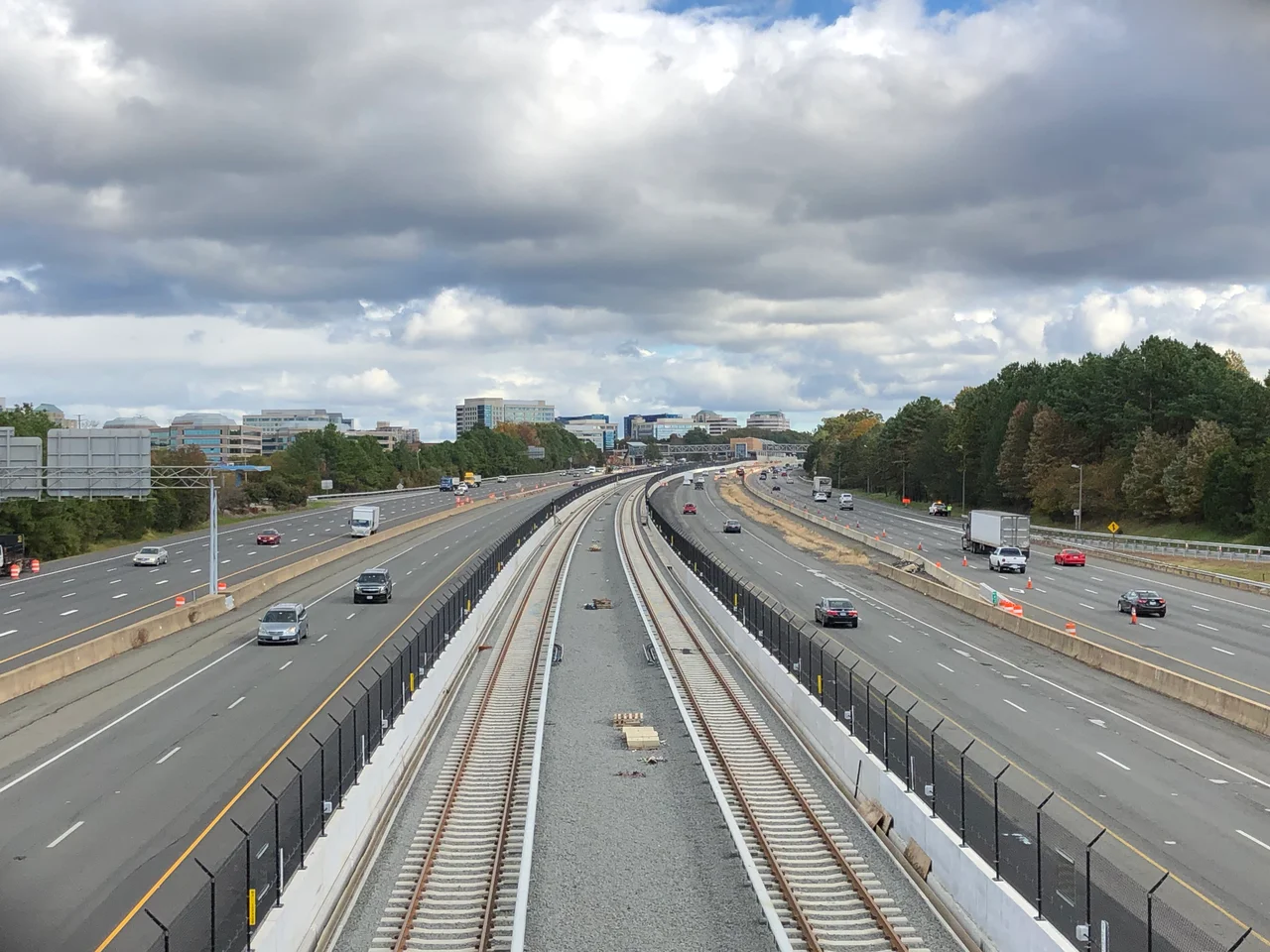
From the air Reston reads as a dense canopy of green broken by four manmade lakes - Lake Anne, Lake Audubon, Lake Newport, and Lake Thoreau - and threaded by curving roads and 55 miles of walking trails. Tree cover protected by aggressive design review still covers about half the total area. The Dulles Toll Road cuts an east-west swath through the middle, with two new Silver Line Metro stations - Reston Town Center and Herndon - opened in November 2022. The original Lake Anne Village Center, with its cubist townhouses and central fountain, was added to the National Register of Historic Places in 2017. The Reston Town Center to the west is a denser cluster of mid-rise commercial buildings and a winter ice rink that runs free public concerts in summer. The town is now headquarters for Bechtel, CACI, Leidos, Verisign, NVR, Volkswagen Group of America, and the German military's North American command. Of the twenty largest venture capital firms in the Washington area, five are based in Reston. The trees Robert Simon insisted on protecting still cover the roofs.
From the Air
Reston, Virginia, sits at 38.95 N, 77.35 W in northern Fairfax County, about 5 nautical miles east of Dulles International Airport. Recommended viewing altitude is 2,500 to 4,000 feet AGL for the best look at the four lakes (Lake Anne, Lake Audubon, Lake Newport, Lake Thoreau), the dense tree canopy, the Reston Town Center high-rises in the center, and the Dulles Toll Road cutting east-west through the middle. The nearest airport is Manassas Regional (KHEF), about 13 nm southwest. Dulles International (KIAD) is 5 nm west - check Class B airspace carefully and expect heavy commercial traffic. The original A. Smith Bowman Distillery site is in central Reston near Wiehle Avenue and Sunset Hills Road. Best light for the lakes and tree canopy is mid-morning.
Nearby Stories
- Bladensburg Dueling Grounds 4.6 km away
- Monocacy Aqueduct 6.4 km away
- Howard County, Maryland 7.9 km away
- Third Battle of Winchester 8.1 km away
- Long Branch Plantation 12 km away
- Stafford County, Virginia 24 km away
- Battle of Cedar Mountain 30 km away
- St. Mary's City, Maryland 73 km away