
Third Battle of Winchester
A Black man named Thomas Laws walked into Winchester, Virginia, with a permit to sell vegetables on September 16, 1864. Inside the basket he carried a coded letter from Union General Philip Sheridan. Laws delivered it to a Quaker schoolteacher named Rebecca Wright, who replied in writing about the troop movements she had been quietly observing from the upstairs window of her boarding house. Three days later Sheridan attacked Jubal Early outside Winchester with 40,000 men. By nightfall on September 19, two Confederate generals were dead, two more were wounded, Early had lost nearly a quarter of his army, and the Shenandoah Valley campaign that finally broke the Confederate hold on the Valley had begun in earnest.
How the Intelligence Got Out
By the summer of 1864 Jubal Early had been operating out of Winchester for months, raiding north toward Washington and tying up Union forces that Ulysses S. Grant needed at Petersburg. Sheridan, the new commander of the Middle Military Division, needed to know what Early actually had. He sent scouts to ask around the city for someone who could carry messages. They found Thomas Laws, enslaved to a Berryville Pike farmer, who had a permit allowing him to enter Winchester to sell produce. Laws agreed to carry letters back and forth. Rebecca Wright, a Quaker schoolteacher boarding in Winchester, agreed to write back. On September 16 a Confederate officer mentioned in her presence that Joseph Kershaw's division had been sent back to Lee at Petersburg. Wright noted it down, wrote a careful summary, and gave it to Laws. He returned to Sheridan that night. Sheridan now knew Early had been depleted by 3,400 men. Three days later he attacked.
Two Future Presidents
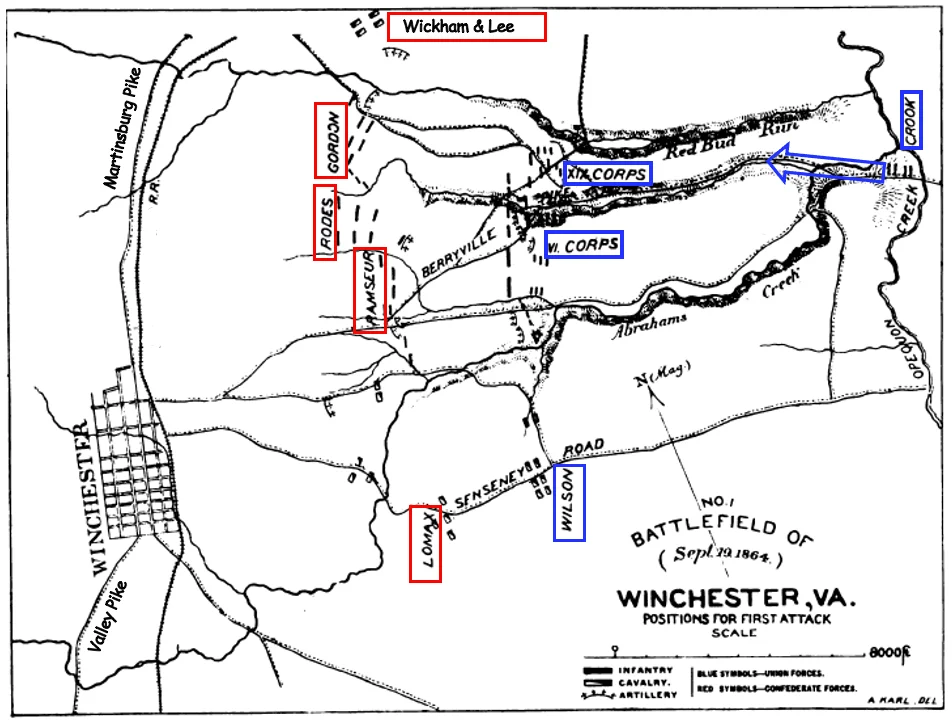
Sheridan moved at 2 a.m. on September 19. James Wilson's cavalry division crossed Opequon Creek east of Winchester and pushed through a narrow ravine known as Berryville Canyon, then engaged Stephen D. Ramseur's Confederate division on Limestone Ridge. Behind Wilson came Horatio Wright's VI Corps and William Emory's XIX Corps - 24,000 Union infantry. But the canyon's narrowness produced a massive traffic jam between Wright's wagons moving forward and ambulances carrying casualties to the rear. Emory's XIX Corps did not get into position until 11 a.m. The delay let Early rush in John B. Gordon's and Robert E. Rodes's divisions to reinforce Ramseur. To the south, Sheridan held George Crook's Army of West Virginia in reserve. Two of Crook's officers became presidents of the United States. Colonel Rutherford B. Hayes commanded one of Crook's brigades and would be elected in 1876. Captain William McKinley served on Crook's staff and would be elected in 1896. Both men fought through the day at Winchester.
Rodes and Russell
Around noon, with both lines now in position, the battle broke open. The Confederate divisions of Gordon and Rodes attacked Emory's XIX Corps in a coordinated counterstroke that drove back the Union right and threatened the entire Federal line. Robert E. Rodes, perhaps the most respected divisional commander in Lee's army, was killed instantly by an artillery fragment as he directed the counterattack. The loss reverberated through the Confederate ranks. On the Union side, Brigadier General David A. Russell, commanding the 1st Division of the VI Corps, was killed by a cannonball as he led a counter-counterattack that stabilized the broken line. The fighting continued through the afternoon. Around 3 p.m., Crook's reserve corps swung in from the north and struck Early's left flank. At the same time, Sheridan's Union cavalry under Wesley Merritt and William Averell broke through north of Winchester and rolled up the Confederate left. Early's army began to come apart. By 5 p.m. the Confederates were retreating south through the streets of Winchester, with Sheridan's troops chasing them down the Valley Pike.
The Patton Connection
Among the Confederate dead was Colonel George S. Patton, commanding the 22nd Virginia Infantry. He was mortally wounded leading his men in the late-afternoon Confederate collapse and died six days later, on September 25, in Winchester. His grandson - George S. Patton Jr., the World War II general who would command the Third Army across France in 1944 - inherited his name. Also present in command was John C. Breckinridge, former vice president of the United States under James Buchanan and now a Confederate major general. Fitzhugh Lee, Robert E. Lee's nephew and a future governor of Virginia, commanded the Confederate cavalry corps. Two future Virginia governors, two future presidents, a former vice president, a colonel whose grandson would later wear four stars - the Third Battle of Winchester held more eventual political and military significance per casualty than almost any other engagement of the war. Total casualties came to roughly 5,000 Union and 4,000 Confederate.
What Came After
Early retreated south down the Valley Pike to a strong position at Fisher's Hill, near Strasburg. Sheridan followed him there and won again on September 22. The Shenandoah Valley campaign continued through October, including the Battle of Cedar Creek on October 19, where Sheridan's famous twelve-mile ride from Winchester to the battlefield rallied his routed army and turned a near-disaster into a decisive Union victory. Early's Army of the Valley never recovered. After defeats at Cedar Creek and finally at Waynesboro on March 2, 1865, it ceased to exist. Sheridan's troops also burned the Shenandoah Valley's farms and barns systematically through the autumn of 1864 - The Burning, the locals called it - destroying the breadbasket that had fed Lee's army for three years. The Winchester battlefield is partially preserved today. The American Battlefield Trust and the Shenandoah Valley Battlefields Foundation have protected over 500 acres at sites including Hackwood Park north of Winchester, where some of the fiercest fighting occurred.
From the Air
The Third Battle of Winchester battlefield sits at about 39.215 N, 78.139 W, north and east of Winchester, Virginia, with the preserved Hackwood Park and Third Winchester Battlefield Park north of the city. Recommended viewing altitude is 2,500 to 4,000 feet AGL to see Opequon Creek, Berryville Canyon (the narrow ravine east of town), and the open ground north of Winchester where most of the fighting occurred. The nearest airport is Winchester Regional (KOKV), about 3 nautical miles south. Front Royal-Warren County (KFRR) lies 14 nm southeast. The Blue Ridge rises 10 nm east; the Allegheny Front 15 nm west. The battle site is bisected by the modern Interstate 81 corridor. Best light is mid-morning for the open fields where the cavalry breakthroughs occurred.
Nearby Stories
- Bryce Resort 3.6 km away
- Disney's America 4.8 km away
- Loudoun County, Virginia 6.1 km away
- Hardy County, West Virginia 15 km away
- The Inn at Little Washington 16 km away
- Camp David: Where Presidents Escape and History Gets Made 36 km away
- Antietam: The Day America Lost 23,000 Men 42 km away
- Garrett County, Maryland 49 km away