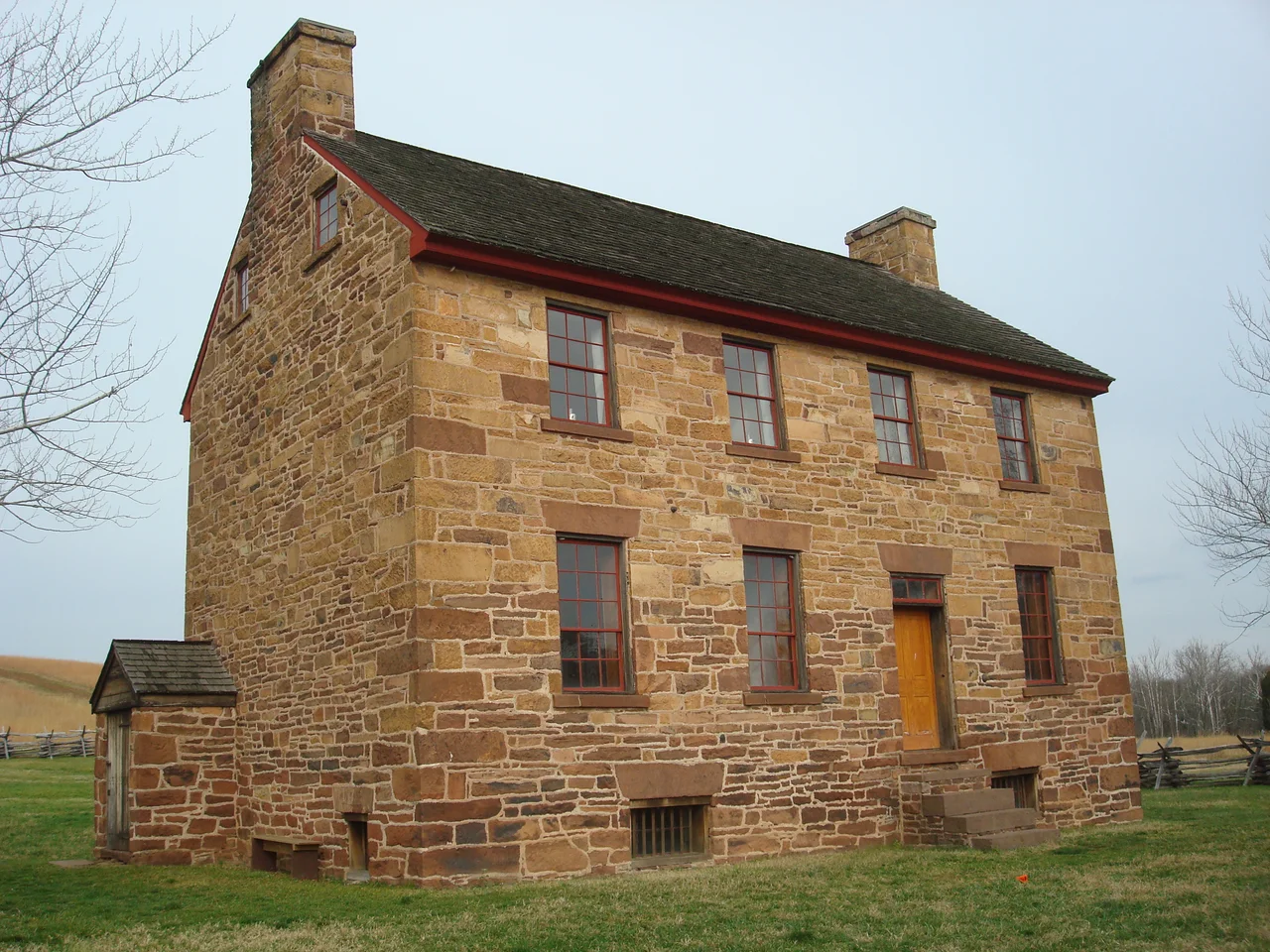

The Stone House, Manassas National Battlefield Park
Two soldiers carved their names into the floorboards of the Stone House on August 30, 1862, while waiting to be looked at by Confederate surgeons in what had become, for the second time, a field hospital. Charles Brehm signed his name in full - Brehm Aug 30. E. P. Geer did not finish - he ran out of room or strength and left only E.P. Ge. Brehm survived the war and lived until 1909. Geer did not live to see the end of 1862. The carvings are still in the floor. The Stone House is still at the same crossroads where it was built in 1848 as a turnpike tavern, and the two Battles of Manassas - First Bull Run in 1861 and Second Bull Run in 1862 - swept around it back and forth.
The Turnpike Tavern
The Fauquier and Alexandria Turnpike Company was chartered in 1808 to build a 28-mile toll road from Fairfax Court House to Fauquier Court House - the modern town of Warrenton. The hope was to draw trade away from Fredericksburg and toward Alexandria. Six toll gates were spaced at five-mile intervals along the route. Construction began in 1812. It took sixteen years to reach Warrenton. The Stone House was built at one of those toll-gate intersections, on land that had passed from Wormeley Carter to his son Thomas Otway Carter to John Lee in 1828. A woman named Mary Polly Clark operated a wagon stand at the tollgate; travelers could pay their toll and buy food, drink, and probably lodging. The current building dates to 1848 - a two-story rectangular structure of fieldstone walls eighteen inches thick, with end chimneys, slate roof, and a cellar that would shelter dozens of wounded men a decade later.
First Manassas, July 21, 1861
On the morning of July 21, 1861, Union General Irvin McDowell sent his army across Bull Run to attack the Confederate left at Sudley Ford. The fighting passed directly across the Stone House crossroads. Union forces pushed Confederates off Matthews Hill to the north and briefly held the area; Confederate artillery and reinforcements drove them back, then the area changed hands again. The Stone House had three things a battlefield hospital needed: thick stone walls that stopped most rifle balls, a well in the yard with reliable water, and a position on the Warrenton Turnpike, the only paved road back to the hospitals in Washington. By midday the building was full of wounded. Colonel John S. Slocum of the 2nd Rhode Island Infantry was carried in mortally wounded and was treated by Surgeon James Harris of the 1st Rhode Island. Harris stayed at the Stone House after the Union retreat, was found there with 21 wounded men, and was captured. A witness the next day reported 32 wounded inside, many torn by cannon fire, with a single overwhelmed surgeon, some men still in clotted clothes, some already dead and not yet removed.
Confederate Occupation and Return
After the Union army broke and ran on the afternoon of July 21, the Confederates recaptured the Stone House and found 36 Union prisoners and about 100 rifles inside. Confederate forces continued to hold the building, using it intermittently as quarters and as a hospital, until March 1862. The Union wounded who survived their wounds were eventually moved to Confederate prisons in Richmond. The Matthews family - Henry Matthews owned the property by then - had abandoned the house before the first battle and may not have returned before the second battle washed over it. Thirteen months after First Manassas, on August 30, 1862, the second day of Second Bull Run, the Stone House was again surrounded by fighting. Confederate troops sweeping toward Matthews Hill found dead and wounded inside and 36 men sheltering behind the thick walls. Federal surgeons posted a flag from a window to identify the building as a hospital. Brehm and Geer carved their names that afternoon.
The Carvings and the Renovations
Charles Brehm of the 5th New York Infantry survived the war and lived to 1909. E. P. Geer, also of the 5th New York Infantry, did not survive 1862. Both men's carvings - Brehm Aug 30 and E.P. Ge - remain visible in the floorboards of the upstairs room where they waited for treatment. They are the most legible of several signatures and dates that wounded soldiers left in the wood, the kind of mark that gets made when a man is bored, hurt, scared, and trying to leave proof that he was there. The Stone House passed through private ownership for the next eighty years. In 1949 the United States government bought the building from George Ayers, a Manassas dentist who had collected artillery shells in the cellar - it is likely Ayers placed the projectiles still on display inside the house. The National Park Service has overseen two major renovations since acquisition, installing a new roof, electrical service, and plumbing. The walls and the floors are still the originals.
What You See Today
The Stone House is unoccupied today but is the visual anchor of the Manassas National Battlefield Park, which protects 5,000 acres of the two Bull Run battlefields. It sits at the intersection of the Warrenton Turnpike, now Route 29, and Sudley Road, now Route 234 - the exact crossroads where the heaviest fighting of the first battle began. From the air the building is a small rectangular stone shape with a pitched roof at the meeting of two highways, with Matthews Hill rising just to the north, Henry Hill rising to the south, and the broad open battlefield fields spreading around it. The Park Service runs guided tours of the interior several times a week. The carvings are roped off but visible. The well outside, where soldiers from both armies drank during the battle, is still there. The Stone House has been at the same crossroads for a hundred and seventy-eight years, and almost all of that history has been peaceful. The two days that were not - July 21, 1861, and August 30, 1862 - are why it is famous.
From the Air
The Stone House sits at 38.819 N, 77.526 W, at the intersection of U.S. Route 29 (Warrenton Turnpike) and Virginia Route 234 (Sudley Road) within Manassas National Battlefield Park, Prince William County. Recommended viewing altitude is 1,500 to 2,500 feet AGL for a clear look at the small two-story stone building and its position at the crossroads with Matthews Hill north and Henry Hill south. The nearest airport is Manassas Regional (KHEF), about 6 nautical miles southeast. Dulles International (KIAD) lies 14 nm north. Watch for Class B airspace and heavy traffic around Dulles. Best light is mid-morning for the limestone walls.
Nearby Stories
- Long Branch Plantation 2.3 km away
- Stafford County, Virginia 6.6 km away
- Surratt House Museum 8.2 km away
- Battle of Cedar Mountain 11 km away
- Leesburg, Virginia 11 km away
- The Inn at Little Washington 11 km away
- Menokin 57 km away