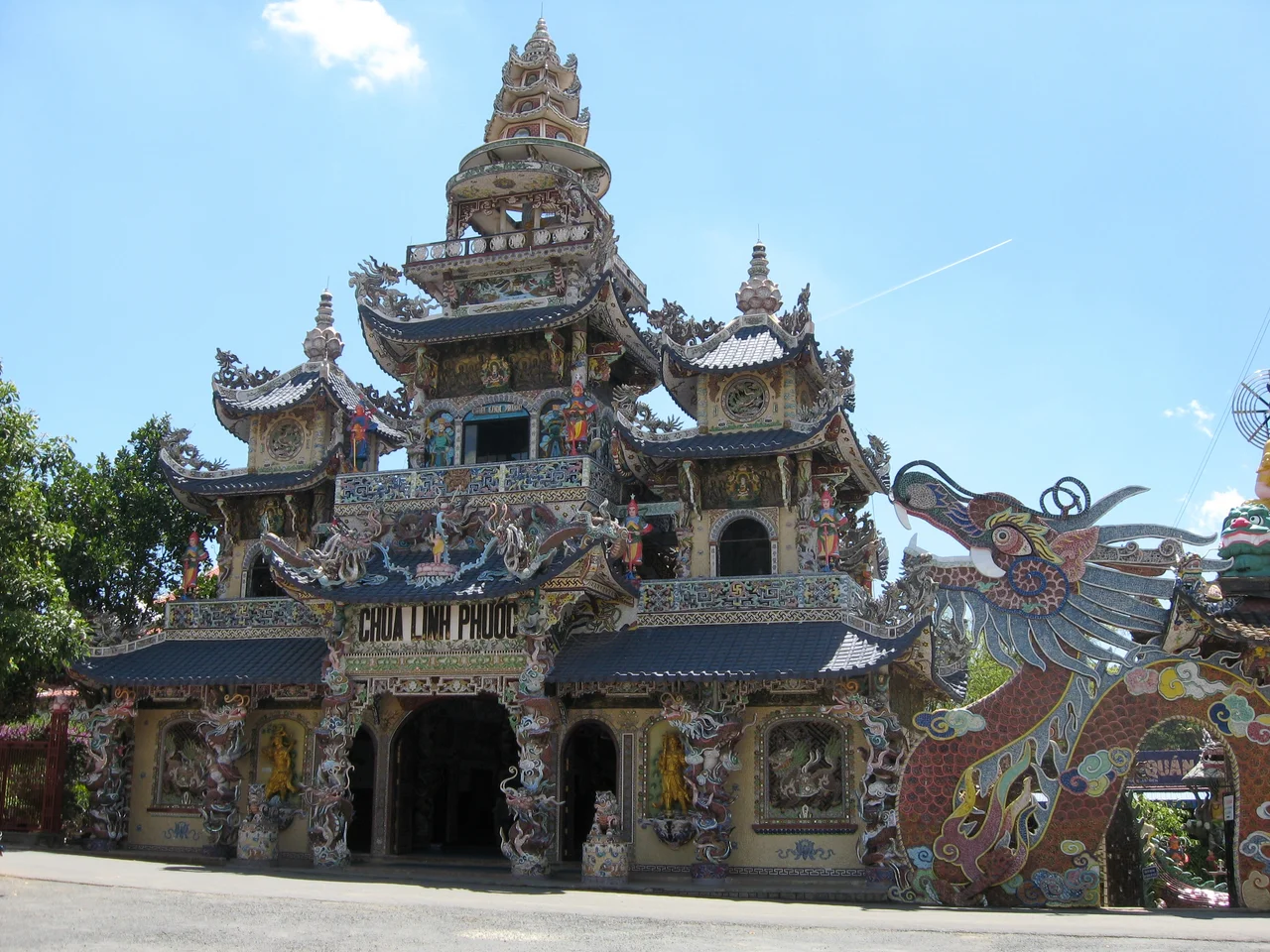

Linh Phước Temple
Twelve thousand beer bottles — cleaned, sorted, fitted together with mortar and patience — form the body of a 49-meter dragon coiling through the grounds of Linh Phước Temple. The dragon's head stands 7 meters high, its open mouth sheltering a statue of Maitreya, the Buddha of the future. This is not folk art improvised in someone's backyard. It is the considered architectural expression of a temple community that spent decades building something unlike anything else in Vietnam — and the dragon is only the beginning.
Built from Devotion
Construction of Linh Phước Temple began in 1949 and was completed in 1952, in the years when Vietnam was still under French control and the First Indochina War was underway. That a religious community could build a substantial temple complex during those years says something about the depth of commitment behind it. The temple sits at No. 120 Tu Phuoc in Trai Mat District, about 8 kilometers from Da Lat's city center along Highway 20 — far enough from the tourist core to feel like a destination reached by choice rather than accident. In 1990, Venerable Thich Tam Vi undertook a significant restoration and expansion, adding new buildings and beginning the mosaic projects that would eventually make the temple one of the most visually distinctive in the region. Thich Tam Vi has served as abbot since 1985, the fifth in the temple's history.
The Architecture of Mosaic
The main ceremonial hall runs 33 meters long and 12 meters wide. Its floors carry two rows of cobblestone mosaics, and the surfaces above them are covered in bas-reliefs depicting the life of Shakyamuni — the historical Buddha — and scenes from the Lotus Sutra. These are not simple decorations. They are dense, narrative, hundreds of small pieces assembled into images that teach. The exterior of the complex continues the mosaic language: ceramic shards, colored glass, and broken porcelain compose surfaces that catch and fragment light. The effect, especially on a clear highland day, is something between jeweled and geological — the walls seem to glitter and shift as you move around them.
The Dragon and the Bell
The temple's most famous features sit at either end of the dramatic scale. The dragon in the grounds — called Hoa Long Vien — stretches 49 meters and is made entirely from 12,000 beer bottles embedded in its structure. Its mouth opens around a Maitreya statue, making the act of entering the dragon's presence an act of approaching the future Buddha. At the other end of the complex stands the Dai Hong Chung bell tower, a seven-story structure rising 37 meters — considered the tallest temple bell tower in Vietnam. Inside hangs a bell cast in 1999: 4.3 meters high, 2.33 meters wide, weighing 8,500 kilograms. It was long considered the heaviest bell in Vietnam, a distinction later surpassed by the bell at Bai Dinh Pagoda in Ninh Binh Province. The tower's height and the bell's mass together produce a resonance that can be heard across considerable distance when it is struck.
A Living Community
Beyond its architectural ambitions, Linh Phước functions as an active place of practice. The temple faces a statue of Quan Thế Âm — the bodhisattva Avalokiteshvara, revered across Vietnamese Buddhism as the embodiment of compassion — and the grounds include gem displays, antique chinaware, and fine art furniture gathered over the temple's decades of history. Visitors arrive in significant numbers, drawn by reputation and by the visual spectacle. But the temple is not primarily a spectacle; it is a place where the Buddhist community of the Trai Mat area gathers and worships. The five abbots who have guided it since 1951 have maintained that balance between witness and practice — building things extraordinary enough to draw the world's attention, while keeping the purpose of attention clear.
From the Air
Linh Phước Temple sits at approximately 11.944°N, 108.500°E, in Trai Mat District roughly 8 km east of central Da Lat along Highway 20. From the air at 2,000–3,000 meters, the temple complex is visible as a distinctive cluster of colorful mosaic structures; the 37-meter bell tower is the tallest element. The surrounding terrain is hilly pine forest at approximately 1,400 meters elevation. Lien Khuong Airport (VVDL) lies approximately 35 km to the southwest. The approach from the west along the Da Lat valley corridor provides a good view of both the city and the Trai Mat area.
Nearby Stories
- Tà Đùng National Park 3.1 km away
- Phan Rang–Tháp Chàm 4.2 km away
- Cam Ranh 18 km away
- Bao Loc 18 km away
- Operation Byrd 23 km away
- Nha Trang Air Base 25 km away
- Bidoup Núi Bà National Park 34 km away
- Duc Lap Camp 43 km away