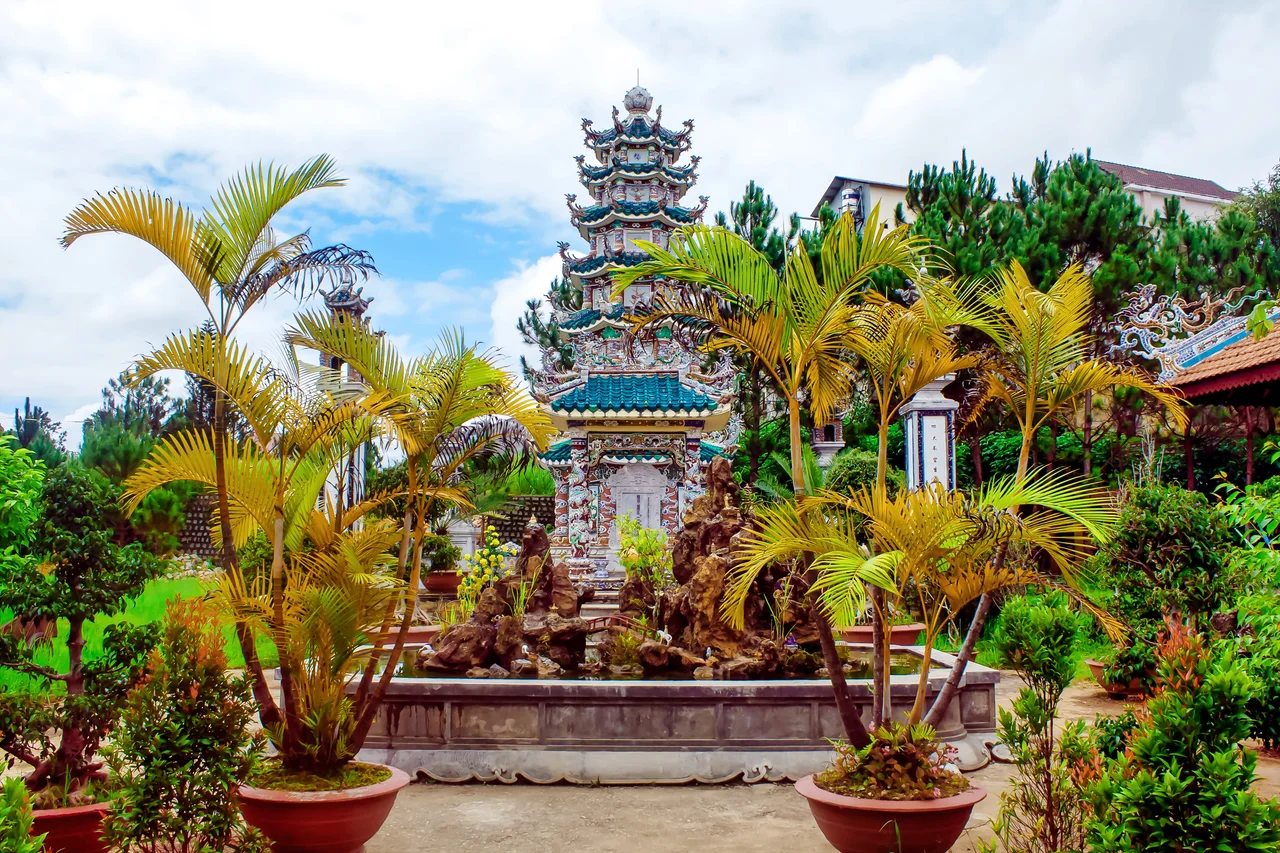

Linh Sơn Temple
The bell at Linh Sơn Temple is said to be alloyed with gold — enough gold that no thief has ever managed to carry it away. Whether the story is literally true matters less than what it reveals: this is a temple that has always attracted things of weight. The bronze Buddha in the main hall weighs 1,250 kilograms. The institution itself carries the administrative weight of the entire Buddhist Association of Lâm Đồng Province. Even the pine trees flanking the entrance path are old and substantial. Linh Sơn is not the most visually spectacular temple in Da Lat, but it may be the most deeply embedded in the life of Vietnamese Buddhism in this part of the highlands.
Built on a Hill, Funded by the Public
Construction began in 1938, and the temple opened two years later in 1940, on a small hill at 120 Nguyễn Văn Trỗi Street in Da Lat's second ward — roughly 700 meters northwest of the city center. The land was chosen for its elevation: from the hilltop, the temple overlooks its neighborhood with quiet authority. Funding came from the community at large, but two lay Buddhists, Võ Đình Dung and Nguyễn Văn Tiến, made the largest individual contributions. Their names are part of the temple's founding story. This model of community-funded religious construction — neither sponsored by the colonial government nor by a wealthy patron alone — reflects the grassroots character of Vietnamese Buddhist practice in the mid-twentieth century.
The Courtyard and Its Symbols
Walk through the entrance gates and the temple's symbolic vocabulary announces itself immediately. Rows of pine trees line the approach — highland trees, native to this elevation, which give the grounds a cool, cathedral-like quality. At the front of the courtyard stands a statue of Avalokiteshvara, the bodhisattva of compassion, seated on a lotus. To the left, an octagonal three-story stupa rises 4 meters. To the right, a pond holds clear water, goldfish, and flowers. The entrance to the main hall requires climbing twelve steps, and two dragon statues flank the staircase — traditional guardians of the dharma, the teachings of the Buddha. At the hall's corners, additional dragon figures stare upward toward the roof's ridgeline. The whole composition is classical in its references and serene in its execution.
The Bronze Buddha
In the center of the main hall, a bronze statue of Gautama Buddha sits on a lotus in the traditional meditation posture. The statue weighs 1,250 kilograms and was cast in 1952 — twelve years after the temple opened. Its inauguration was conducted by Thích Tịnh Khiết, the Buddhist Patriarch of Vietnam, a figure of national religious authority. The presence of the Patriarch at the ceremony underlines how seriously the broader Buddhist community regarded this temple, even in its relative youth. The hall itself is simple in layout, and that simplicity seems deliberate: the bronze figure at the center benefits from the space around it, from the light that falls on it without competition from elaborate decoration.
A Living Temple in the Highlands
Around twenty monks and approximately six novices currently reside at Linh Sơn, making it a functioning monastic community as well as a pilgrimage destination. The monks tend a variety of tea and coffee plants on the temple grounds — appropriate for Da Lat, a region whose highland agriculture produces both crops. The temple draws visitors throughout the year, though it is particularly popular in the spring, when the climate softens and the plantings around the courtyard are in full growth. The office of the Lâm Đồng Province Buddhist Association is also housed here, bringing an administrative dimension to the spiritual one. In a city that draws visitors partly because of its French colonial architecture and its cool air, Linh Sơn offers something different: continuity with Vietnamese Buddhist practice that predates the tourism industry and will outlast it.
From the Air
Linh Sơn Temple sits at approximately 11.950°N, 108.437°E, on a small hill about 700 meters northwest of Da Lat's city center. The pine-covered hilltop is visible from the air at 2,000–3,000 meters. The broader Da Lat urban area is easily identified by Xuan Huong Lake to the southeast. The surrounding plateau sits at roughly 1,500 meters elevation. Lien Khuong Airport (VVDL) is approximately 28 km to the south-southwest. Cam Ranh International Airport (VVCR) is roughly 100 km to the northeast along the coastal corridor.
Nearby Stories
- Tà Đùng National Park 3.1 km away
- Phan Rang–Tháp Chàm 4.2 km away
- Cam Ranh 18 km away
- Bao Loc 18 km away
- Operation Byrd 23 km away
- Nha Trang Air Base 25 km away
- Bidoup Núi Bà National Park 34 km away
- Duc Lap Camp 43 km away