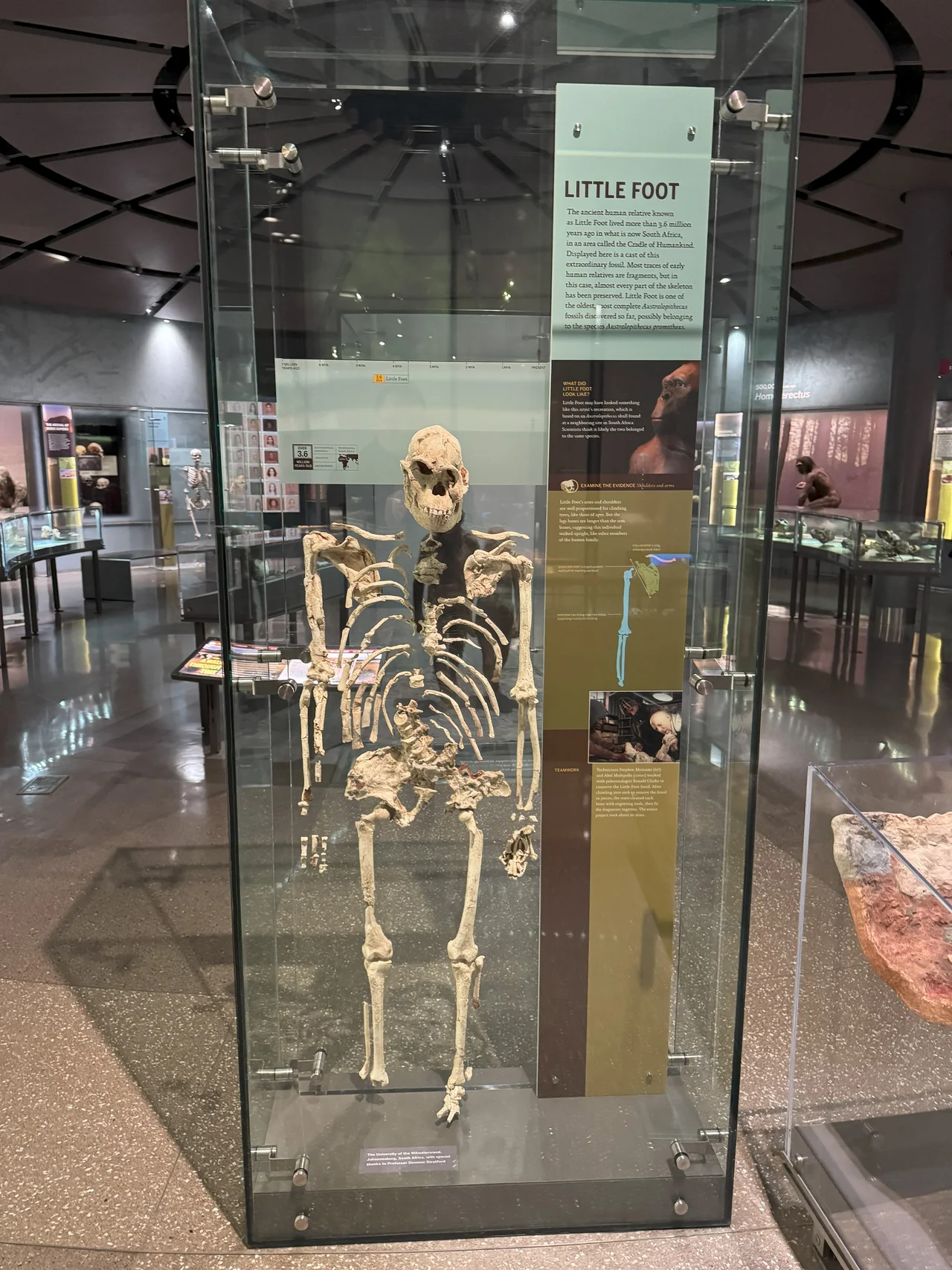

Little Foot
It began with four small bones in the wrong box. In 1994, paleoanthropologist Ronald Clarke was sorting through museum containers at Sterkfontein labeled as old-world monkeys when he noticed something that did not belong: four bones from a left foot that were unmistakably those of an upright-walking hominin. They had been collected from the cave in 1980 and quietly misfiled for fourteen years. Clarke gave them a nickname for their modest size - 'Little Foot' - and then set out to find the rest of the body. What he found, deep in a chamber called the Silberberg Grotto, would turn out to be the most complete skeleton of an early human relative ever recovered.
The Match in the Dark
The bones in the museum had a clean break where one had been sheared off - which meant its other half might still be in the cave. Clarke handed casts of the broken edge to two technicians, Stephen Motsumi and Nkwane Molefe, and asked them to search the Silberberg Grotto by lamplight. The grotto sits roughly twenty meters underground, a cathedral of darkness and dripping rock. In just two days, the pair found the matching surface. The fit was exact. There, embedded face-down in the cave floor, lay an entire skeleton - legs, arms, pelvis, ribs, and skull - frozen in stone roughly three and a half million years before anyone went looking for it.
Locked in Stone
The discovery was the easy part. The bones were encased in breccia, a cement-hard rock formed from ancient cave sediment, and freeing them without shattering them became one of the most painstaking excavations in the history of the science. Clarke and his team worked with hammers, small chisels, and air-powered tools, carving away rock millimeter by millimeter inside the cramped, humid chamber. The work stretched across roughly fourteen years of excavation, followed by years more of cleaning and reconstruction. By the time the skeleton was unveiled to the public in 2017, more than ninety percent of the body had been recovered - far more complete than 'Lucy,' the famous Australopithecus afarensis from Ethiopia.
Who She Was
The skeleton belonged to a female, standing roughly 1.2 to 1.3 meters tall - about four feet. Her legs were longer than her arms, her hips built to drive force from the ground, her feet adapted for walking upright across open country. Yet her hands were large and her shoulders still carried the curve of an animal that climbed. She likely walked the savanna by day and slept in the trees at night, where predators could not easily reach. Reading her bones, scientists could reconstruct not just an anatomy but a way of living - one foot, quite literally, in two worlds.
An Argument Three Million Years Old
Little Foot has never stopped provoking debate. Without volcanic ash to date - the usual clock for African fossils - researchers turned to the rock itself. Estimates ranged wildly, from 2.2 to 3.5 million years, until a 2015 radioisotopic study placed her at about 3.67 million years old, older than Lucy. Her species is disputed too. Clarke argues she belongs to Australopithecus prometheus, a distinct species; other researchers, including a 2025 study, contend that name is just another label for Australopithecus africanus. The bones, silent for millions of years, still refuse to settle the question of exactly what they are.
Why It Matters Here
Sterkfontein lies within the Cradle of Humankind, a cluster of dolomite caves northwest of Johannesburg that has yielded more early hominin fossils than almost anywhere on Earth. Little Foot is the crown of that collection - not a fragment or a single skull, but a near-whole individual who can tell us how our distant ancestors stood, walked, and reached. She spent millions of years in the dark beneath these hills. It took a misfiled drawer, two sharp-eyed technicians, and decades of patient chiseling to bring her back into the light.
From the Air
The Sterkfontein Caves sit at approximately 26.02 degrees south, 27.73 degrees east, in the Cradle of Humankind northwest of Johannesburg, South Africa. The site rests on rolling grassland at roughly 1,500 meters (about 4,900 feet) elevation; the visitor center and Maropeng dome are visible landmarks from the air. The nearest major airport is OR Tambo International (FAOR) about 60 km east, with Lanseria International (FALA) roughly 25 km to the southeast. Clear, dry highveld winter skies (May to August) offer the best visibility over the cave-pocked dolomite ridges.
Nearby Stories
- Voortrekker Monument 8.7 km away
- Rand Refinery 13 km away
- Kweneng' Ruins 15 km away
- Mponeng Gold Mine 18 km away
- Marikana Massacre 20 km away
- Vaal Reefs Mining Disaster 70 km away
- 2014 Orkney Earthquake 103 km away
- Matsieng Footprints 167 km away