
Voortrekker Monument
Once a year, for a few minutes around noon, a shaft of sunlight does exactly what the architect intended. On 16 December, a beam falls through an opening in the dome of the Voortrekker Monument, down through a circular hole in the floor below, and lands on a stone cenotaph in the chamber beneath, illuminating four Afrikaans words: Ons vir Jou, Suid-Afrika, "We for Thee, South Africa." Gerard Moerdijk engineered the whole vast granite building around that moment of light, timed to the date of the Battle of Blood River in 1838. To understand why a single sunbeam was worth a forty-metre cube of stone is to understand both the devotion the monument was built to express and the deep divisions it still stirs.
A Hill, a Vow, and a Building
The monument commemorates the Voortrekkers, the Afrikaner farmers who loaded their families into ox-wagons and left the British-ruled Cape Colony between 1835 and 1854 in the migration known as the Great Trek. The idea of honouring them was first raised in 1888 by President Paul Kruger, but it took the rising Afrikaner nationalism of the 1930s to make it real. Construction began in 1937, and on 16 December 1949 the finished monument was inaugurated before a crowd of more than a quarter of a million people. Rising 62 metres from a base 40 metres square, it stands on a hilltop south of Pretoria as a deliberate counterweight to the Union Buildings across the city, so significant in the national imagination that local law forbids any structure tall enough to block the view between the two.
The Largest Marble Frieze on Earth
Inside, the main entrance opens into the domed Hall of Heroes, a cavernous space lit by four arched windows of golden Belgian glass. Around its walls runs the monument's artistic centrepiece: a marble frieze of 27 carved panels, said to be the largest in the world, telling the story of the Great Trek from the first wagons of 1835 to the Sand River Convention of 1852. The carvings depict daily life, work, and faith, but their emotional core is the panel showing the killing of Piet Retief and his delegation. In February 1838 the Voortrekker leader and roughly a hundred of his party, having just signed a land treaty, were seized and put to death on the orders of the Zulu king Dingane. That betrayal, and the Boer victory at Blood River that followed it ten months later, form the sacred narrative the building enshrines.
Light, Stone, and Strange Symbolism
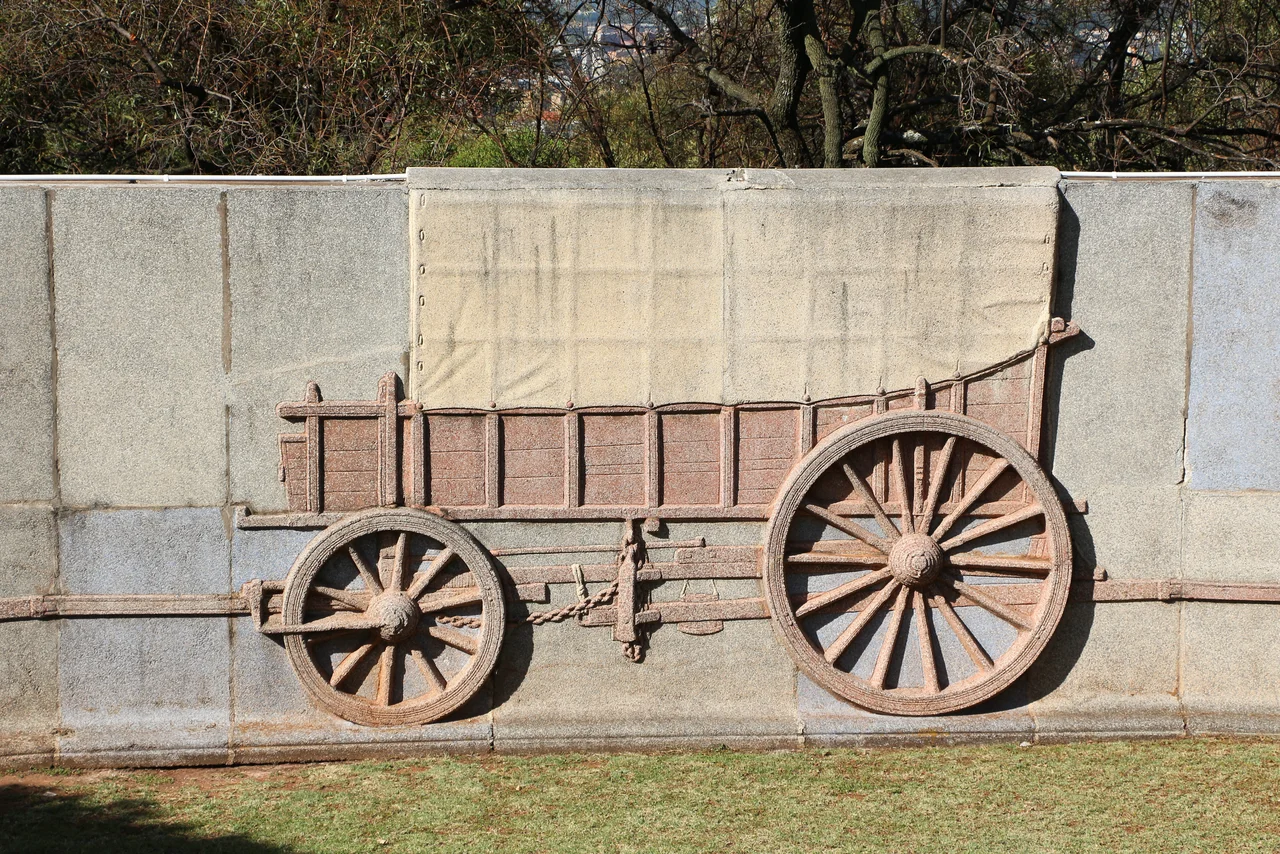
Moerdijk was a man of unusual obsessions, and the building carries them. He revered ancient Egyptian architecture, and his first design, a causeway between two obelisks, so resembled an Egyptian temple that the South African press erupted in protest. He reworked it, ringing the structure with a granite laager of 64 stylised ox-wagons in tribute to the wagon-forts the trekkers drew up for defence. Yet the Egyptian thread survived in the symbolism within. Looking down from the dome, a chevron pattern radiates across the floor like 32 rays of the sun, with the natural sunbeam through the oculus forming a 33rd, a numerology that has invited comparison to Freemasonry. The annual ray of light striking the cenotaph was meant to read as a divine blessing, the trinitarian God of the trekkers answering their vow with one of His own. Few monuments anywhere fuse pioneer myth, Christian faith, and pharaonic geometry quite so unabashedly.
Two Sides of the Same Story
The history the monument tells is real, but it is told from one vantage point, and that is the source of its controversy. For generations of Afrikaners, the building is a shrine to ancestors who endured hardship and loss, a place of pilgrimage and identity. For many other South Africans, it is a monument to conquest, raised in the same era that hardened into apartheid, that celebrates white settlement on land taken from those already living there. The Battle of Blood River, remembered here as a miracle of deliverance, left some three thousand Zulu warriors dead against barely a scratch among the Voortrekkers, a slaughter as much as a salvation. The very date the sunbeam honours was a public holiday called the Day of the Vow until 1994, when democratic South Africa renamed it the Day of Reconciliation, an act of deliberate reinterpretation rather than erasure.
What the Monument Means Now
Rather than tear it down, post-apartheid South Africa has largely chosen to let the Voortrekker Monument stand and speak for itself, an honest if uncomfortable record of how one community saw its own past. It was declared a national heritage site in 2011. A flame kept burning since 1938, lit during the symbolic ox-wagon trek that ended on this hill, still flickers in its niche. Visitors climb to the dome for one of the finest views over Pretoria, and the surrounding heritage centre works to preserve Afrikaans culture and history. The building remains exactly what its makers wanted it to be: monumental, devotional, and impossible to ignore. What has changed is the country around it, which now asks every visitor to hold two truths at once, that this is a place of genuine memory for some, and a hard reminder of dispossession for others.
From the Air
The Voortrekker Monument stands on a hilltop just south of Pretoria at roughly 25.78 degrees south, 28.18 degrees east, on the Highveld plateau at about 1,400 metres elevation. The massive granite cube is a distinctive landmark from the air, and the protected sightline runs north across the city to the Union Buildings on Meintjieskop. The nearest field is Wonderboom Airport (ICAO FAWB, elevation about 4,095 feet) north of the city; Lanseria (ICAO FALA, about 4,517 feet) lies to the southwest, and OR Tambo International (ICAO FAOR, about 5,558 feet) serves Johannesburg to the south. The dry winter months of June to August offer the clearest air and the long shadows that show the monument's bulk to best effect, while summer afternoons bring highveld thunderstorms.
Nearby Stories
- Little Foot 3.9 km away
- Hartebeesthoek Radio Astronomy Observatory 18 km away
- Boksburg explosion 23 km away
- Tswaing crater 24 km away
- Secunda CTL 69 km away
- Sun City 71 km away
- Bushveld Igneous Complex 87 km away
- Battle of Bergendal 127 km away