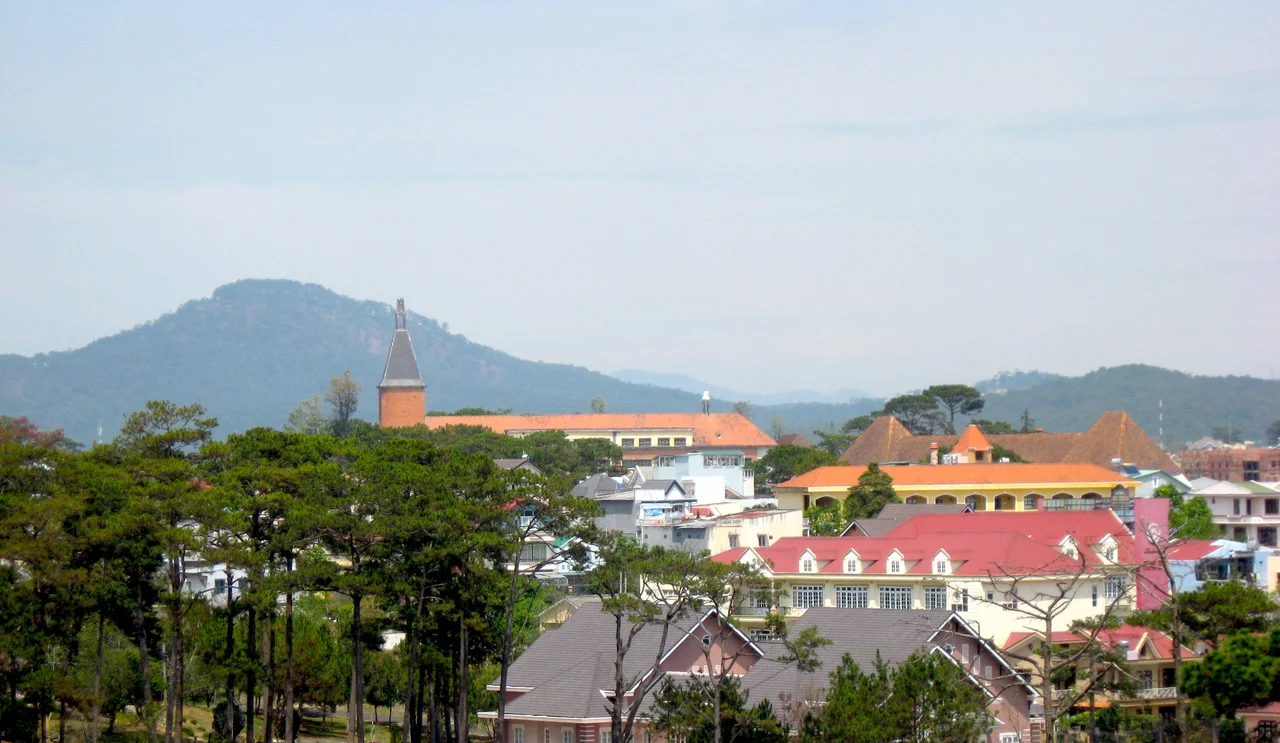

Lycée Yersin
Two future heads of state sat in classrooms here. Emperor Bảo Đại of Vietnam and King Norodom Sihanouk of Cambodia both studied at the Lycée Yersin in Da Lat — an institution that was simultaneously one of the finest schools in Indochina and one of its most visible instruments of colonial assimilation. The red bricks were imported from Europe, the roof tiles from France, and the curriculum was designed to turn the children of Asian elites into people comfortable navigating French culture. That the Vietnamese and Cambodian students often achieved the best academic results was an irony the colonial administration preferred not to examine too closely.
A Building That Earned Its Place
The building stands on a plateau overlooking Xuan Huong Lake on one side and the valley of Da Lat's railway station on the other. French architect Paul Moncet designed it, and the structure he produced is remarkable enough to have been recognized by the World Association of Architects as one of the 1,000 most original buildings of the twentieth century. The main building is three stories high, with 24 rooms; it describes an arc rather than a straight line, following the contour of its hilltop. A 54-meter bell tower rises from one end, still bearing traces of a large clock face on its exterior. Red European brick gives the whole mass a warm solidity that reads differently against Da Lat's highland mist than it might have in any European city. The roof has been restored since the original French materials aged, but the bones of the building remain as Moncet left them.
Founded for Segregation, Undone by Reality
The Lycée Yersin did not begin as a single institution. Two schools were founded in 1927: the Petit Lycée, created by decree on 16 July and opened on 16 September, was restricted to European children. The Grand Lycée opened the same year, intended for French children and the Vietnamese elite. By 10 May 1935 — when it formally took the name Lycée Yersin in honor of Dr. Alexandre Yersin, the Swiss-French physician who had first identified Da Lat as a suitable sanatorium site — the segregation was already eroding. The Vietnamese elite's presence in Da Lat had grown, and maintaining strict racial separation was becoming administratively impractical. Governor-General Jules Brévié visited the school on 12 July 1938 and addressed a racially mixed student body. The system had not changed its ideology; reality had simply outpaced its rules.
The Children the School Did Not Teach
A 1948 brochure for the Lycée Yersin depicted a column of highland people — the indigenous ethnic minorities of the Central Highlands — on its cover. The text made no mention of these communities. Their children were not admitted to the school. The brochure's visual choice, whether intended as picturesque decoration or as a nod to local geography, was a kind of erasure: the people were present enough to serve as imagery, absent enough to be ignored in the institution's actual life. As late as 1950, more French students graduated from the Lycée Yersin than Vietnamese. It was only in the early 1950s that Emperor Bảo Đại granted scholarships enabling young highland students — mostly sons of chiefs or civil servants — to attend. The school's integration was gradual, partial, and always shaped by the hierarchies of the society it served.
What It Became
The school closed its colonial chapter in 1975, having already been renamed the Hung Vuong Education Center in 1970 under the Republic of Vietnam, repurposed as a training facility for primary school teachers. After 1975 it became Da Lat Teachers College. In August 2022 it merged with two other institutions to form the College of Dalat, a vocational and pedagogical institution that continues to operate in the original Paul Moncet building. The arc-shaped red-brick structure has outlasted the empire that built it, the republic that renamed it, and the ideology that defined its original enrollment policies. It remains one of Da Lat's most distinctive pieces of architecture — and a building that asks its visitors to hold two things at once: genuine aesthetic achievement, and a history of who was and was not allowed inside.
From the Air
Lycée Yersin sits at approximately 11.946°N, 108.453°E on a plateau in central Da Lat, visible from the air as a large arc-shaped red-brick structure with a prominent 54-meter bell tower. Xuan Huong Lake lies to the northwest; the railway station valley opens to the southeast. The surrounding city sits at roughly 1,500 meters elevation. Lien Khuong Airport (VVDL) is approximately 28 km to the south-southwest. The building's distinctive curved form and tower make it identifiable from 2,000–3,500 meters.
Nearby Stories
- Tà Đùng National Park 3.1 km away
- Phan Rang–Tháp Chàm 4.2 km away
- Cam Ranh 18 km away
- Bao Loc 18 km away
- Operation Byrd 23 km away
- Nha Trang Air Base 25 km away
- Bidoup Núi Bà National Park 34 km away
- Duc Lap Camp 43 km away