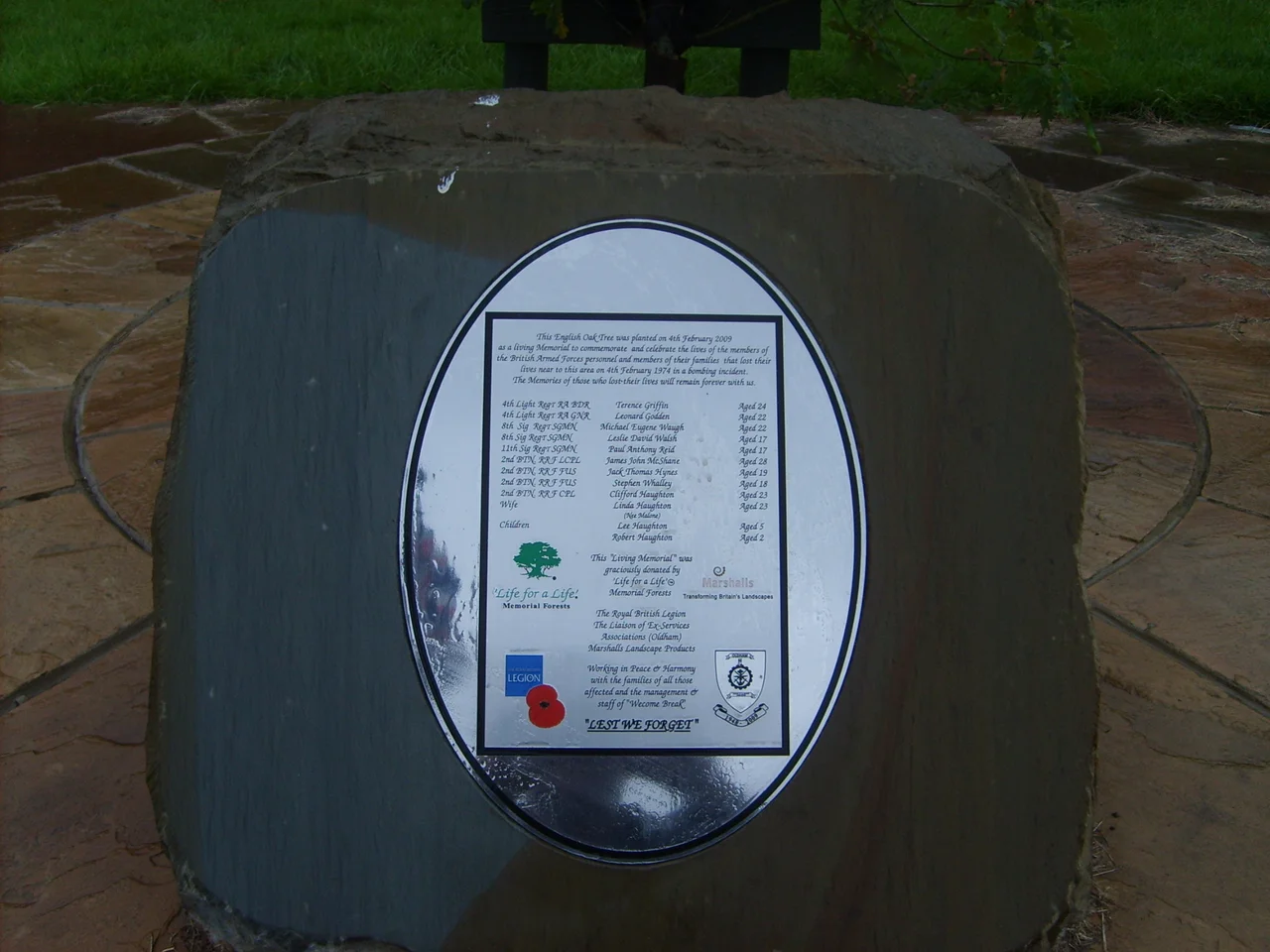

M62 Coach Bombing
Linda and Clifford Haughton were taking their two young sons back to their father's unit after a weekend's leave. The boys, Lee and Robert, were five and two. The four of them were asleep in their seats when the coach passed between junctions 26 and 27 of the M62 in Yorkshire, just after midnight on 4 February 1974, and the suitcase in the luggage compartment beneath them exploded. The Haughtons died together. So did nine soldiers and the wives of two others. The IRA had bombed a sleeping family.
The Coach From Manchester
There was a railway strike on. British Forces personnel returning to Catterick Garrison and bases at Darlington could not take their usual trains, and so a coach had been specially commissioned to carry them. It left Manchester on the late evening of Sunday 3 February 1974, carrying off-duty British Army and Royal Air Force personnel and family members who had spent the weekend at home. Many had small children. The vehicle was travelling at about 60 mph along the M62, the new trans-Pennine motorway that linked Manchester to Yorkshire. Most of those aboard were asleep when, between junctions 26 and 27 near Hartshead Moor, a 25-pound Provisional IRA bomb hidden inside a suitcase in the luggage compartment detonated. Twelve people died. Nine were soldiers. Three were civilians: Linda Haughton, age 23, her husband Corporal Clifford Haughton, and their sons Lee and Robert. Thirty-eight other people were injured. The coach driver, Roland Handley, kept what was left of the bus on the road as it came apart around him, a feat for which he was later belatedly honoured with a memorial.
The Bomb in the Luggage Hold
It was one of the deadliest IRA attacks ever carried out on British soil and remains one of the worst single incidents of the Troubles outside Northern Ireland. The bomb had been placed in the coach's external luggage compartment, where it sat among suitcases and kitbags as the vehicle pulled out of Manchester. The geography of the explosion meant the families travelling in the rear, above the luggage hold, took the worst of it. The military personnel and their dependents on that coach had no role in the conflict in Northern Ireland beyond being British soldiers returning to barracks after a weekend home with family. The Haughtons had nothing whatsoever to do with it. Memorial services have been held at Hartshead Moor on every major anniversary since, with families of the dead returning to the spot where the M62 cuts across the moor. A monument now stands at the service area, with the names of the twelve, including the family of four.
Judith Ward
Ten days after the bombing, a 25-year-old woman named Judith Ward was arrested in Liverpool waiting to board a ferry for Ireland. Ward had a history of false confessions and mental fragility; she had also told stories about being involved with the IRA that were demonstrably untrue. At her October 1974 trial she was convicted of the M62 bombing and two other non-fatal attacks and sentenced to life imprisonment plus thirty years. She would spend more than seventeen years in prison before her conviction was quashed by the Court of Appeal in May 1992. The appeal court found that government forensic scientists had deliberately withheld evidence from the defence at her original trial, evidence that strongly indicated her innocence. Of 63 police interviews conducted with Ward before and after her confession, only 34 had been disclosed. Forty-three separate items of withheld material were identified in her appeal. The Ward case is now considered one of the worst miscarriages of justice in British legal history, sitting alongside the Birmingham Six and the Guildford Four as a marker of what the British state did during the Troubles to manufacture convictions from the broken and the vulnerable.
Hartshead Moor Today
The M62 still runs across Hartshead Moor between Bradford and Huddersfield, carrying tens of thousands of vehicles a day past the spot. The service area at Hartshead Moor has a memorial garden with twelve names: Clifford Haughton, Linda Haughton, Lee Haughton, Robert Haughton, James McShane, Bryan Hanson, Leslie Walsh, Michael Waugh, Paul Reid, John Hynes, Stephen Whalley, and James Lonsgale. Lee Haughton was five years old. Robert Haughton was two. They are buried with their parents. On the fortieth anniversary in 2014, family members met at Hartshead Moor; relatives of the soldiers and of the Haughtons travelled in from across the country to stand together. They have done it again on every major anniversary since. The bomb that killed them was an act of political violence carried out in a fight over a constitutional question. The people it killed were a family on their way home.
From the Air
The bombing site sits at 53.74N, 1.67W on the M62 motorway between junctions 26 and 27, near Hartshead Moor Service Area between Bradford and Huddersfield, West Yorkshire. The memorial garden is at Hartshead Moor services. Leeds Bradford Airport (EGNM) is 9 nautical miles northeast. From altitude, look for the M62 corridor crossing the high Pennine moorland between the Calder Valley to the south and the Aire Valley to the north.
Nearby Stories
- Stockport Air Disaster 4.5 km away
- Hillsborough Disaster 6.1 km away
- Murder of Sophie Lancaster 6.3 km away
- Battle of Stamford Bridge 9.8 km away
- Wressle Castle 12 km away
- Gordale Scar 12 km away
- Gainsborough Old Hall 19 km away