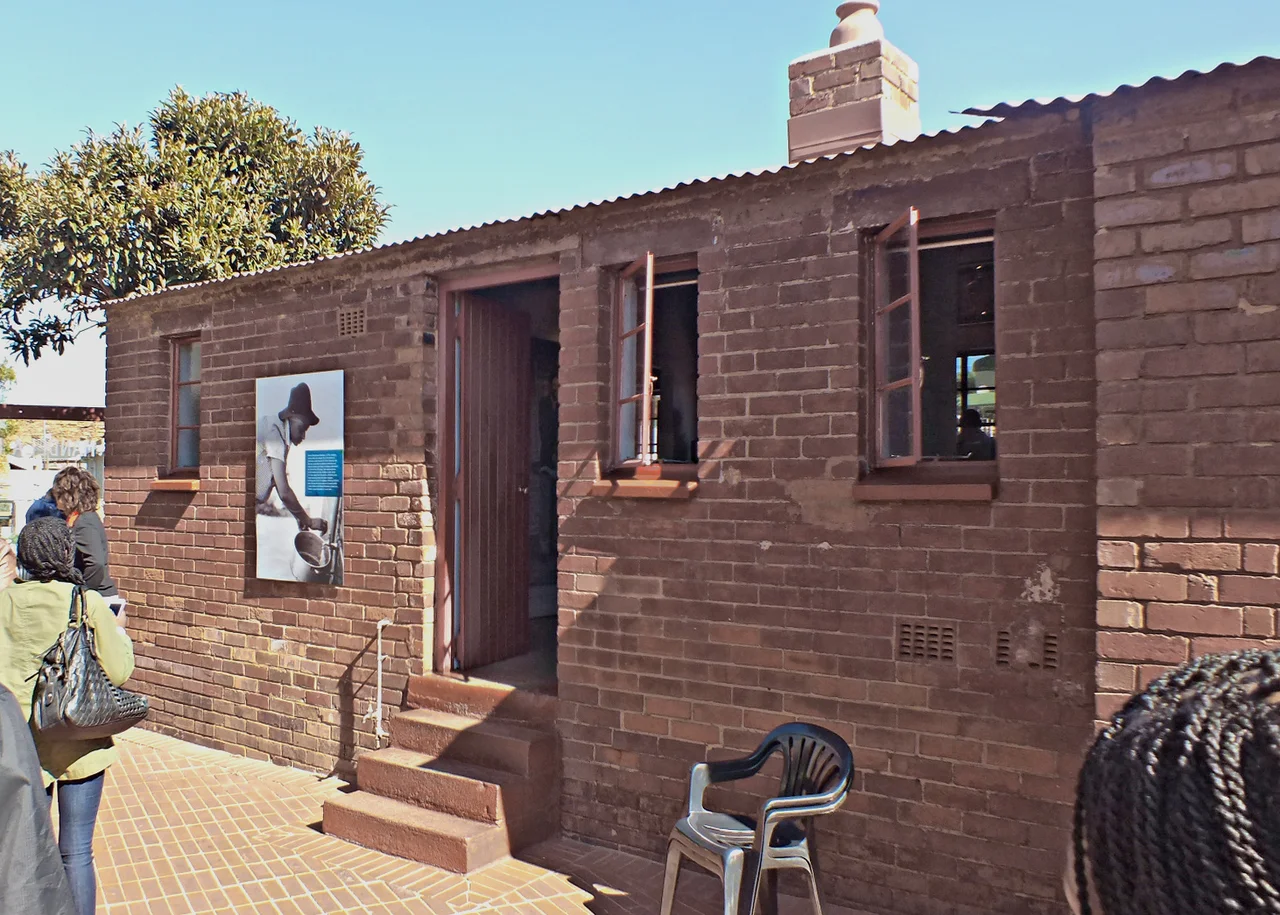

Mandela House
"For me, No. 8115 was the centre point of my world, the place marked with an X in my mental geography." Nelson Mandela wrote those words about a modest red-brick house on a Soweto corner, a single-storey matchbox of the kind the apartheid state built by the thousand for Black families it wanted kept at arm's length. He moved in during 1946, a young lawyer-to-be with his whole struggle ahead of him. By the time he could call it home again, twenty-seven years of prison stood in between. The house at 8115 Vilakazi Street is small enough to cross in a few strides, and large enough to hold the gravity of all of it.
The Street of Two Laureates
Vilakazi Street runs a little over 450 metres through Orlando West, and it holds a distinction no other street on Earth can claim: it has been home to two Nobel Peace Prize winners. Walk up the road from Mandela's house and you reach the home of Archbishop Desmond Tutu, who won the prize in 1984 for his stand against apartheid; Mandela received his own, shared with F.W. de Klerk, in 1993. Two men who helped break a system of racial tyranny once lived as neighbours on the same Soweto lane. That such moral force emerged from a township the regime designed to contain and diminish its people is the deepest irony of the place, and its quiet triumph.
A House That Bears Its Scars
The structure itself was built in 1945, plain and unadorned, but the years of the struggle marked it. The walls carry bullet holes. The facade still shows scorch marks where Molotov cocktails were thrown during the worst of the violence that swirled around the Mandela family. Inside, the house keeps fragments of the life lived here, original furnishings, photographs, the citations and honours that came to Mandela over the decades, and, improbably, a world championship boxing belt presented to him by Sugar Ray Leonard, a nod to Mandela's lifelong love of the ring. The damage was never patched smooth and forgotten. It was left visible, because the scars are part of the testimony.
I Have Come Home at Last
When Mandela walked free in February 1990, officials urged him to settle somewhere safer than this exposed corner of Soweto. He came back to 8115 anyway. At a rally welcoming him home, his opening words were simple and complete: "I have come home at last." That night, returning with Winnie to the little house, he later wrote, was the moment he truly knew he had left prison behind. The homecoming did not last long; the demands and dangers of his new life meant he moved out again after just eleven days. But the brief return mattered more than its length. He needed to stand inside the X on his map before the world swept him onward.
Held in Trust
In September 1997 Mandela gave the house to the Soweto Heritage Trust, which he had founded, so that it could be run as a museum rather than fade into private memory. It opened to visitors that December, and in 1999 it was declared a National Heritage Site; that same year Soweto ranked among the most visited destinations in South Africa, drawing travellers in part to this very door. By 2007 the house was in real need of care, its contents fragile, its facilities thin, and a restoration closed it through much of 2008 before it reopened in March 2009 with a new visitor centre. As president, Mandela lived in a grand mansion in Houghton. But the house that holds the man's heart is the small one in Soweto, on the street where two laureates once kept the lights on against the dark.
From the Air
Mandela House stands at 26.239 degrees south, 27.909 degrees east, at the corner of Vilakazi and Ngakane streets in Orlando West, Soweto, southwest of central Johannesburg at roughly 1,680 metres elevation on the Highveld. From the air the neighbourhood reads as a dense grid of small township houses; the most prominent nearby landmarks are the twin cooling towers of the old Orlando Power Station to the northeast, now painted and used for bungee jumping, which make a useful visual anchor. The nearest large airport is O.R. Tambo International (FAOR), about 30 km to the east; Rand Airport (FAGM) lies to the east and Lanseria (FALA) to the north. Clear, calm winter mornings give the best light; summer afternoons bring heavy Highveld thunderstorms.
Nearby Stories
- Kyalami Grand Prix Circuit 12 km away
- TauTona Mine 16 km away
- Boipatong Massacre 17 km away
- Battle of Bronkhorstspruit 33 km away
- Nan Hua Temple 57 km away
- Royal Bafokeng Nation 59 km away
- Secunda CTL 69 km away
- Vaal Reefs Mining Disaster 79 km away