
Mannin Moar
On 14 July 1933, supercharged Grand Prix cars roared past the Villa Marina and into a tight right-hander on Greensills Corner. They were headed for Church Road, Finch Road, the House of Keys, Prospect Hill, and a zig-zag of suburban streets that ran up to Governor's Bridge before dropping back to the promenade. In the cockpit beside each driver sat a riding mechanic, hanging on. It was the Mannin Moar, Manx Gaelic for Great Man, and for three years it gave Britain something it could not legally have anywhere else: a true street-circuit Grand Prix.
The Loophole
The Royal Automobile Club wanted a British answer to the Monaco Grand Prix, but the law was uncooperative: closing public roads for racing was illegal on the British mainland. The Isle of Man, however, made its own laws, and it had already lent its roads to motorcycle racing for the TT. The R.A.C. drew up a circuit through the streets of Douglas and organized two events for July 1933: the Mannin Beg, or Small Man, for unsupercharged voiturettes under 1500cc on the twelfth, and two days later the Mannin Moar for cars over 1500cc and supercharged voiturettes. The same streets that hosted Tynwald and the Manx parliament would, for forty-eight hours, host Bugattis and Maseratis.
Riding Mechanics, Reluctantly
The R.A.C. insisted on a rule that almost no one wanted. Every car had to carry a riding mechanic alongside the driver. The official purpose was communication: the mechanic could signal flag marshals when his driver wanted to overtake the car ahead, and the marshals would wave the slower car aside. Earl Howe, writing on behalf of the drivers to The Motor magazine, called the rule an embarrassment that would reduce a serious international event to second-rate status. The R.A.C. held its ground. This was almost certainly the last time the riding-mechanic requirement was used in Grand Prix racing anywhere in the world.
Faster Than Monaco
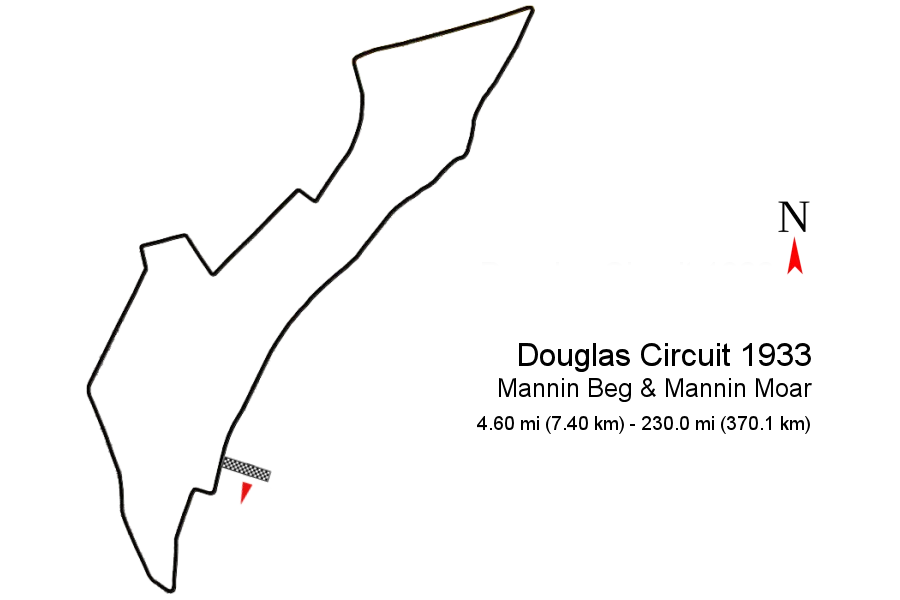
The first track measured 7.4 kilometres. Drivers ran up Greensills Corner to Church Road, hooked into a sharp left on Finch Road, fired past the House of Keys, climbed Prospect Hill, snaked through six rapid bends across Ballaquale Road, St Ninians Road, Dukes Road, and Falcon Terrace, then dropped to Governor's Bridge in a fast left-hander. From Onchan they came howling down Summer Hill Road between a stone wall on one side and Victorian terraces on the other, then ran along the promenade past Castle Mona back to the start. The 1934 course was shortened to 5.889 kilometres, and 1935 lengthened to 6.494. What stunned visitors was the speed. The Douglas circuit produced an average lap speed of about 105 kilometres per hour, compared to Monaco's 96. Brian Lewis, who would later become the 2nd Baron Essendon, won all three runnings.
What Remained
The Mannin Moar ran in 1933, 1934, and 1935, and then it stopped. The reasons were practical: declining entries, the looming pressures of the late thirties, and a sport that was professionalizing past the small Manx street race. But for a brief moment Douglas had been a Grand Prix venue, with crowds lining the promenade and engines howling between the boarding houses. The street names on the route remain: Bucks Road, Prospect Hill, Summer Hill Road, Governor's Bridge. Drive them today in a normal car at normal speeds and they reveal themselves as ordinary urban streets. Then read the lap times from 1933, and imagine a supercharged voiturette taking the same corners flat-out, with a mechanic strapped in beside the driver, ready to wave the next slower car aside.
From the Air
Located at 54.154°N, 4.479°W in central Douglas. Nearest airport is Ronaldsway (EGNS) about 8 miles southwest. The race circuit ran through central Douglas streets between the Loch Promenade waterfront and Governor's Bridge in Onchan, with the start line near the Villa Marina. From the air, look for the curve of Douglas Bay; the original course followed the seafront promenade north, then climbed inland through the streets above.
Nearby Stories
- St Bees Lighthouse 15 km away
- Celtic Array 22 km away
- Kirkmaiden 23 km away
- Isle of Whithorn 23 km away
- Seascale Lifeboat Station 31 km away
- German submarine U-1024 36 km away
- SS Georgetown Victory 40 km away
- Blackpool Illuminations 56 km away