
Manx Electric Railway
Two of the wooden tramcars that opened this line in September 1893 are still in service. Not preserved in a museum, not pushed out for the occasional photo opportunity. Actually working: hauling visitors and locals along the Manx coast under their original Hopkinson bow collectors, then under the trolley poles that replaced them at the turn of the twentieth century. The Manx Electric Railway is the oldest electric tram line on Earth that still runs its original rolling stock, and for the price of a day ticket you can ride it.
Three Men and a Coast
The line was the work of three Manchester-flavoured Manxmen with complementary skills. Alexander Bruce was a banker. Frederick Saunderson was a civil engineer. Alfred Jones Lusty was a landowner who wanted to develop the green slopes north of Douglas. They formed the Douglas Bay Estate company in the early 1890s with a plan to run an electric tramway up the coast, both to serve their new houses and to bring tourists to the cliffs. Construction began in 1893 on a short line from Derby Castle, at the north end of Douglas promenade, out to Groudle Glen. Regular public service started on 7 September that year. The first cars wore distinctive boxy bodies. They had to: the design predated any consensus on what an electric tramcar should look like.
Reaching Ramsey
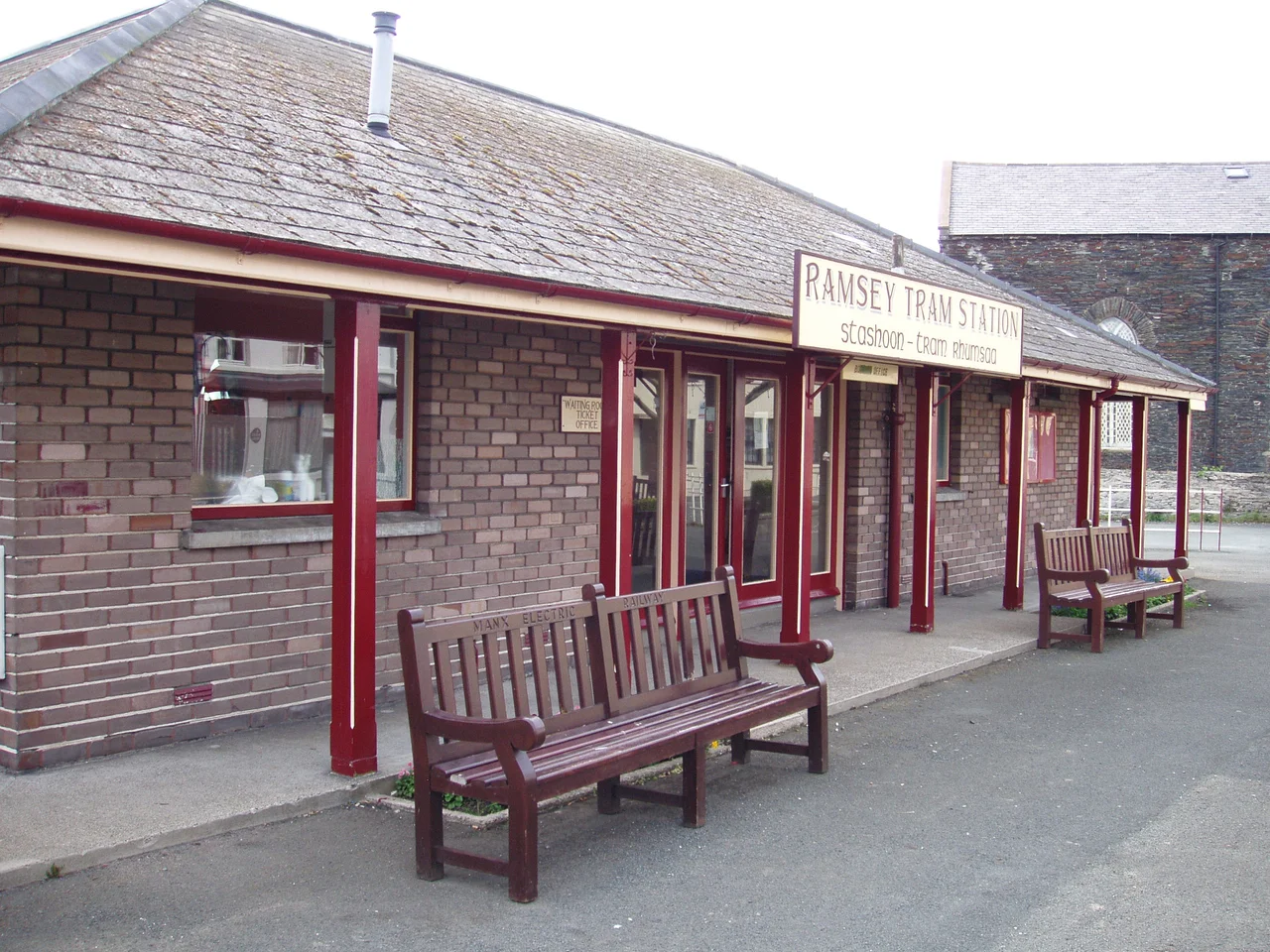
Almost as soon as Groudle opened, the company extended to Laxey. Work began in February 1894 and the line formally opened on 28 July of the same year. Ramsey, sixteen miles up the coast, was the obvious next target. Approval came in May 1897, and on 2 August 1898 the Lieutenant Governor, John Henniker-Major, 5th Baron Henniker, opened the section from Laxey to Ballure on the edge of Ramsey. The final extension into the centre of Ramsey opened on 24 July 1899. The financial cost was crushing. The company carried £150,000 of debt by 1901. The owning Dumbell's Bank, exposed to that debt, collapsed. In 1902 a Manchester syndicate led by Herbert Kidson bought the assets, including the Snaefell Mountain Railway, for £252,000, and the Manx Electric Railway as a named company was born. On 2 August that year, King Edward VII and Queen Alexandra travelled from Douglas to Ramsey in enclosed trailer No. 59.
Fires, Nationalisation, and a Crisis
The railway has not had an easy century. The Laxey refreshment room burned in 1917. In 1930 the Laxey car shed went up in flames, taking with it four cars, seven trailers, three tower wagons, and an open wagon. The post-war years bled the company financially, and in 1957 the Isle of Man Government nationalised it for £50,000. Investment followed: a ten-year track replacement programme between Derby Castle and Laxey at £25,000 a year. But the Laxey-to-Ramsey section was perennially at risk. Mail traffic was lost in 1975 and that stretch closed. After public protest, services to Ramsey restarted in 1977. The line nearly died again in 2008, when a consultancy report exposed critical failings in the permanent way. Tynwald committed nearly £5 million to relay track over July, August, and September. Tourism Minister Adrian Earnshaw was widely criticized; Chief Minister Tony Brown ordered an inquiry. By 2009 the full line was running again, and it has run every summer since.
How the Line Works
Seventeen miles of narrow-gauge track run from Derby Castle to Ramsey, mostly on private right-of-way through the countryside, with the first few miles in roadside reservation alongside the A2. The overhead lines carry 550 volts of direct current. The original cars used Hopkinson bow collectors, which are still used on the Snaefell Mountain Railway where strong winds favour them, but the MER itself switched to trolley poles around 1900. A motor car typically tows a single open trailer in good weather; the trailer comes off when the sea breeze turns bitter. Of thirty-four motor cars built in the line's history, twenty-seven survive. The trailer fleet is more tangled, with conversions, renumberings, and a Royal Saloon (No. 59) that emerges for rare ceremonial outings. The line is now seasonal, running from Easter through early November, and operated by Isle of Man Heritage Railways, a division of the Department of Infrastructure.
Stops with Names
The official stations have humble shelters and timetabled stops: Groudle Glen, Laxey, Dhoon Glen, Cornaa, Ballaglass Glen. But the line is dotted with informal stopping places, request halts known only by the nearest farmer's name or the nearest pole number. Rome's Crossing, Watson's Crossing, Dhoon Farm. The 1,904 poles between Derby Castle and Ramsey are each numbered. Trams stop more or less anywhere it is safe, except where the line runs alongside a main road. Visitors who buy a day rover can spend a morning watching a Victorian tram materialize out of a green glen, take them ten minutes up the coast, and drop them in an empty field with nothing but birdsong and a request-stop sign for company.
From the Air
Located at 54.157°N, 4.464°W along the east coast of the Isle of Man between Douglas (54.15°N, 4.48°W) and Ramsey (54.32°N, 4.39°W). Nearest airport is Ronaldsway (EGNS) about 9 miles southwest. From cruising altitude the route traces a roughly straight green line along the east coast, with Derby Castle at the north end of Douglas Bay, Laxey halfway up at the foot of Snaefell, and Ramsey at the northern terminus. The track is largely on private right-of-way through wooded glens between hills and sea.
Nearby Stories
- St Bees Lighthouse 15 km away
- Celtic Array 22 km away
- Kirkmaiden 23 km away
- Isle of Whithorn 23 km away
- Seascale Lifeboat Station 31 km away
- German submarine U-1024 36 km away
- SS Georgetown Victory 40 km away
- Blackpool Illuminations 56 km away