
Manx Museum
Rebecca Noble laid the foundation stone on Crellin's Hill and then did not live to see the building open. That was 1885. The building she put her name to was a hospital, paid for by the philanthropist and businessman she had married, Henry Bloom Noble. When the new Noble's Hospital opened on Westmoreland Road in 1912, the old one sat empty for nearly a decade. Then in November 1922 it opened again, this time as the Manx Museum, with the antiquarian Philip Moore Callow Kermode as its first director. Today it holds ten thousand years of Manx history, from Stone Age tools to TT-winning Suzukis.
The Museum That Wasn't
There had been a museum called the Manx Museum before, founded by the entrepreneur and author Trevor Ashe in 1825. It has nothing to do with the current institution. The modern Manx Museum traces its origin to the Manx Museum and Ancient Monuments Act of 1886, an act of Tynwald that resolved to create a proper national institution for the island's archaeological and historical heritage. It took thirty-six years and a vacant hospital before the resolution turned into a working museum. Today the museum serves as the headquarters of Manx National Heritage, the public body that also manages the Laxey Wheel, Castle Rushen, the House of Manannan, and much else.
Ten Thousand Years on Crellin's Hill
Walk in from the small car park and the chronology begins early. The Stone Age tools sit beside Bronze Age burials. The Viking section is one of the museum's strengths: the island was a Norse kingdom for centuries, and its slate crosses, with their tangled animal-knot carvings, are some of the finest in the British Isles. Medieval, early modern, and twentieth-century Manx life unfold in turn. The natural history collection runs alongside. Between 1986 and 1989 the museum was significantly remodelled, with a large extension adding a lecture and film theatre and an art gallery. The National Art Gallery and the Manx National Library and Archives now share the site.
Bikes and Wartime Stories
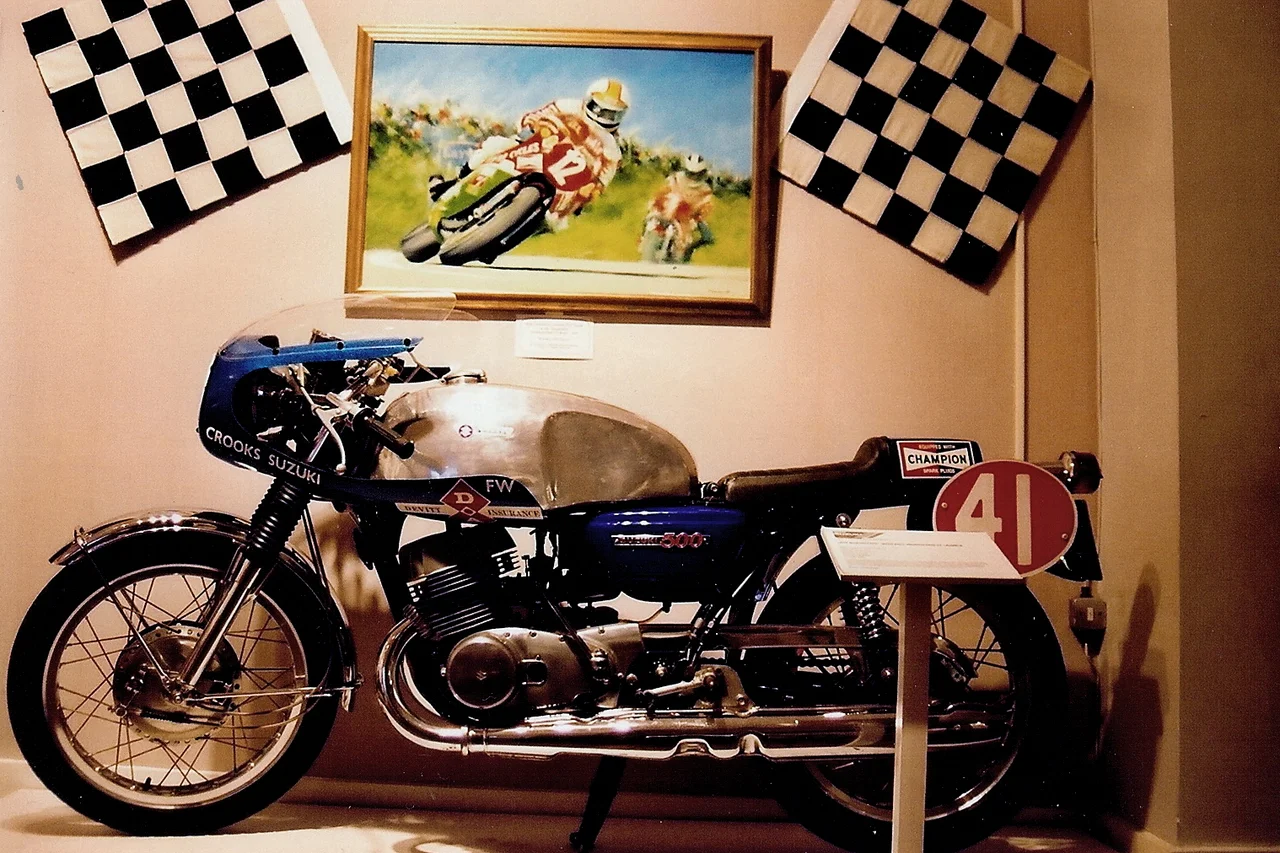
Every summer, the museum mounts an exhibition on the Isle of Man Tourist Trophy and motorcycle racing, which is the closest thing the island has to a national religion. The display has included a 1970 Suzuki T500, race-prepared by Eddie Crooks and ridden by Frank Whiteway to victory in that year's 500cc Production Class TT. Visitors stand in front of the bike, which still wears its original racing scuff marks, and look up at a large painting of Mike Hailwood and Phil Read at the 1978 TT. Other recent exhibitions have ranged further: This Terrible Ordeal explored the experience of the Manx people during the First World War, and a 2020 show celebrated the work of the British artist William Hoggatt. The museum has launched books too, including the 2008 publication of Practical Manx by Jennifer Kewley Draskau, an attempt to revive interest in the Manx Gaelic language.
How Many Visitors, Really?
In 2018, Manx National Heritage said the museum drew around 100,000 visitors a year on average. The local press disagreed. A freedom of information request from the Isle of Man Newspapers revealed the actual counted figures: 63,953 in 2015, 68,602 in 2016, and 72,661 in 2017. The trend was up, by 8,708 over three years, but still 27,339 short of the museum's stated average. MNH explained that a remodelled entrance had complicated their visitor counting, and conceded the methodology needed updating. The exchange is a small Manx story in itself: a public institution gently called to account by a local paper, the kind of correction that small places can still manage.
From the Air
Located at 54.154°N, 4.482°W on Crellin's Hill in central Douglas, a short walk from the promenade. Nearest airport is Ronaldsway (EGNS) about 8 miles southwest. The museum sits in a Victorian institutional building above the town centre, with the original Noble's Hospital structure forming the core and a 1980s extension on one side. From the air, look for the building inland from the curve of Douglas Bay, on the hillside between the promenade and the Tower of Refuge offshore.
Nearby Stories
- St Bees Lighthouse 15 km away
- Celtic Array 22 km away
- Kirkmaiden 23 km away
- Isle of Whithorn 23 km away
- Seascale Lifeboat Station 31 km away
- German submarine U-1024 36 km away
- SS Georgetown Victory 40 km away
- Blackpool Illuminations 56 km away