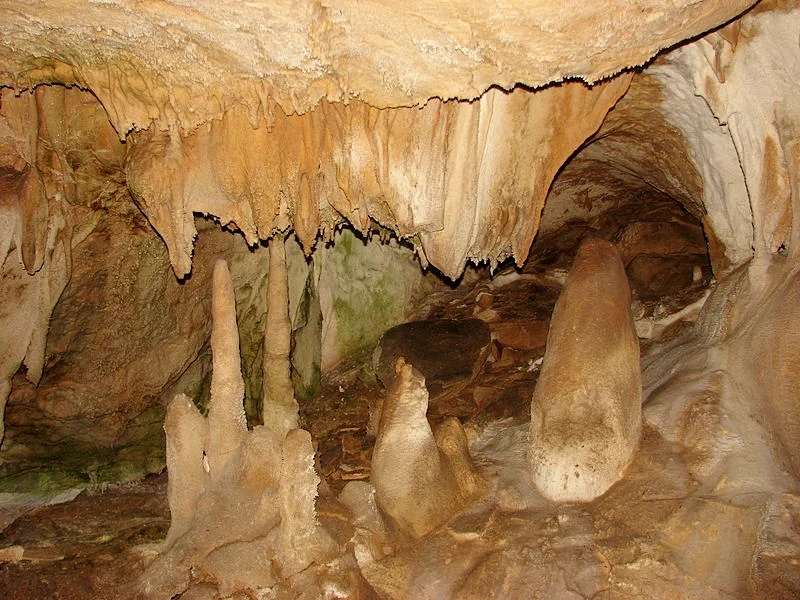

Marble Cave
In 1987, a team of cavers from Simferopol squeezed into a gap in the limestone of Chatyr-Dag and found themselves standing inside one of the most beautiful places in Crimea. What they discovered, high on the mountain's lower plateau at 920 meters, was a system of vast halls and galleries hung with stone the color of pale marble. They named it, simply, the Marble Cave. Within a few years speleologists were ranking it among the five most beautiful caves on the entire planet, and it became one of the Seven Natural Wonders of Ukraine. Few underground places on Earth were found so recently, or dressed so richly.
A Door in the Mountain
The cave sits on the lower plateau of Chatyr-Dag, wedged between two older, folklore-named caverns: Bin Bash-Koba, the Cave of a Thousand Heads, and Suuk-Koba, the Cold Cave. When the Simferopol speleology team broke through in 1987, they found chambers formed not in ordinary rock but in marble limestone, whose fine grain lends the walls their smooth, luminous quality. The name Marble stuck, though for a time the explorers also called it Afghan. This was not a ruin or an ancient site but a genuinely new discovery, a great decorated hall that had waited in total darkness for however many thousands of years it took the water to carve it, opened at last within living memory.
Halls Fit for a Palace
By 1988, a year after the discovery, the Onyx-tour center had laid concrete paths and strung lighting through the cave, turning a wild find into a walkable wonder. The route reads like a tour of an underground palace. Visitors pass through the Fairy Tale Gallery and along the Tiger Path, lined with hundreds of stalactites, then into the Reconstruction Room, the largest cave chamber in Crimea and one of the biggest developed halls in Europe, fully a hundred meters long and twenty-eight meters high. Beyond lie the Pink Room, its ceiling crowded with what look like stone roses, and the Palace Hall, guarded by two great columns nicknamed the King and the Queen. It is a sequence built for astonishment, each chamber outdoing the last.
The Room of Chandeliers
The tour's showpiece is the Luster Room, reached through what visitors call a forest of stalactites. Here the ceiling drips with dozens of formations that hang like chandeliers, their surfaces crusted with delicate coralite flowers, some so long they nearly brush the floor. This is where the public route ends, but the cave itself does not: four more chambers, named Landslide, Channel, Chocolate, and Geliktite, continue on beyond the reach of casual visitors. The recognition came quickly for such a young attraction. In 1992, just five years after its discovery, the Marble Cave was admitted to the International Association of Equipped Caves, formal acknowledgment of a place that had gone from unknown gap in the rock to world-class wonder in barely half a decade.
One of the Wonders
Fame followed fast. Speleologists came to rank the Marble Cave among the five most beautiful caves on the planet, and it was named one of the Seven Natural Wonders of Ukraine, extraordinary standing for a cavern that no one had set foot in before the late 1980s. Part of the appeal is sheer accessibility: sitting high on Chatyr-Dag, the cave is one of a cluster the mountain harbors, but its lit paths and grand halls make it the one most visitors choose, and it has become one of the most visited caves in all of Europe. There is a particular thrill in a wonder so young. Most of the world's celebrated caves were known to ancient peoples, woven into local legend over centuries. This one was found within living memory, its beauty revealed all at once, as if the mountain had been keeping a secret and finally chose to share it.
From the Air
The Marble Cave lies at 44.80 degrees north, 34.28 degrees east, on the lower plateau of the Chatyr-Dag massif at 920 meters elevation, in the Crimean Mountains between Simferopol and Alushta. From the air, the entrance is hidden, but the distinctive tent-shaped bulk of Chatyr-Dag marks the location clearly. The nearest airport is Simferopol International (ICAO UKFF), about 30 kilometers to the northwest.
Nearby Stories
- Object 100 8.1 km away
- Livadia Palace 11 km away
- Battle of the Alma 12 km away
- Novyi Svit Winery 13 km away
- Saky Air Base 16 km away
- Surp Khach Monastery 20 km away
- Taigan Safari Park 23 km away
- Abkhazia 523 km away