
Marga: Where Bali's Last Stand Became Its Founding Myth
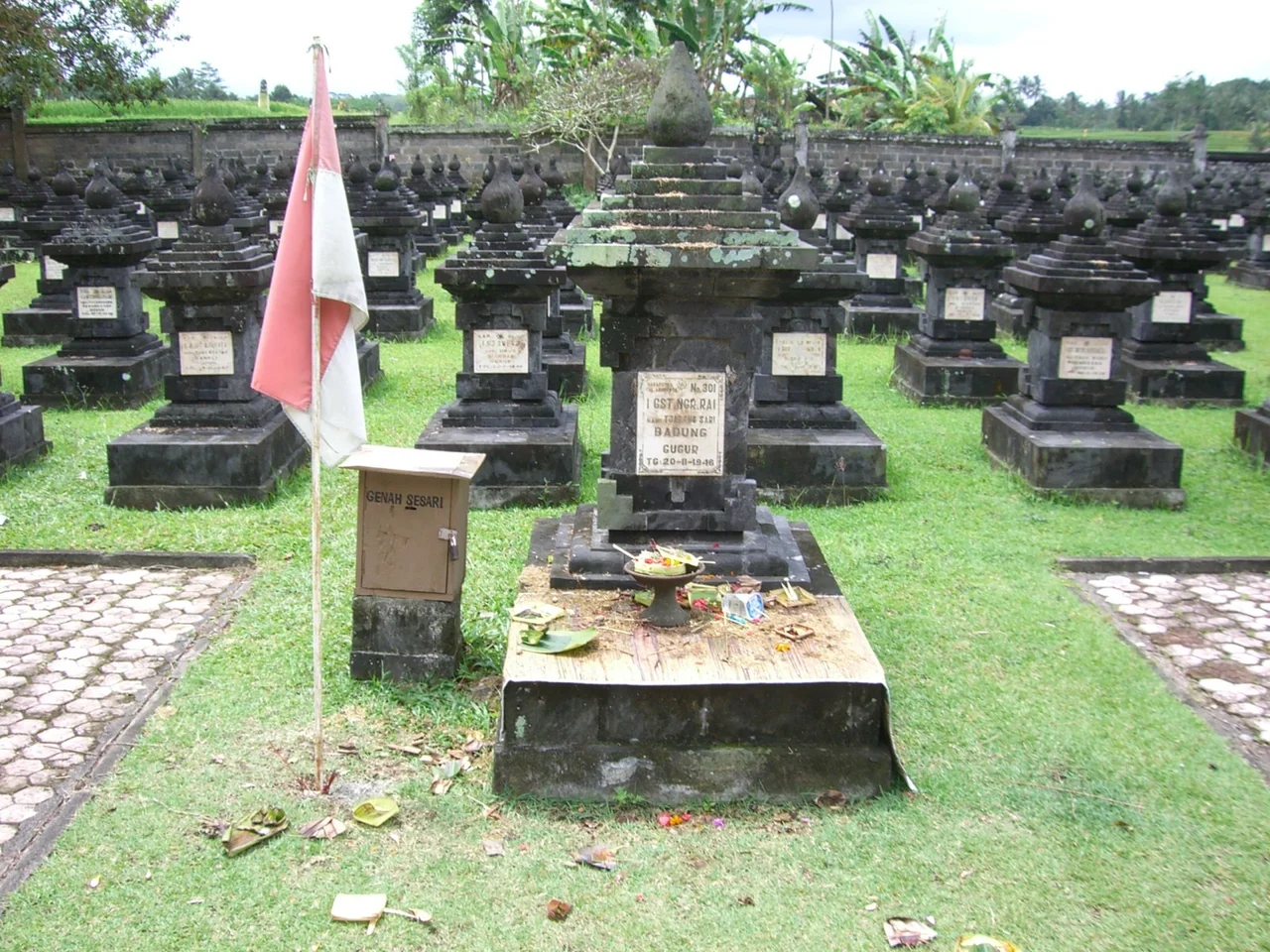
Bali's busiest airport is named after a man who died in a rice field. I Gusti Ngurah Rai never flew commercially, never saw a jet engine, never boarded an international flight. He was a 29-year-old military commander who led 96 fighters in a suicidal charge against Dutch forces on November 20, 1946, in the district of Marga. All of them died. The Balinese call what happened a puputan -- a fight to the end -- echoing the mass suicides Balinese kingdoms chose over surrender in 1906 and 1908. Today Marga is a quiet inland enclave in the Tabanan Regency, a place of fruit orchards and temple ceremonies, where the heroes' graves lie beneath frangipani trees and the nation's founding violence rests under carefully tended stone.
The Battle That Named an Airport
By late 1946, the Indonesian Revolution was grinding through its bloodiest phase. The Dutch had returned after the Japanese occupation, determined to reassert colonial control. On Bali, I Gusti Ngurah Rai assembled a guerrilla force and fought a series of engagements across the island's interior. When the Dutch cornered his unit at Marga, Rai chose the path Balinese tradition had long prepared for its leaders facing certain defeat. He ordered a puputan -- an all-out attack with no retreat, no surrender, no survival expected. Ninety-six Indonesians died in the assault, including Rai himself. The Dutch won the battle and lost the argument. Indonesia's independence, formally recognized in 1949, transformed Rai from a fallen guerrilla into a National Hero. His name went on Bali's airport, ensuring that every tourist who lands on the island steps onto ground consecrated, however unknowingly, by his sacrifice.
The Monkey Forest of Alas Kedaton
Marga's other claim on visitors is Alas Kedaton, a protected forest inhabited by hundreds of long-tailed macaques that scamper through the canopy of towering nutmeg trees. At the forest's heart sits Pura Alas Kedaton, a temple whose origins trace to Ki Gusti Ngurah Pacung, a descendant of Sri Arya Sentong who is said to have built a chain of sacred sites stretching from Nusa Penida island inland to the highland peaks. The temple complex begins at Alas Kedaton and extends through Pura Puser Tasik to Pucak Padang Dawa, tracing a spiritual axis that connects the coast to the mountains in the manner characteristic of Balinese cosmology, where altitude equals proximity to the divine. The monkeys, like those at Ubud's Sacred Monkey Forest, are both nuisance and emblem -- sacred in the landscape's eyes, opportunistic in their own.
Orchards and Irrigation
Marga produces an astonishing variety of tropical fruit. Durian, tangerine, mango, papaya, banana, starfruit, guava, mangosteen, rambutan, sapodilla, and soursop all grow in the district's volcanic soils, with guava leading production at over a thousand metric tons annually. The abundance is not accidental. Marga sits in the Tabanan Regency's fertile interior, landlocked and ringed by other districts on every side -- an exclave, technically, separated from Tabanan's coastal zone. Water flows down from the Baturiti highlands to the north through the subak irrigation channels that UNESCO recognized in 2012, feeding rice paddies and orchards alike. The name Marga itself may derive from an older Balinese term: local tradition holds that the district was originally called Urat Mara, meaning "new strength," before the name shortened to Marga after a political split in the court at Puri Perean.
Sixteen Villages, Two Systems of Governance
Modern Marga comprises sixteen villages, home to roughly 40,000 people, governed by a dual system that makes Balinese administration unique in Indonesia. Every village has a Banjar Dinas, the official government unit that handles ID cards, elections, health posts, and development programs. But alongside it operates the Banjar Adat -- the customary council that schedules temple ceremonies, organizes marriages and funerals, and maintains the ritual arts performances that define Balinese cultural life. The two systems run in parallel, one answering to Jakarta and the other to tradition. Neither supersedes the other. A villager in Cau Belayu, the district's largest village at 4.31 square kilometers, navigates both bureaucracies as naturally as breathing. This is how Bali preserves its Hindu culture within the world's most populous Muslim-majority nation: by maintaining institutions older than the republic itself.
From the Air
Marga (8.48S, 115.17E) is an inland district in Tabanan Regency, central Bali. Ngurah Rai International Airport (WADD/DPS) lies approximately 30km to the southeast with runway 09/27 (3,000m). The district sits in Bali's agricultural interior -- expect green rice terraces and dense forest canopy. Mount Batukaru (2,276m) rises to the northwest. The area is not easily distinguishable from altitude but lies between the coastal strip and the volcanic highlands. Tropical climate, wet season November-March.
Nearby Stories
- The Village That Speaks in Silence 3.5 km away
- Garuda Wisnu Kencana Cultural Park 4.1 km away
- When the Ground Moved at Dawn: Bali's 1979 Earthquake 10 km away
- The Tiger's Last Stand: West Bali National Park 17 km away
- Alas Purwo: Where Java Begins and the Surf Never Stops 24 km away
- Mandalika: The Racetrack That Summoned a Shaman 71 km away
- Forty-Five Men and Thirty-Six Depth Charges 107 km away
- The Silent Wave: Java's 1994 Tsunami Earthquake 270 km away