
Garuda Wisnu Kencana Cultural Park
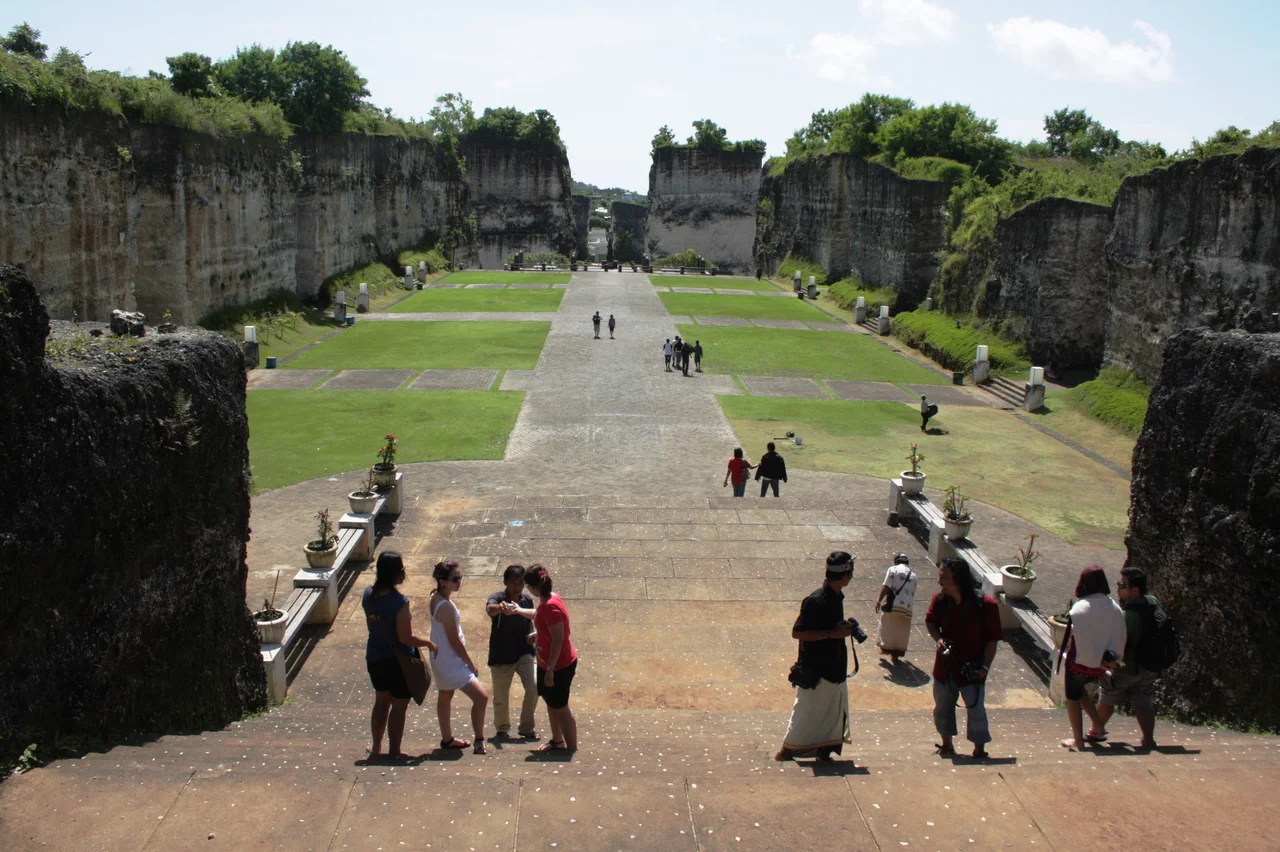
The first thing you notice is the limestone. Carved pillars rise from the ground like the ruins of a forgotten temple, stretching across more than 4,000 square meters of open space in neat, monumental rows. Between them, lotus ponds catch the equatorial light. Above it all, visible from much of southern Bali, a 121-meter copper-and-brass figure rides a mythical bird through the sky -- or appears to, frozen in mid-flight atop a hilltop pedestal. This is Garuda Wisnu Kencana Cultural Park, known simply as GWK, a 60-hectare complex perched on the limestone plateau of Ungasan in Bali's Badung regency. It sits just 10 to 15 minutes from Ngurah Rai International Airport, close enough to be convenient but elevated enough to feel removed from the coastal sprawl below.
A Myth Cast in Metal
The park takes its name from the colossal statue at its center, which depicts the Hindu god Vishnu astride Garuda, his divine mount. The story it illustrates is one of devotion and sacrifice: in Hindu mythology, Garuda agreed to carry Vishnu in exchange for the right to use Amrita, the elixir of life, to free his enslaved mother. The tale is central to Balinese Hinduism, and sculptor Nyoman Nuarta designed the statue to give it physical form on a scale that would be impossible to ignore. Standing 121 meters tall with its 46-meter pedestal, the completed monument rivals a 21-story building and weighs 4,000 tonnes -- making it the heaviest statue in Indonesia. The crown of Vishnu gleams with golden mosaics. The statue's copper and brass skin is stretched over a stainless steel skeleton and a reinforced concrete core. It was inaugurated by President Joko Widodo on September 22, 2018.
Twenty-Eight Years in the Making
The statue almost did not happen. Nyoman Nuarta conceived the design in 1990, working under the patronage of Tourism Minister Joop Ave, Energy Minister Ida Bagus Sudjana, and Governor of Bali Ida Bagus Oka. Groundbreaking came in 1997 -- just in time for the Asian financial crisis to halt construction entirely. For sixteen years the project sat dormant, the unfinished pieces a reminder of ambitions that had outrun the economy. Religious authorities on the island raised objections, too, arguing that a statue of such massive size might disrupt the spiritual balance of Bali and that its commercial nature was inappropriate for a sacred subject. Others countered that the monument would bring visitors to otherwise barren land. Construction resumed in 2013 when property developer PT Alam Sutera Realty agreed to finance the project. The statue was assembled from 754 modules fabricated in Bandung, West Java, then shipped to Bali and cut into 1,500 smaller pieces to fit the cranes. The cost reached approximately $100 million.
Where World Leaders Meet Heavy Metal
The park's Lotus Pond area, ringed by those carved limestone pillars, holds up to 7,000 people and has become one of Bali's most versatile event venues. Its guest list reflects that range. On February 20, 2011, Iron Maiden played the park's first rock concert, selling out the venue during their Final Frontier Tour. Six months later, Paramore performed the second date of their Pacific Rim Tour on the same stage. In December 2018, the Djakarta Warehouse Project -- Asia's largest electronic dance music festival -- relocated from Jakarta to GWK for its tenth anniversary, with a headlining set by the Weeknd. Then the tone shifted entirely: on November 14, 2022, President Joko Widodo hosted the leaders of the G20 nations at the Lotus Pond for the welcoming cultural dinner during the G20 Bali summit. The same plaza that had vibrated with bass drops and guitar solos served poached fish and diplomatic conversation under the gaze of Vishnu and Garuda.
The Limestone Stage
GWK's landscape is as much a part of the experience as the statue. The park occupies a former limestone quarry on the Bukit Peninsula, the southernmost point of Bali, and the quarrying exposed dramatic cliff faces and corridors that the park's designers incorporated rather than concealed. Walking between the carved pillars of Lotus Pond or through the narrow limestone canyons that surround it, visitors move through a space that feels simultaneously ancient and manufactured -- part temple complex, part geological exhibit. The Garuda Plaza, directly behind Plaza Wisnu, houses an 18-meter-tall standalone statue of the Garuda head, its fierce expression carved in detail that is easy to miss from a distance. The park's elevation above sea level provides views across southern Bali toward the ocean, and at night, a dedicated lighting system illuminates the main statue against the tropical sky, making it visible for miles.
From the Air
Located at 8.81S, 115.17E on the Bukit Peninsula at the southern tip of Bali, Indonesia. The massive GWK statue is one of the most visible landmarks on Bali from the air, rising from a limestone plateau above Ungasan. Best viewed from 2,000-4,000 feet AGL on approach to or departure from Ngurah Rai International Airport (WADD/DPS), which is only 10-15 minutes away by road. The Bukit Peninsula and the distinctive shape of Bali's southern coast provide clear visual references.
Nearby Stories
- Pura Taman Ayun: The Garden That Floats on Sacred Water 8.9 km away
- When the Ground Moved at Dawn: Bali's 1979 Earthquake 17 km away
- Alas Purwo: Where Java Begins and the Surf Never Stops 27 km away
- The Invisible Frontier: Where Asia Ends and Australia Begins 46 km away
- The Tiger's Last Stand: West Bali National Park 53 km away
- The Silent Wave: Java's 1994 Tsunami Earthquake 245 km away
- When the Towers Fell: The Waru Wora Fire 408 km away
- Sumba's Hidden Kingdom of Wings 503 km away