
Sumba's Hidden Kingdom of Wings
The Sumba hornbill announces itself before you see it. A heavy, rhythmic whooshing -- like someone swinging a blanket overhead -- fills the canopy as the bird powers through the forest on broad wings, its massive casqued bill cutting the humid air. This is one of the rarest hornbills in Indonesia, found only on the island of Sumba, and Manupeu Tanah Daru National Park is one of the last places it survives in meaningful numbers. The park sprawls across roughly 88,000 hectares of lowland forest on steep slopes that rise to about 600 meters, a green stronghold on an island increasingly converted to savanna and farmland. For birders, entomologists, and anyone drawn to landscapes that evolution forgot to standardize, this is hallowed ground.
An Island Apart
Sumba occupies a peculiar position in Indonesian geography and biology. Part of the Lesser Sunda chain in the province of East Nusa Tenggara, it sits south of Flores and west of Timor, isolated enough that its flora and fauna evolved along separate paths from its neighbors. The result is an island with an unusually high proportion of endemic species -- organisms that exist here and nowhere else on Earth. Manupeu Tanah Daru protects the largest remaining tract of lowland forest on Sumba, a habitat type that has been shrinking steadily as the island's population grows and agriculture expands. The park's terrain is steep and rugged, cut by rivers that carve deep valleys through the limestone before spilling over cliffs in spectacular waterfalls. The most famous of these, Lapopu, drops roughly 90 meters in a multi-tiered cascade that visitors reach after trekking through dense forest -- a journey that doubles as an introduction to the park's extraordinary biodiversity.
The Birds That Belong to No Other Place
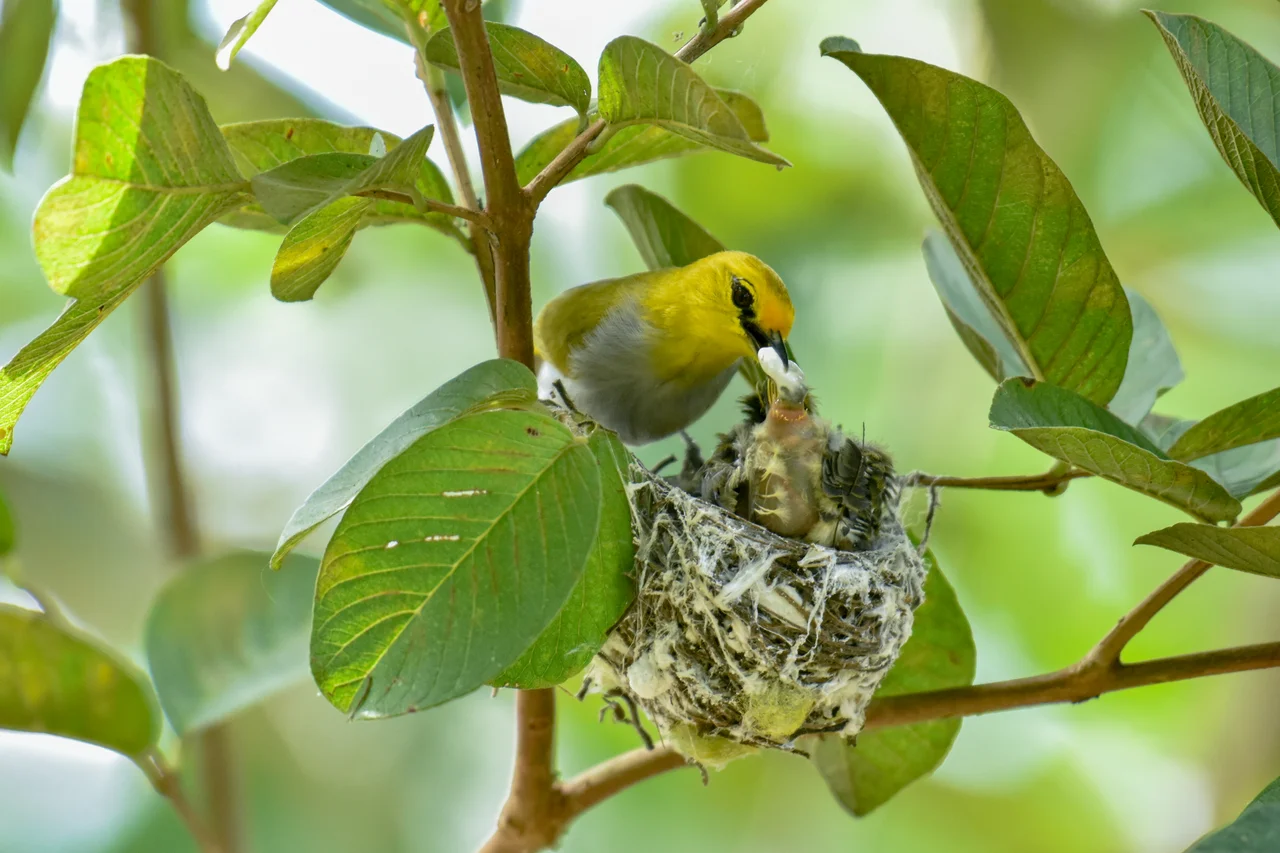
Seven bird taxa are endemic to Sumba, and Manupeu Tanah Daru shelters all of them. The yellow-crested cockatoo -- the Sumba subspecies, with its lemon-colored crest and ear-splitting call -- is critically endangered, its numbers diminished by decades of capture for the pet trade. The Sumba green pigeon moves through the canopy in flocks, feeding on fruit with a quiet efficiency that makes it easy to overlook until a shaft of light catches its iridescent plumage. The Sumba flycatcher, the Sumba cicadabird, and the apricot-breasted sunbird round out a list that reads like a birder's fever dream. In total, 87 bird species receive protection within the park's boundaries. But it is the hornbill that draws the most attention -- partly for its size, partly for its rarity, and partly because watching one fly overhead, its wingbeats audible from a hundred meters away, is the kind of experience that rearranges your sense of what a forest can contain.
A Lepidopterist's Paradise
Birds get the headlines, but the butterflies of Manupeu Tanah Daru are equally remarkable. Fifty-seven species are protected within the park, and seven of those are endemic to Sumba. Papilio neumoegenii, a swallowtail with dark wings marked by pale crescents, is one of the most sought-after by collectors -- which is precisely why it needs a national park. The delicate Delias fasciata, with its red and white underwings, flickers through forest clearings like a living flame. Ideopsis oberthurii, Junonia adulatrix, Athyma karita, Sumalia chilo, and Elimnia amoena complete the endemic roster, each adapted to the specific conditions of Sumba's forests -- the humidity, the altitude, the particular mix of flowering plants that sustain them. These are not charismatic megafauna. They will never appear on a tourism poster. But their existence in a single place, found nowhere else, makes this park a conservation site of global significance.
The Forest Itself
About 118 plant species are protected within Manupeu Tanah Daru, forming the foundation on which everything else depends. Toona sureni, a valuable timber tree, grows alongside the pungent Sterculia foetida -- whose name warns of its smell -- and the lac-producing Schleichera oleosa. Tamarind and candlenut trees provide food for both wildlife and the local communities that border the park. Casuarina species, with their needle-like leaves, stabilize slopes and riverbanks. Invasive Lantana camara, an aggressive shrub from the Americas that has colonized disturbed areas throughout the tropics, poses an ongoing management challenge. Beyond the cataloged species, the forest floor supports medicinal herbs used by Sumbanese communities for generations, and rare orchids cling to the trunks of canopy trees in the park's more humid valleys. Long-tailed macaques swing through the mid-story, and Timor deer -- introduced but now well established -- move through the undergrowth at dawn and dusk.
Waterfalls and Sacred Water
The park's rivers do not merely drain the landscape; in Sumbanese culture, they carry spiritual significance. Matayangu Waterfall, which plunges roughly 100 meters over unusual rock formations deep in the park's interior, is considered a sacred site -- a place where ancestors dwell. Reaching it requires a trek through savanna and forest that can take hours, a journey that filters out casual visitors and rewards those who persist with a cascade of extraordinary power and beauty. Lapopu Waterfall, more accessible and better known, offers a 90-meter stair-step descent surrounded by forest so dense the sunlight arrives green-filtered and softened. These waterfalls are not tourist attractions in the conventional sense. There are no handrails, no gift shops, no interpretive signs. They are pieces of a landscape that remains, in many stretches, as wild and unmediated as anything in Indonesia -- which is exactly what makes Manupeu Tanah Daru worth protecting.
From the Air
Located at approximately 9.73S, 119.68E in the central-western part of Sumba island, East Nusa Tenggara province, Indonesia. The nearest airport is Tambolaka/Lede Kalumbang Airport (ICAO: WATK, IATA: TMC) in southwestern Sumba, approximately 40 km to the west. From the air, the park is identifiable as a large swathe of dense green forest amid Sumba's otherwise dry, brown savanna landscape. Steep terrain with river valleys and visible waterfalls. Best viewed at 3,000-5,000 feet AGL. Look for the contrast between forested park boundaries and surrounding agricultural land.
Nearby Stories
- Sumba's Hidden Canopy 52 km away
- Flight 6715: Vanished Over the Molo Strait 86 km away
- Liang Bua: The Cave That Rewrote Human History 109 km away
- Wae Rebo: Seven Houses Above the Clouds 142 km away
- The Island That Shook the World 154 km away
- The Lotus That Broke: Cyclone Seroja's Path Across Two Nations 167 km away
- The Day the Earth Lost Its Summer 212 km away
- The Silent Wave: Java's 1994 Tsunami Earthquake 696 km away