
Sumba's Hidden Canopy
The citron-crested cockatoo announces itself before you see it -- a flash of sulfur-yellow crest through dark canopy, then a shriek that carries across the valley. This subspecies exists nowhere else on the planet outside the island of Sumba, and Laiwangi Wanggameti National Park is one of its last strongholds. Established in 1998, the park covers the mountainous interior of eastern Sumba, protecting a landscape that compresses every forest type found on the island into a single contiguous reserve: from lowland monsoon forest through tropical evergreen to montane cloud forest at the highest elevations.
An Island Unto Itself
Sumba sits apart from the rest of the Indonesian archipelago in ways that transcend geography. Located south of the main island chain, separated from Flores by the Sumba Strait, the island developed its own ecological character. The flora of Laiwangi Wanggameti reflects this isolation. Cinnamon trees share the canopy with towering Alstonia scholaris, their white wood traditionally used for coffins and ceremonial carvings. Ficus species anchor the forest's architecture, their aerial roots creating natural colonnades. Wild nutmeg, sandalwood, and the oil-producing Schleichera oleosa grow in the understory. This botanical diversity is not a manicured garden but a functioning ecosystem where each species fills a niche shaped by Sumba's unique combination of monsoon climate, limestone geology, and oceanic isolation.
The Birders' Pilgrimage
Ornithologists have been drawn to Sumba since the mid-eighteenth century, though their visits have been sporadic and often separated by decades of silence. The naming of the citron-crested cockatoo by Fraser in 1844 and the Sumba eclectus parrot by Bonaparte in 1853 established that the island held species found nowhere else. Ernst Mayr, the legendary evolutionary biologist, documented 121 bird species on Sumba before Indonesian independence. Then ornithological interest effectively ceased for thirty years. It was not until 1979 that John MacKinnon resumed systematic bird surveys, producing the first modern species lists. Today, the park shelters an extraordinary concentration of endemic and threatened species: the purple-naped lory, the Sumba green pigeon, the Sumba buttonquail, the Sumba flycatcher, the Sumba cicadabird, and the apricot-breasted sunbird, whose iridescent throat catches the light like hammered copper.
Creatures of the Forest Floor
The birds get the attention, but the forest floor tells its own story. Crab-eating macaques move through the lower canopy in troops, their social hierarchies playing out in a landscape far removed from the mainland populations that gave them their common name. Water monitors -- the large, muscular lizards that can grow over two meters long -- patrol riverbanks and forest edges, their forked tongues tasting the humid air. The Timor python, a species restricted to the Lesser Sunda Islands, hunts in the undergrowth. Wild pigs root through the leaf litter. This ground-level ecosystem operates largely unseen beneath the canopy that attracts birdwatchers, a parallel world where predator and prey negotiate the same ancient terms they always have.
Between the Monsoons
Sumba's climate divides the year into wet and dry with little subtlety. The monsoon rains drench the island from November through March, swelling rivers and turning forest trails to mud. The dry season that follows can be punishing, and the forest types within Laiwangi Wanggameti reflect this seasonal extremity. Deciduous monsoon forest dominates the lower elevations, trees shedding their leaves during drought months to conserve water, the forest floor briefly opened to sunlight. Higher up, tropical evergreen forest maintains its canopy year-round, fed by moisture trapped against the mountain slopes. At the highest points, cloud forest persists in a permanent state of dampness, moss draping from branches and epiphytes colonizing every available surface. Walking uphill through the park is walking through climate zones compressed into a few kilometers of elevation gain.
Remote by Any Measure
Laiwangi Wanggameti does not appear on most tourist itineraries, and this remoteness is both its vulnerability and its protection. Sumba remains one of Indonesia's less-visited islands, better known for its traditional textile arts and annual Pasola horseback jousting festivals than for its national parks. The infrastructure around the park is minimal. Researchers who do make the journey often find themselves retracing paths that have gone unwalkled since the last expedition, sometimes years earlier. Yet the park's obscurity has spared it the pressures facing more accessible Indonesian reserves. The forests here have not been carved up by palm oil plantations or logged for export. What the citron-crested cockatoo needs most is what Sumba's remoteness provides: a place where the canopy remains unbroken and the loudest sound is still the shriek of a bird that exists nowhere else.
From the Air
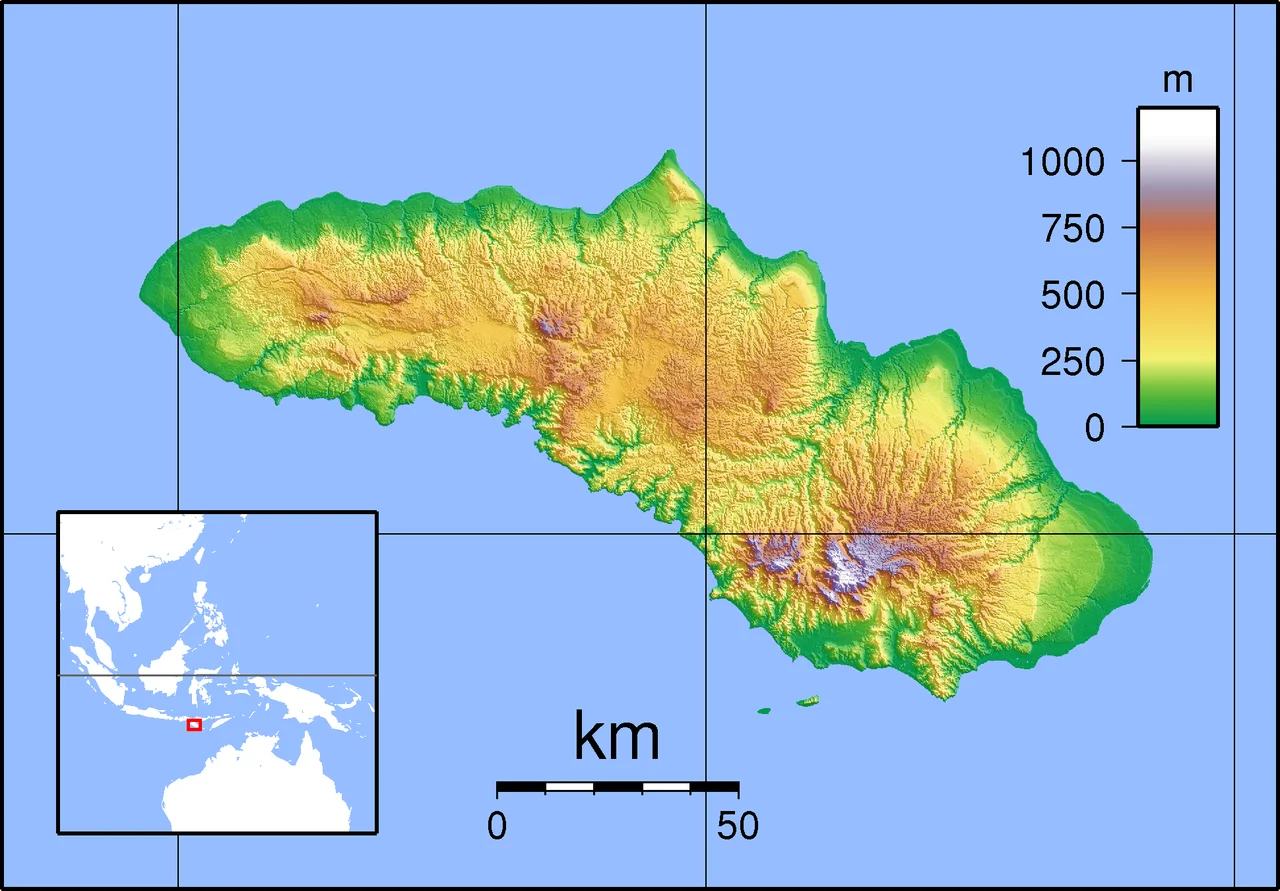
Located at 10.07°S, 120.18°E in the mountainous interior of eastern Sumba Island, Indonesia. From altitude, the park's dense forest cover contrasts sharply with the drier, more open landscape surrounding it. The terrain is rugged and elevated, rising to the island's highest points. Nearest airport is Umbu Mehang Kunda Airport (WRRW) in Waingapu, approximately 30 nm to the north. Tambolaka Airport (WRRA) lies on Sumba's western coast, roughly 80 nm to the west. The island sits south of Flores, separated by the Sumba Strait.
Nearby Stories
- Sumba: The Sandalwood Island 14 km away
- When the Towers Fell: The Waru Wora Fire 24 km away
- The Lotus That Broke: Cyclone Seroja's Path Across Two Nations 113 km away
- Where the Hobbits Grew Small: The Fossils of Mata Menge 139 km away
- Ordinary Hunger: Life on Savu Island 146 km away
- Dragon Island: Where Monsters Are Real 170 km away
- Indonesia's Southern Frontier: Rote Island 337 km away
- The Silent Wave: Java's 1994 Tsunami Earthquake 732 km away