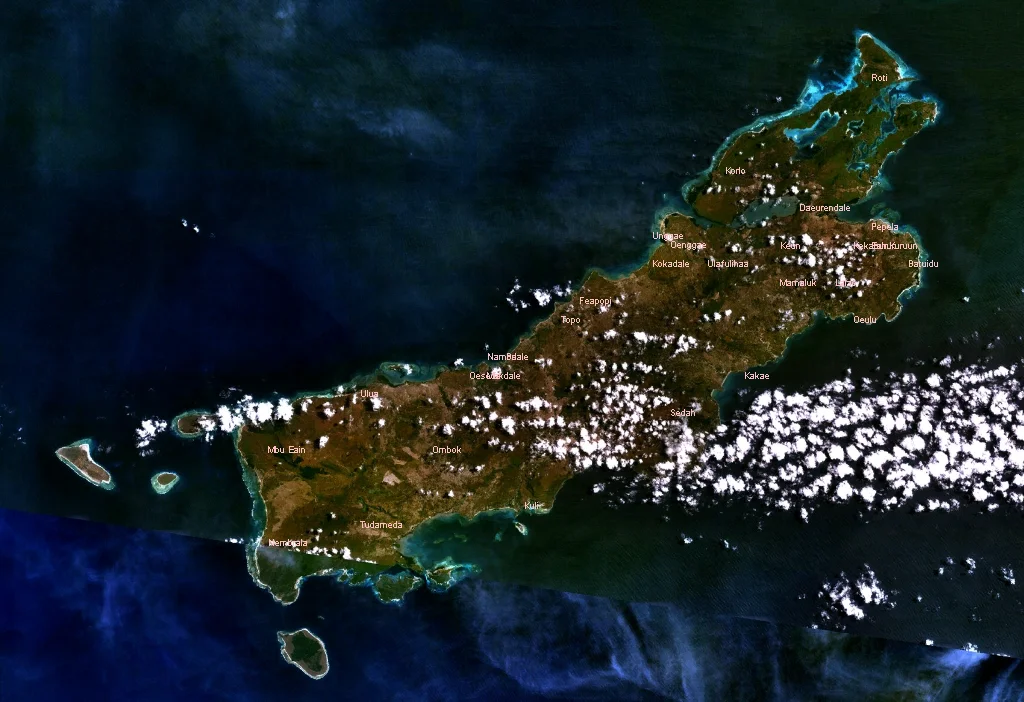
_123.05527E_10.71620S.png)
Indonesia's Southern Frontier: Rote Island
According to legend, the island got its name by accident. A lost Portuguese sailor stumbled ashore and asked a farmer where he was. The farmer, who spoke no Portuguese, simply introduced himself: Rote. Whether the story is true hardly matters -- it captures something essential about a place that has always existed on the margins of larger powers' maps, noticed mainly by those who arrive unintentionally or are looking for something specific. Rote is the southernmost inhabited island in the Indonesian archipelago, closer to Australia than to Jakarta, a place where seven distinct languages are spoken across rolling hills of savanna and lontar palm. Just off its southern tip, the uninhabited island of Pamana marks the absolute southern boundary of a nation of 17,000 islands.
The Youngest Stone in the Arc
Rote is the youngest island of the Banda Fore Arc, an accretionary wedge formed where the Australian continental shelf grinds beneath the Banda Arc. As the Australian Plate subducts, marine sediment is scraped onto the upper plate and slowly lifted above sea level. Most of this wedge remains submarine, but fragments have broken the surface to form Sumba, Savu, Timor, and -- most recently in geological terms -- Rote. Researchers have dated the island's emergence by studying the biostratigraphy of foraminifera, microscopic organisms whose calcite shells accumulated in thick layers of chalk on the deep seafloor before being pushed upward. The Batu Putih Formation, a chalk deposit hundreds of meters thick, is now exposed at Rote's surface -- a reminder that the ground beneath your feet was once the bottom of a deep ocean. The island continues to rise, millimeter by millimeter, squeezed between two plates that show no sign of reaching an agreement.
The Palm That Sustains
Life on Rote has always revolved around the lontar palm. The Rotinese depend on it not merely as one resource among many but as the foundation of survival, supplemented by fishing and small-scale agriculture. The island's climate is harsh for farming: tropical savanna with dry winds from mainland Australia dominating most of the year. Between 80 and 95 percent of annual rainfall arrives during the west monsoon from November to March, and during the long dry season streams and rivers vanish entirely. Wells become the sole water source. Mean annual rainfall runs between 1,200 and 1,300 millimeters -- enough to sustain grassland and palms but barely enough for reliable agriculture. The Rotinese adapted by building their economy around what the landscape reliably produces rather than fighting it for crops it cannot consistently support. Fishing provides protein, particularly from the eastern village of Papela, whose fishermen have historically ranged so far south that they've sparked diplomatic disputes with Australia over fishing rights in the waters between the two nations.
Horns, Drums, and Seven Tongues
Rote's cultural identity is unmistakable, literally worn on its inhabitants' heads. The ti'i langga, a traditional hat with a distinctive horn-like protrusion at the top, is the symbol of Rotinese identity -- visible in photographs dating back to the nineteenth century, worn by rajas and drummers alike. The island's cultural diversity runs deeper than a single symbol, though. Seven distinct languages are spoken across Rote: Bilba, Dengka, Lole, Ringgou, Dela-Oenale, Termanu, and Tii, all related to the languages of nearby Timor. This linguistic richness on an island of roughly 144,000 people reflects centuries of semi-autonomous kingdoms that maintained distinct traditions even as they shared the same narrow landscape. About 80 percent of Rote's population is Christian, a legacy of Portuguese and Dutch colonial contact. The sasando, a stringed instrument made from lontar palm leaves, is the island's most famous musical export -- a sound as distinctive as the ti'i langga's silhouette, built from the same palm that feeds and shelters the people who play it.
Waves at the Edge of the Map
Rote has drawn a new kind of visitor in recent decades. The village of Nembrala, on the island's southern coast, sits in front of surf breaks that rank among the best in Southeast Asia -- long, consistent lefts that peel across shallow reef in water so clear you can see the coral from the lineup. The island's remoteness, which kept it off the radar of mass tourism, became its selling point for surfers willing to make the journey. Beyond the waves, Rote offers an archipelago of 96 small islands, only six of them inhabited, with white-sand beaches and reef systems largely untouched by development. In the eastern part of the island, a pond in Landu Village contains non-poisonous jellyfish -- a phenomenon found in only a handful of locations worldwide. The island also holds historical relics including antique Chinese porcelain, evidence of centuries of maritime trade that connected this remote outpost to the wider world. Wings Air operates daily flights from Kupang's El Tari International Airport to Rote's David Constantijn Saudale Airport, a 30-minute hop that bridges the gap between Timor and Indonesia's southernmost frontier.
The Turtle and the Tectonic Squeeze
Rote's most famous non-human resident is also its most endangered. The Rote Island snake-necked turtle, found nowhere else on Earth, is critically endangered -- a victim of habitat loss and the illegal pet trade that prizes its unusual appearance. The turtle's survival is bound to the same freshwater lakes and streams that the Rotinese depend on, water sources that shrink to almost nothing during the dry season. Conservation efforts face the challenge common to remote islands: resources are scarce, enforcement is difficult, and the local population has its own pressing needs. Yet Rote's ecological significance extends beyond a single species. The island sits within the broader Sawu Sea Marine National Park, one of the richest marine ecosystems in Indonesia, where coral reefs, sea turtles, and migrating whales pass through waters warmed by equatorial currents and churned by the same tectonic forces that continue to push Rote, millimeter by millimeter, toward the sunlight.
From the Air
Rote Island is located at approximately 10.74S, 123.12E, the southernmost inhabited island of Indonesia. It is clearly visible from cruising altitude as a low, elongated landmass south-southwest of Timor. David Constantijn Saudale Airport (WATO) on Rote serves daily Wings Air flights to/from Kupang's El Tari International Airport (WATT), a 30-minute flight to the northeast. The Savu Sea lies to the north, the Timor Sea to the south, and Australia is 500 km to the southeast. The uninhabited Pamana (Ndana) Island, just south of Rote, marks the southernmost point of Indonesia. Weather is tropical savanna with a pronounced dry season; best visibility April-October.
Nearby Stories
- Kupang 58 km away
- Ordinary Hunger: Life on Savu Island 93 km away
- Ashmore and Cartier Islands 133 km away
- The Lotus That Broke: Cyclone Seroja's Path Across Two Nations 152 km away
- Montara Oil Spill 205 km away
- The Lakes Where Souls Go to Rest 247 km away
- Mungalalu Truscott Airbase 463 km away
- Wakatobi: Four Islands, One Name 557 km away