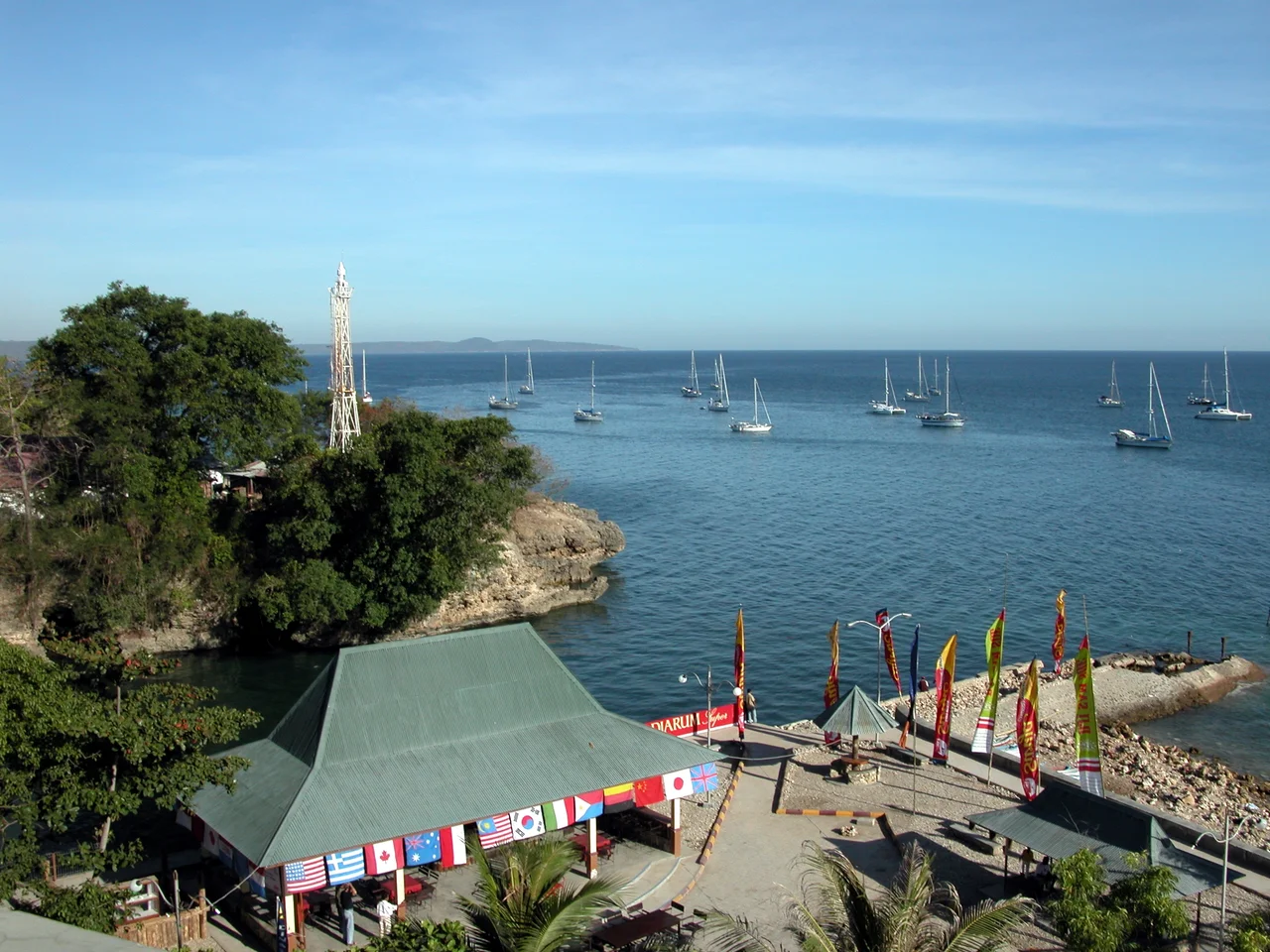

Kupang
After 41 days adrift in an open boat, having been cast off by mutineers 3,618 nautical miles away near Tonga, William Bligh saw land. It was June 14, 1789, and the land was Kupang -- a Dutch trading post on the parched southwestern tip of Timor, about as far from England as a man could get. Bligh's arrival after the Mutiny on the Bounty would make Kupang briefly famous. But the town at the edge of the Savu Sea had been drawing desperate arrivals long before Bligh, and it would keep doing so long after. For four centuries, this small port city has been a hinge point -- between Dutch and Portuguese empires, between Asia and Australia, between the island's contested halves. Today Kupang is the capital of East Nusa Tenggara province, home to nearly half a million people, and still the closest large Indonesian city to the Australian coast.
Fort Concordia and the Struggle for Timor
Kupang's strategic value was obvious to every empire that encountered it. Sitting at Timor's southwestern tip, the town commanded views of shipping lanes along the island's southern coast, while the Koinino River supplied fresh water. The Dutch East India Company first arrived in 1613, striking a deal with the local Helong raja, but Portuguese influence -- channeled through the Topasses, a mixed-heritage community of 'Black Portuguese' -- kept Kupang in contested limbo for decades. In January 1653, the VOC finally built Fort Concordia on an elevated bank above the river estuary, and Kupang became the base for Dutch operations against the Portuguese. The decisive moment came in 1749, when the Topasses were crushed at the Battle of Penfui on the hillside just east of town. After that, VOC influence spread across western and central Timor, Chinese merchants settled into the local economy, and Kupang evolved from a frontier fort into something resembling a colonial capital.
Refuge at the World's Edge
Kupang's remoteness made it a destination for the desperate. Bligh's epic voyage across the open Pacific remains the most famous arrival, but it was not the last. Inspired by news of Bligh's journey, nine convicts and two children escaped from the penal colony at Sydney Cove in Australia and sailed an open boat 3,254 nautical miles over ten weeks to reach Kupang. The town also absorbed waves of refugees closer to home -- groups from the Sonbai and Amabi principalities fleeing Portuguese and Topass aggression settled around Kupang in the 1650s and 1680s, forming small polities on Helong land. The Amfoang and Taebenu followed. By the nineteenth century, Kupang had attracted British and North American whalers, drawn by the free port status declared in 1866, though the whaling trade faded as hunting grounds shifted. Through it all, the Helong raja remained the ceremonial 'Lord of the Land,' even as real power rested with the Dutch.
Bombed, Occupied, Reborn
The twentieth century brought upheaval. Kupang served as a refueling stop for long-distance flights between Europe and Australia -- a stepping stone in the age of aviation pioneering. Then came the Japanese, who occupied the city from 1942 to 1945. Allied bombing destroyed much of Old Town Kupang, erasing colonial-era buildings that had stood for centuries. After the war, the city passed through a rapid series of political identities: part of the Dutch-created State of East Indonesia in 1946, absorbed into the United States of Indonesia in 1949, then folded into the Republic of Indonesia in 1950. In 1967, Kupang became the seat of a Catholic diocese, elevated to an archdiocese in 1989 -- a reflection of the city's distinctive religious character. Unlike most Indonesian cities, Kupang is predominantly Protestant, with over 326,000 Christians forming the majority in a nation where Islam predominates.
A City of Arrivals
Modern Kupang is a multi-ethnic boomtown whose population grew 31 percent between 2010 and 2020, reaching roughly 443,000. Young migrants from across East Nusa Tenggara pour in for education and work -- the dominant age group is 20 to 24. The economy has shifted decisively from agriculture to services, which now account for nearly half the city's output and employ almost 80 percent of its workforce. Agricultural land shrank by 41 percent in a single year between 2018 and 2019. Three cement plants operated by PT Semen Kupang produce about 250,000 tons annually, though the province and neighboring East Timor need more than seven times that amount. Grab and Gojek ride-hailing apps have arrived. The city's 327 churches and 69 mosques stand alongside seven Hindu temples and a Chinese Buddhist temple, a mosaic of faiths that mirrors Kupang's history as a place where cultures collide and coexist.
Living with Cyclones and Dry Seasons
Kupang's climate is extreme by Indonesian standards. The city receives a tropical savanna classification, with monsoon rains dumping 386 millimeters in January and then virtually nothing -- just 2 millimeters -- in August and September. The contrast shapes daily life, agriculture, and the dusty landscape visible from the air during the long dry season. In April 2021, Tropical Cyclone Seroja -- a rare and powerful storm for this latitude -- battered Kupang for nine consecutive hours, causing heavy damage across the city. The cyclone was a reminder that this corner of Indonesia, closer to Australia than to Jakarta, plays by different meteorological rules. At just 62 meters above sea level at its highest point, built on non-volcanic soils of Latosol and Terra rossa, Kupang sits low and exposed on Timor's arid coast -- a city shaped as much by what the sky withholds as by what it delivers.
From the Air
Located at 10.16°S, 123.58°E on the southwestern tip of Timor island. El Tari International Airport (ICAO: WATT) serves the city and is visible as the main aviation landmark. Kupang sprawls along the coast facing the Savu Sea to the north. The terrain is flat to gently rolling, arid savanna -- noticeably drier than most of Indonesia. Look for the port facilities along the waterfront and the urban area extending inland. Australia lies approximately 680 km to the south across the Timor Sea. The East Timor border is about 150 km east. Recommended viewing altitude: 3,000-6,000 feet for city layout and coastal geography.
Nearby Stories
- Indonesia's Southern Frontier: Rote Island 65 km away
- Ordinary Hunger: Life on Savu Island 133 km away
- The Night the Mountain Fell into the Sea 139 km away
- The Husband Who Will Not Be Quiet 149 km away
- Solor: The Island That Empires Fought Over and Forgot 182 km away
- Montara Oil Spill 270 km away
- Mungalalu Truscott Airbase 507 km away
- The Banda Sea: Where Continents Collide 605 km away