.jpg)
The Husband Who Will Not Be Quiet
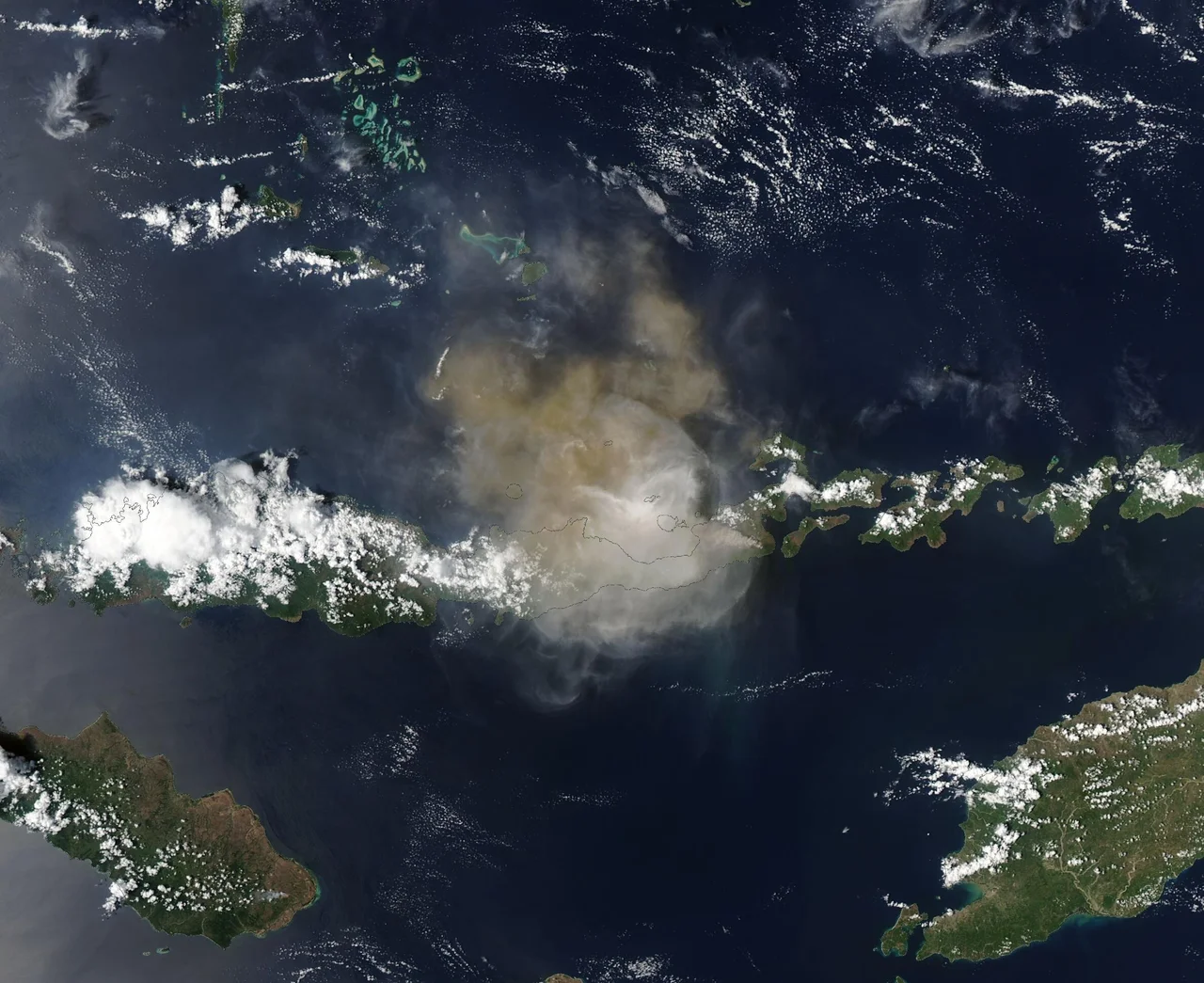
The people of eastern Flores call them husband and wife. Lewotobi Perempuan, the female peak, rises to 1,703 meters and has erupted only twice in recorded history. She is the quiet one. Her partner, Lewotobi Laki-laki, stands shorter at 1,584 meters but compensates with restless, sometimes violent energy. He has erupted repeatedly since the nineteenth century, and in 2024 and 2025 he turned genuinely dangerous, sending ash columns ten kilometers into the sky, killing nine people, and disrupting air travel as far away as Bali. The Wulanggitang communities who live in the volcano's shadow perform the Tuba Ile ceremony to honor the mountain couple, blending ancestral custom with Catholic prayer. Lately, the husband has given them much to pray about.
A Marriage Written in Stone
Lewotobi's twin peaks are stratovolcanoes built from alternating layers of lava, ash, and volcanic debris, rising from the southeastern corner of Flores along the Lesser Sunda Islands volcanic arc. The arc exists because the Indo-Australian Plate is diving beneath the Eurasian Plate, generating the heat and pressure that feeds Indonesia's chain of volcanoes. Lewotobi Laki-laki and Lewotobi Perempuan stand less than two kilometers apart along a northwest-southeast line, their summits so close that from a distance they appear as a single mountain with two heads. Older European maps labeled the complex Lobetabi or Loby Toby. A prominent flank cone, Lewotobi Iliwokar, sits on the eastern side of the female peak, a geological footnote to a landscape dominated by the main pair.
The Restless Husband
Lewotobi Laki-laki has been frequently active since at least the nineteenth century, producing explosive and effusive eruptions that have generated ash plumes, lava flows, and pyroclastic surges. His taller wife has erupted only twice in historical time. This asymmetry is part of what makes the local naming so apt: in the cultural imagination of eastern Flores, the male volcano is the one who cannot sit still. The imbalance is also geological. The male peak's magma supply appears more connected to active conduit systems, while the female peak's plumbing has largely sealed itself. Whether Lewotobi Perempuan's quiet reflects dormancy or the slow accumulation of future violence is a question volcanologists cannot yet answer with certainty.
November 2024: The Escalation
On November 4, 2024, Lewotobi Laki-laki spewed molten debris onto several villages, destroying homes and killing nine people. The Centre of Volcanology and Geological Hazard Mitigation recommended evacuating a wide radius around the summit. Seven villages were affected. Three days later, a larger eruption followed. On November 8, the volcano erupted multiple times, sending an ash plume to a height of 10 kilometers. The next day, authorities scrambled to evacuate approximately 16,000 people from surrounding communities. The eruptions disrupted flights in Bali, more than 500 kilometers to the west, and forced the cancellation of a jazz festival in Labuan Bajo. What had been a regional concern became a national one.
2025: A Volcano That Would Not Stop
The eruptions continued into 2025 with increasing frequency. On March 21, Lewotobi Laki-laki sent ash clouds soaring, prompting authorities to raise the alert to Indonesia's highest volcanic level. Jetstar canceled flights to Bali. Ngurah Rai International Airport remained open, but seven international flights were scrubbed. Further eruptions struck on May 18, June 17, and then catastrophically on July 7, when two major blasts ejected debris far from the crater and produced pyroclastic flows. At least 24 flights were canceled in Bali. An eruption on August 2 sent volcanic material high into the atmosphere. Seismic monitors recorded tremors that ranked the eruption among Indonesia's most significant since Mount Merapi's major eruption in 2010. The husband, it seemed, had no intention of settling down.
Living Beside the Couple
For the communities of eastern Flores, Lewotobi is not an abstraction. Families farm its slopes. Children attend schools within the evacuation zone. The Wulanggitang people maintain the Tuba Ile ceremony, a ritual that acknowledges the volcanoes as living presences deserving of respect and offering. The ceremony blends elements of pre-Christian ancestral tradition with Catholic faith, a synthesis characteristic of Flores, where Portuguese missionaries arrived centuries ago but never fully displaced older beliefs. Evacuations disrupt everything: livelihoods, education, the rhythms of daily life. Yet people return when the alert levels drop, because the volcanic soil is rich, because the community is rooted here, because the mountain couple is theirs. The husband may rage, but the marriage endures.
From the Air
Lewotobi (8.53S, 122.77E) is a prominent twin-peaked volcanic complex in southeastern Flores, with summits at 1,584 m (Laki-laki) and 1,703 m (Perempuan). The twin peaks are clearly visible from the air, separated by less than 2 km. CRITICAL: Check NOTAMs before flying near Lewotobi. The volcano has been in an active eruption cycle since late 2024, with ash plumes reaching 10 km or higher. Eruptions have disrupted flights as far as Bali (WADD), over 500 km to the west. The nearest airport is Frans Seda Airport (WATG) near Maumere. Avoid the volcanic hazard zone and maintain awareness of ash advisories across the eastern Indonesian archipelago.
Nearby Stories
- The Night the Mountain Fell into the Sea 14 km away
- Five Minutes After the Shaking Stopped 50 km away
- The Month the World Didn't Know 97 km away
- Kupang 154 km away
- Lesser Sunda Islands 172 km away
- Ordinary Hunger: Life on Savu Island 202 km away
- The Bluff That Worked and the Storm That Didn't Care 240 km away
- Wakatobi: Four Islands, One Name 306 km away