
The Lakes Where Souls Go to Rest
Every August 14, the Lio people of central Flores climb the slopes of Mount Kelimutu carrying pork, betel nuts, and rice to feed the spirits of their ancestors. They leave offerings on ceremonial rocks beside crater lakes that may have changed color since their last visit. The lakes do this constantly and without warning: a pool that was turquoise last month might be rust-red today, or bottle-green, or ink-black. Scientists explain the shifts through oxidation-reduction chemistry and subaqueous volcanic venting. The Lio have a different explanation. These are the lakes where souls go after death, and the colors reflect the moods of the dead.
Three Waters, Three Fates
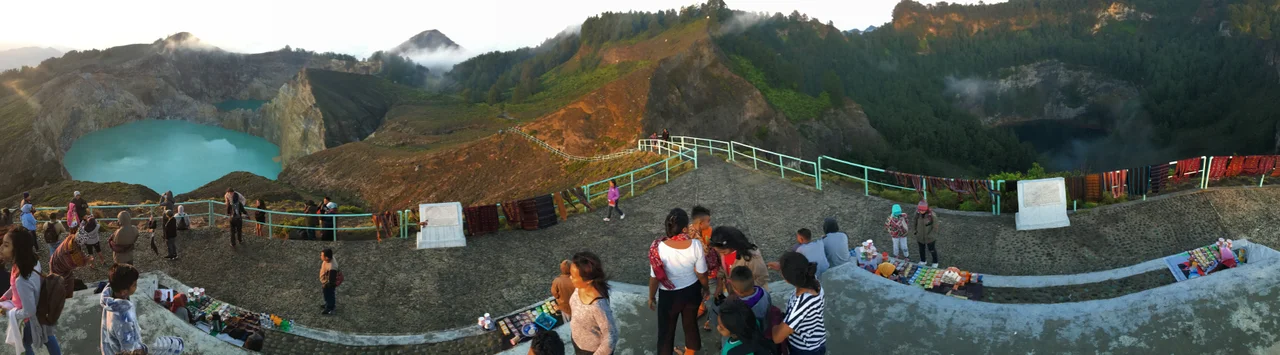
Mount Kelimutu stands 1,639 meters above sea level, roughly 50 kilometers east of Ende on the island of Flores. Its summit holds three volcanic crater lakes, each with its own name and spiritual purpose. Tiwu Ata Bupu, the Lake of Old People, sits on the western side and is usually blue. To the east, separated by a thin shared crater wall, lie Tiwu Ko'o Fai Nuwa Muri, the Lake of Young Men and Maidens, and Tiwu Ata Polo, the Bewitched Lake. The Lio believe that when a person dies, their soul migrates to the lake that matches their life. The elderly go to the cold waters of Tiwu Ata Bupu. The young find warmth in Tiwu Ko'o Fai Nuwa Muri. And the wicked are consigned to Tiwu Ata Polo, the enchanted lake, where the water frequently turns a deep, unsettling red.
The Chemistry of Color
What makes the lakes change is both mundane and remarkable. Volcanic vents on the lake floors release gases and minerals into the water, altering concentrations of iron, manganese, and other elements. As these concentrations shift, so does the oxidation state of the water, which determines its color. Iron-rich water turns red or brown. Dissolved minerals in different ratios produce greens, blues, whites, and blacks. The two eastern lakes, despite being separated by a crater wall just meters wide, often display completely different colors simultaneously. One might glow emerald while the other broods in dark chocolate. The first recorded eruption at Kelimutu occurred in 1865 and lasted more than five years. The most recent volcanic activity, a series of minor phreatic explosions, took place in June and July of 1968. Since then, the volcano has been quiet, but the lakes continue their restless transformations.
A Park of Hidden Life
Kelimutu National Park protects far more than its famous lakes. Mount Kelibara, the park's highest peak at 1,731 meters, anchors a landscape of montane forest that shelters species found nowhere else on Earth. The endemic Begonia kelimutuensis grows in the park's understory, alongside turuwara rhododendrons and arngoni vaccinium. A 4.5-hectare arboretum preserves 78 tree species from 36 families, a miniature catalog of Flores's botanical diversity. Javan rusa deer move through the lower forests. Red junglefowl scratch in the leaf litter. Two montane rodents, Bunomys naso and Hainald's rat, are among four mammals found only within the park's boundaries. The isolation of Flores, strung along the volcanic arc of the Lesser Sunda Islands, has produced this pocket of life that exists in a world of its own.
Dawn on the Crater Rim
Most visitors begin the climb to the crater rim in darkness, leaving the small town of Moni well before first light. The reward is watching sunrise hit the lakes. As light spills over the eastern ridgeline, the water surfaces ignite with whatever color they happen to be wearing that morning. The Lio named this place well: keli means mountain, mutu means boiling. The mountain that boils. Even on calm days, the lakes seem to simmer with internal energy, their surfaces shifting between opacity and translucence as gases escape from below. The colors are never guaranteed. Visitors who return years later sometimes find a landscape unrecognizable from their photographs. The lakes have their own schedule, indifferent to human expectation.
The Ceremony of Feeding the Dead
The annual ceremony on August 14, known as the feeding of the forefathers' spirits, is the most important ritual in the Lio calendar. Families ascend together, bringing the foods their ancestors loved. They dance on the volcanic slopes. They pray. The ceremony predates any outside religion and persists alongside the Catholicism that Portuguese missionaries brought to Flores centuries ago. For the Lio, there is no contradiction. The dead are simply somewhere specific: in the blue water, in the green water, in the red. The lakes hold them. And once a year, the living climb up to make sure they are not forgotten.
From the Air
Mount Kelimutu (8.76S, 121.84E) stands at 1,639 meters in central Flores. The three crater lakes are visible from above as distinct colored pools near the summit. Approach from the north over the Flores Sea for a dramatic view of the volcanic ridgeline. The nearest significant airport is H. Hasan Aroeboesman Airport (WATC) in Ende, approximately 50 km to the west. Ngurah Rai International Airport (WADD) in Bali serves as the main international gateway. Be aware of volcanic terrain and potential turbulence over the mountainous interior of Flores.
Nearby Stories
- Rokatenda: The Volcano That Is the Island 18 km away
- Where the Hobbits Grew Small: The Fossils of Mata Menge 20 km away
- The Husband Who Will Not Be Quiet 50 km away
- Lamakera: The Village That Traded Harpoons for Snorkels 91 km away
- The Bluff That Worked and the Storm That Didn't Care 147 km away
- Sumba: The Sandalwood Island 165 km away
- Ordinary Hunger: Life on Savu Island 175 km away
- Kupang 190 km away