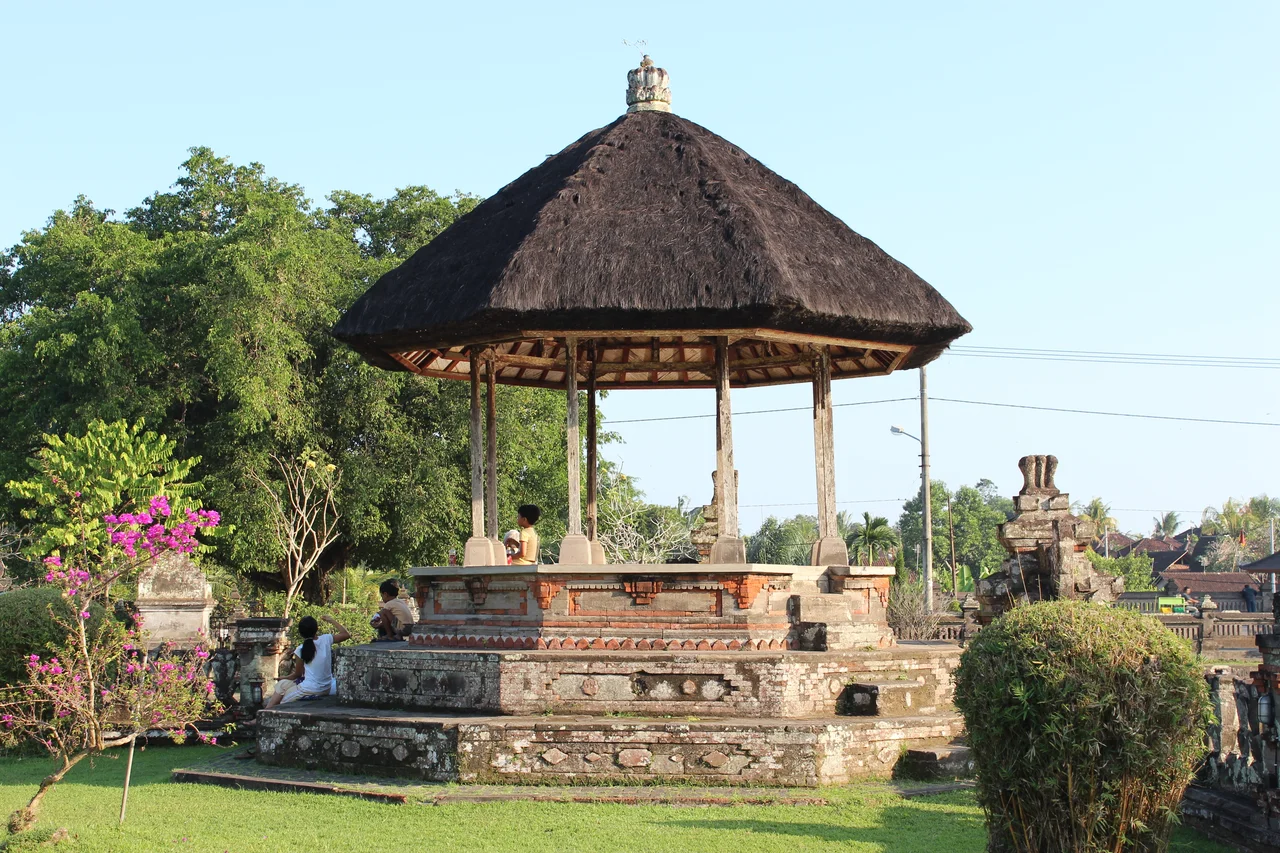

Pura Taman Ayun: The Garden That Floats on Sacred Water
The Kingdom of Mengwi lasted 257 years. Founded in 1634 by I Gusti Agung Putu, it controlled much of western Bali through two centuries of shifting alliances and territorial wars before neighboring kingdoms of Tabanan and Badung conquered it in 1891. The kingdom is gone. Its temple remains. Pura Taman Ayun rises from a moat so broad it resembles a lake, 6.9 hectares of sacred ground surrounded by water on three sides, accessible only by a bridge on the south. The name translates to Temple of the Garden on the Water, and the description is literal. Stand at the entrance and the compound appears to float, its tiered shrines and pavilions reflected in the still surface. This is not ornamental landscaping. The water that surrounds the temple feeds three subak irrigation channels in the Badung Regency, making Taman Ayun both a place of worship and a functioning node in Bali's thousand-year-old agricultural network.
A King's Monument to His Ancestors
I Gusti Agung Putu built Taman Ayun as a pura kawiten, a family temple for honoring the spirits of royal ancestors. The Mengwi dynasty traced its lineage through generations of Balinese rulers, and the temple was designed to reflect that continuity. Multi-tiered meru towers rise throughout the inner sanctuary, their stacked roofs symbolizing Mount Meru, the cosmic center of the Hindu universe. The tallest reaches eleven tiers. Others stand at nine, seven, five, or two, each height corresponding to the divine status of the ancestor or deity it honors. Brahma, Vishnu, and Shiva receive worship here, alongside the deified kings who built and maintained the kingdom. The architecture communicates hierarchy without words: the higher the shrine, the greater the reverence.
Three Courtyards, Three Realms
Balinese temple architecture divides sacred space into three zones, and Taman Ayun follows the pattern precisely. The outer courtyard, called jabaan or Nista Mandala, is the secular threshold. Here stands the wantilan, a large open pavilion originally built for cockfighting, a practice that carried ritual significance in Balinese Hinduism. The middle courtyard, jaba tengah or Madia Mandala, serves as transitional ground. Split gates called candi bentar mark each boundary, their divided halves representing the cosmic duality between good and evil. The inner sanctuary, the Utama Mandala, is reserved for worshippers. Guardian sculptures flank its entrance, some wearing European-style crowns, a curious sculptural detail that hints at colonial-era contact. Inside, the meru towers cluster at the northeast corner, the most sacred direction in Balinese cosmology.
Water as Architecture
What distinguishes Taman Ayun from every other temple on the island is its relationship to water. The outer moat encircles the compound like a defensive fortification, but its purpose is spiritual as much as practical. Within the inner sanctuary, a second, smaller moat creates a temple within a temple, isolating the holiest ground from the merely sacred. This layered separation by water mirrors the Balinese philosophical concept of Tri Hita Karana, the harmony between the spiritual realm, the human world, and nature. In 2012, UNESCO recognized the design's significance by inscribing Taman Ayun as one of five sites in the Cultural Landscape of Bali Province, honoring the subak system as a manifestation of that philosophy. The temple's waters are not decorative. They flow outward into channels that irrigate rice paddies across the regency, sustaining the same agricultural cycle they have fed for centuries.
Decline, Neglect, and Return
When Mengwi fell in 1891, the temple fell with it. Without royal patronage, the compound deteriorated. The moat silted. The meru towers weathered. For two decades, Bali's second-largest temple sat largely abandoned. Then, in 1911, a branch of the royal family returned to Mengwi and began the slow work of restoration. Major renovations followed in 1937, 1949, 1972, and 1976, each campaign recovering something of the original grandeur. Today the compound also houses ogoh-ogoh figures, the towering demon effigies paraded through Balinese streets during Ngrupuk, the night before Nyepi, the Day of Silence. These fierce sculptures, stored in the temple between festivals, inject a note of theatrical menace into a space otherwise defined by calm water and quiet devotion. The contrast is deliberate. Balinese Hinduism holds that balance requires acknowledging both serenity and chaos.
From the Air
Pura Taman Ayun (8.542S, 115.173E) is in the town of Mengwi, 19 km north of Denpasar in western Bali. Ngurah Rai International Airport (WADD/DPS) lies approximately 25 km to the south, with one runway 09/27 (3,000m). From the air, the temple compound is identifiable by its large rectangular moat and green grounds amid the denser development of Mengwi town. The surrounding landscape is a mix of rice paddies and villages. Mount Batukaru (2,276m) rises to the north. Tropical climate with wet season November-March.
Nearby Stories
- The Village That Speaks in Silence 3.5 km away
- Garuda Wisnu Kencana Cultural Park 4.1 km away
- When the Ground Moved at Dawn: Bali's 1979 Earthquake 10 km away
- The Tiger's Last Stand: West Bali National Park 17 km away
- Alas Purwo: Where Java Begins and the Surf Never Stops 24 km away
- Mandalika: The Racetrack That Summoned a Shaman 71 km away
- Forty-Five Men and Thirty-Six Depth Charges 107 km away
- The Silent Wave: Java's 1994 Tsunami Earthquake 270 km away