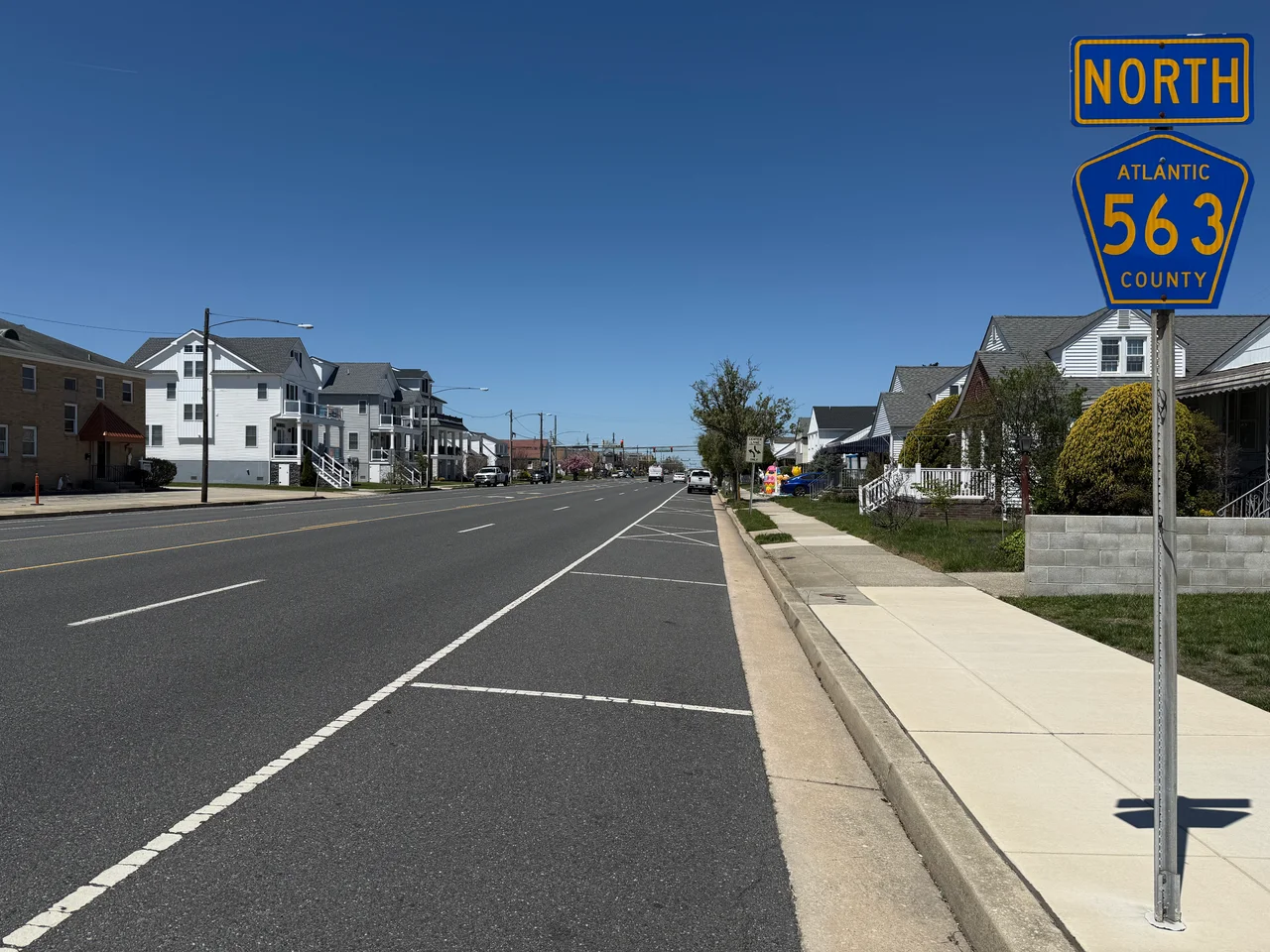
_just_north_of_Atlantic_County_Route_629_(Ventnor_Avenue)_in_Margate_City,_Atlantic_County,_New_Jersey.jpg)
Margate City, New Jersey
She stands six stories tall on a patch of beachfront land at the corner of Atlantic and Decatur, gazing out over the same Atlantic Ocean she has watched since Chester Arthur was president. Her name is Lucy, she weighs roughly ninety tons, and she is an elephant - or rather, the world's oldest surviving roadside attraction in the shape of one, fashioned in 1882 from nearly a million pieces of wood and sheathed in tin. Tourists climb a spiral staircase up through her left leg into the howdah on her back. Lucy is the kind of thing that should have been demolished a dozen times over. Instead, Margate City - the surprisingly old, surprisingly literary town that surrounds her - kept saving her. That is most of what you need to know about the place.
A Town Renamed Three Times
When the New Jersey Legislature carved Margate out of Egg Harbor Township on September 7, 1885, it called the new borough South Atlantic City - a name that promised much and delivered nothing distinctive. The town reincorporated as a city in 1897, then renamed itself one more time on April 20, 1909 after Margate, the seaside resort in Kent, England that pioneered the British holiday-by-the-sea tradition a century earlier. The English Margate was already by then a fading icon of leisure, slowly losing ground to package tours of the Mediterranean. New Jersey's Margate, still finding its footing, borrowed both the name and the aspiration. Today the city covers 1.42 square miles of land - eight blocks at most points between the Atlantic and the bay. A 2020 census counted 5,317 year-round residents in a town built to handle many more during summer.
Lucy and the Tin Skin
James V. Lafferty was a Philadelphia real estate developer with a problem common to nineteenth-century shore promoters: nobody could find his land. So in 1882, on the advice that a stunt-architecture would draw crowds, he commissioned a 65-foot wooden elephant to anchor his tract south of Atlantic City. The first patent issued for a building shaped like an animal still bears his name. Lafferty went broke. Lucy survived, passed through several owners, served briefly as a tavern and as a private summer cottage, and very nearly fell apart from sea air and termite damage. A community campaign moved her two blocks in 1970 to save her from demolition. The National Register designation came in 1971; National Historic Landmark status followed in 1976. The most recent restoration of her exterior tin skin, completed in December 2022 at a cost of about $2.4 million, used a mix of government funds and donor contributions. Roughly 130,000 people climb inside her every year.
Marven Gardens, Sort Of
Open a Monopoly board and look at the cluster of yellow properties just before Go. Marvin Gardens, the spelling reads. It is a misspelling - and the property the game's designers intended is in Margate, not Atlantic City proper. Marven Gardens is a real residential enclave straddling the Margate-Ventnor line, named in 1929 by developer Frank Hahn as a combination of Margate and Ventnor. When Charles Darrow developed Monopoly in the 1930s using Atlantic City street names, he picked Marven Gardens as one of the high-rent suburbs, then misspelled it on the board. The error stuck. By the 1970s, Margate residents had grown irritated enough to lobby Parker Brothers, which formally apologized but left the typo intact rather than reprint forty years of game boxes. The neighborhood still exists - small, leafy, suburban, with the same Spanish Mission-style architecture Hahn favored - and remains one of the most quietly famous addresses on the East Coast that almost nobody outside South Jersey can actually find.
Storms and Strange Choices
Margate built a boardwalk in 1906, closer to the high tide line than its sister boardwalks in Ventnor and Atlantic City. The placement made it more vulnerable, and the Atlantic eventually took the rest. The Great Atlantic Hurricane of September 1944 destroyed major sections. The Ash Wednesday Storm of March 1962 - a nor'easter that pummeled the mid-Atlantic coast for three full tide cycles - finished off what remained. Margate never rebuilt the boardwalk. Instead the city argued, for half a century, against the protective dunes the Army Corps of Engineers wanted to build along its beachfront. Residents preferred the unbroken ocean view. The post-Sandy referendum that finally authorized the dune project in 2013 passed only narrowly. Today the dunes are there, the view is partly obscured, and the beaches are wider than they have been in living memory. Whether the trade-off was worth it remains, in some Margate living rooms, a topic of fierce disagreement.
The Improbable Roster
For a town this size, Margate has produced an unusual range of figures. Red Klotz, born 1920, founded the Washington Generals - the basketball team that has lost to the Harlem Globetrotters more than 16,000 times by Klotz's own count, and whose business model is to keep losing. Pete Latzo held the world welterweight boxing title in 1926. Jessica Savitch, born here in 1947, became one of NBC's first prominent female news anchors before her death in a 1983 car accident at the height of her career. Screenwriter Scott Neustadter grew up in Margate and used it as the hometown of Joseph Gordon-Levitt's character in (500) Days of Summer. Micaela Diamond went from Margate to Broadway, originating the role of young Cher in The Cher Show. The list runs to politicians, scientists, neurologists - and at least one ISIS fighter. Small shore towns can be like that. Everybody comes from somewhere, and Margate, despite its quiet streets, comes up surprisingly often.
From the Air
Margate City occupies the central section of Absecon Island at 39.3308°N, 74.5072°W, about three nautical miles southwest of downtown Atlantic City. From altitude the city forms a tight grid between the Atlantic and the back bay, with the Downbeach Express toll bridge running west to Egg Harbor Township and the mainland. The most distinctive landmark from the air is Lucy the Elephant, a small dark form on the beachfront roughly at the foot of Decatur Avenue. The Marven Gardens neighborhood straddles the Margate-Ventnor line a few blocks inland. Atlantic City International Airport (ACY) lies about 11 nautical miles west-northwest. Ocean City Municipal (26N) is about 6 nautical miles south. Recommended viewing altitude: 1,500-3,000 feet AGL. The contrast between Margate's narrow eight-block grid and the broader sweep of Atlantic City to the northeast is clear from this elevation.
Nearby Stories
- Cape May 8.1 km away
- A. J. Meerwald 14 km away
- The Pine Barrens: Home of America's Oldest Monster 25 km away
- Hereford Inlet Lighthouse 38 km away
- Constitutional Convention (United States) 50 km away
- PS General Slocum 143 km away
- Wardenclyffe Tower 201 km away
- USS Atik 493 km away