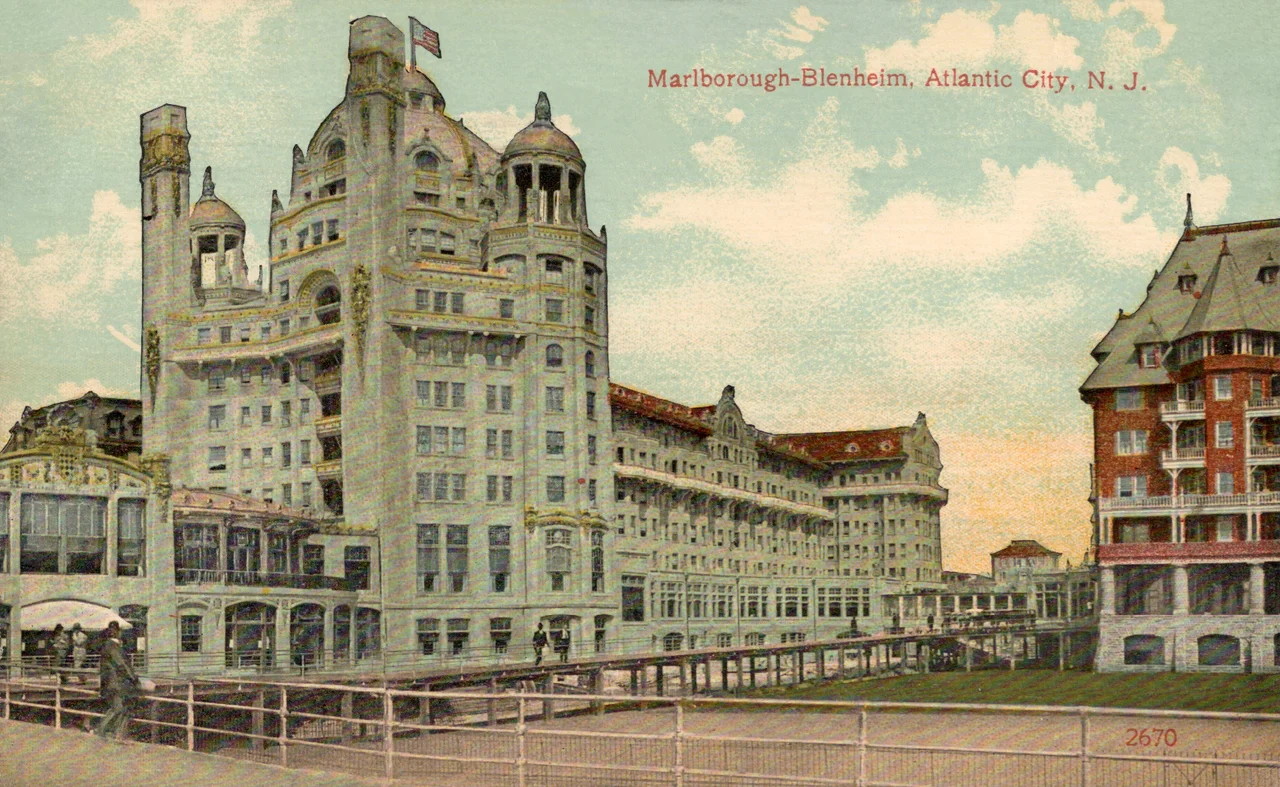

Marlborough-Blenheim Hotel
When the dome came down on the Blenheim Hotel in the autumn of 1978, Bruce Springsteen had a film crew there to capture it. The footage - a Moorish onion dome collapsing in slow billows of dust above the Atlantic City Boardwalk - made it into the music video for his song Atlantic City a few years later, set to the line about everything dies, baby, that's a fact. By then the hotel had stood on Park Place for seventy-two years. When it opened in 1906, it was the largest reinforced concrete building on Earth. It was also one of the strangest - a Spanish-Moorish fantasia at the edge of the Atlantic, designed by a Quaker architect, named for a British palace, and built largely because steel was unavailable and other Atlantic City hotels kept catching fire.
Built on a Steel Strike
In 1900, Josiah White III bought a parcel between Ohio Avenue and Park Place on the boardwalk and put up a Queen Anne-style hotel he called the Marlborough House. It made money. By 1905, White wanted to add a tower. He hired the Philadelphia architecture firm of Price and McLanahan, whose principal William Lightfoot Price had just finished designing the entirely-concrete Jacob Reed clothing store back in Philadelphia. That fall, a steel strike crippled American construction. Price chose to build the new Blenheim entirely from reinforced concrete instead - the third hotel ever to do so. When it opened in 1906, the Blenheim was not the first reinforced concrete hotel in the world (the French engineer Francois Hennebique's Imperial Palace in Nice had opened five years earlier) but it was the largest. Price topped it with a giant Spanish-Moorish dome and a forest of chimney clusters that owed nothing to the classical hotels around it.
The Churchill Connection
The name Blenheim refers to Blenheim Palace, the immense Oxfordshire estate built between 1705 and 1722 as a gift from Queen Anne to John Churchill, First Duke of Marlborough, for his victory at the Battle of Blenheim. Winston Churchill - grandson of the seventh Duke - was born there in 1874. So when Atlantic City's Marlborough-Blenheim invoked the British palace, it was tapping into the most prestigious aristocratic address in the English-speaking world. In 1916, Churchill himself stayed at the Atlantic City hotel as a guest. By then he had resigned as First Lord of the Admiralty following his disastrous Gallipoli campaign - he had stepped down in May 1915 and served briefly on the Western Front - and was seeking some quiet on the American shore. In 1946, the Daughters of the American Revolution held their 55th Continental Congress at the hotel under President General May Erwin Talmadge. The Broadway musical No, No, Nanette set its entire second act here in 1925, with a song lyric promising that Nanette was the prize and pet of the Marlborough-Blenheim Hotel.
The Coming of Bally
On March 14, 1977, after Atlantic City voters had legalized casino gambling but before any casino had actually opened, Reese Palley - the eccentric Atlantic City art dealer and promoter - and the local attorney Martin Blatt bought the Marlborough-Blenheim from the White family. They proposed to spend $35 million renovating, keeping the Blenheim's distinctive concrete tower while replacing the wood-framed Marlborough with a new casino. The plan did not last three months. In June 1977, Bally Manufacturing - then the world's largest maker of slot machines - leased the complex from Palley and Blatt with a 40-year term and a 100-year option. In August, Bally bought the neighboring Dennis Hotel for $4 million. On October 25, 1977, Josiah White IV, grandson of the founder, presided over the formal closure of the hotel his great-grandfather had built. He locked the front door. Bally announced that all three hotels would come down, replaced by an $83 million casino-hotel called Bally's Park Place. Public protests followed. The Dennis was ultimately spared as a temporary tower.
The Implosion
The Marlborough went first, knocked down by conventional wrecking ball. The Blenheim was different - reinforced concrete on a scale no ordinary demolition could handle. Bally hired Controlled Demolition, Inc., the family-run Maryland firm that essentially invented modern implosion engineering, along with Winzinger Incorporated of Hainesport, New Jersey, which had taken down the Traymore Hotel a few years earlier. A local preservation group went to court and won a temporary stay of demolition for the Blenheim's rotunda section facing the boardwalk. The rotunda was physically separated from the main building. Then, in the fall of 1978, the rest of the Blenheim came down in a planned implosion - dust rising over the boardwalk, the dome collapsing into itself, Springsteen's eventual cameraman recording the fall. Months later the historic-status appeal was denied, the stay lifted, and CDI finished off the rotunda on January 4, 1979.
Ghost of a Hotel
What stands at Ohio Avenue and Park Place today is Bally's Atlantic City - a 39-story octagonal casino tower above a sprawling podium designed by Maxwell Starkman Associates of California. It is competent corporate hotel architecture, but it inherited none of the strangeness of what came before. The Marlborough-Blenheim lives on in other places. HBO's Boardwalk Empire based the fictional Ritz-Carlton where Nucky Thompson lived on the Blenheim's actual architecture rather than the real Ritz-Carlton that Nucky Johnson, the historical Atlantic City boss, actually inhabited. The 1972 film The King of Marvin Gardens, starring Jack Nicholson and Bruce Dern, was set partly inside a fictionalized version of the hotel called the Essex-Carlton. Heidi Winzinger, daughter of the demolition contractor who helped take the building down, later wrote a folk-rock song called Queen of Atlantic City as an elegy for the hotel her family had destroyed. The Blenheim is one of those buildings whose absence is more visible than most buildings' presence.
From the Air
The Marlborough-Blenheim Hotel no longer exists - the site at 39.3556°N, 74.4317°W is now occupied by Bally's Atlantic City, identifiable from the air by its 39-story octagonal tower at the boardwalk between Park Place and Ohio Avenue. The building sits about midway between the Steel Pier (to the northeast) and the Tropicana (to the southwest). The boardwalk runs along the ocean side; the casino podium extends inland nearly two full blocks. Atlantic City International Airport (ACY) lies about 9 nautical miles west-northwest. Recommended viewing altitude: 1,500-2,500 feet AGL. The site is unmistakably part of the dense Boardwalk casino corridor, with Caesars and the old Trump Plaza site immediately adjacent. From the right angle, the contrast between Bally's blocky 1979 silhouette and the early-twentieth-century rooflines that survive at the Claridge a block away shows what the Boardwalk lost when the dome came down.
Nearby Stories
- Cape May 8.1 km away
- A. J. Meerwald 14 km away
- The Pine Barrens: Home of America's Oldest Monster 25 km away
- Hereford Inlet Lighthouse 38 km away
- Constitutional Convention (United States) 50 km away
- PS General Slocum 143 km away
- Wardenclyffe Tower 201 km away
- USS Atik 493 km away