
The Mengo Crisis
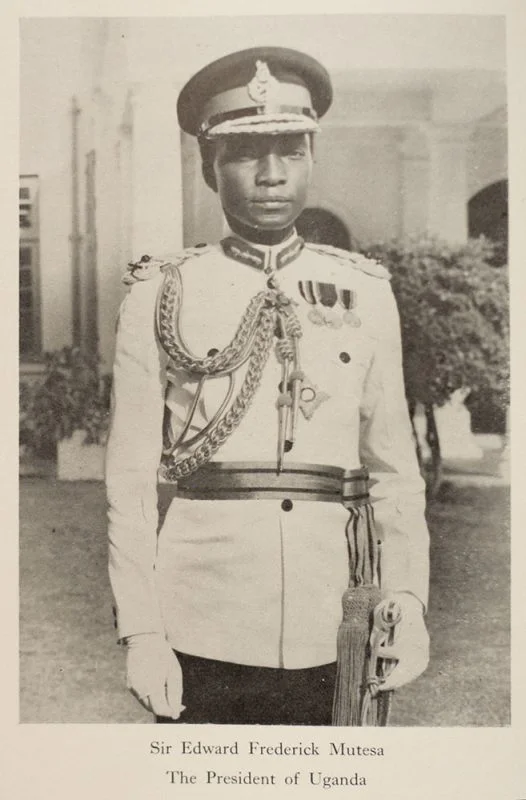
A taxi driver in Kampala once gave a ride to a king. It was the morning of 24 May 1966, rain pouring down, and the passenger who flagged him near Mengo Hill was Edward Mutesa II - Kabaka of Buganda, and until weeks earlier the first president of Uganda. His palace was burning behind him. He had just climbed over its wall as the army closed in, injuring his back in the fall, and now he needed to disappear. The driver took him to a cathedral, where priests at breakfast gave the king clerical robes and arranged his flight. The Kabaka would never see his kingdom again.
Two Men, One Country
Uganda came to independence in 1962 as an uneasy union. Its largest and proudest region, the kingdom of Buganda, had its own monarch, the Kabaka, and centuries of identity that no national border could erase. In a fragile arrangement, Mutesa II became Uganda's ceremonial president while Milton Obote, a politician from the north, held real power as prime minister. The balance could not hold. As Obote consolidated his position - sidelining rivals, fending off a corruption scandal that also touched his rising army officer Idi Amin - the kingdom and the central government drifted toward open conflict. In February 1966, Obote suspended Mutesa, accused him of plotting with foreign powers, and seized the presidency for himself.
The Resolution and the Reply
Buganda's parliament, the Lukiiko, pushed back. On 20 May it passed a resolution demanding that Obote's government leave Buganda's soil. It was a declaration of defiance from a kingdom that would not be absorbed quietly. The reply came in soldiers. On 23 May the Uganda Army surrounded the Lubiri, the Kabaka's palace, and arrested chiefs who had backed the resolution. Across Buganda, people began to resist. Obote turned to the officer he trusted to act without hesitation, and ordered the army to take the palace.
The Battle of Mengo Hill
Early on 24 May, the army attacked. Inside the Lubiri, roughly 120 royal guards held the walls with bolt-action Lee-Enfield rifles, a handful of carbines, and a few machine guns - a ceremonial force against a national army. They had one ally: the weather. A heavy rain slowed the assault and bought time. Realizing they could not win, the guards chose to save their king rather than die holding ground, and helped Mutesa slip over the rear wall in the downpour. His brother, Prince Alexander David Ssimbwa, was captured and tortured. The fighting and the looting that followed all but destroyed the palace. Royal regalia were stolen and smashed, including the Mujaguzo - the sacred royal drums, whose silence the Baganda felt as a wound. Volunteers carried more than two hundred dead to the morgue; the army buried an unknown number in mass graves.
There Is Nothing to Regret
Obote went before parliament and offered no apology. "There is nothing to regret," he declared. "The oneness of Uganda must be assured." The courts fell into line: a judge ruled that Obote's seizure of power, though a coup, was a lawful means of taking control, and the cabinet ministers he had jailed stayed jailed despite their appeals. In 1967 Obote went further, introducing a new constitution that abolished every traditional kingdom in Uganda. The thousand-year monarchy of Buganda was, on paper, simply erased. Mutesa II died in exile in London in 1969. It would fall to the next ruler, Idi Amin, to permit the king's body to come home for burial - a gesture Amin used to burnish his own legitimacy.
The Hill Remembers
The Lubiri was rebuilt and restored in 1993, after Uganda restored its kingdoms and a new Kabaka took the throne. But for many Baganda, what happened on Mengo Hill in 1966 remains a defining wound, and Obote a name attached to it. The palace stands again on its hill in the heart of Kampala, near the cathedral where a fleeing king once borrowed a priest's robes - a reminder that beneath a modern capital lies an older kingdom that was attacked, scattered, and refused to be forgotten.
From the Air
Mengo Hill and the Lubiri palace stand at 0.302 N, 32.566 E, near the heart of Kampala at roughly 3,900 feet of elevation - one of the historic seven hills on which the city grew. From the air, the walled palace compound and the nearby twin landmarks of Rubaga (Catholic) and Namirembe (Anglican) cathedrals, each crowning its own hill, help orient the city's old core. The nearest airport is Entebbe International (ICAO: HUEN, IATA: EBB), about 40 km south on Lake Victoria. Equatorial Kampala sees heavy afternoon rains - fittingly, rain shaped the events of 1966 - so clear morning light offers the steadiest view of the hills and their crowning buildings.
Nearby Stories
- White Nile 24 km away
- Ssese Islands 57 km away
- Ntusi 89 km away
- Battle of Kabamba 94 km away
- Nyero Rock Paintings 98 km away
- Bunyoro 134 km away
- Migingo Island 140 km away
- Budongo Forest 172 km away