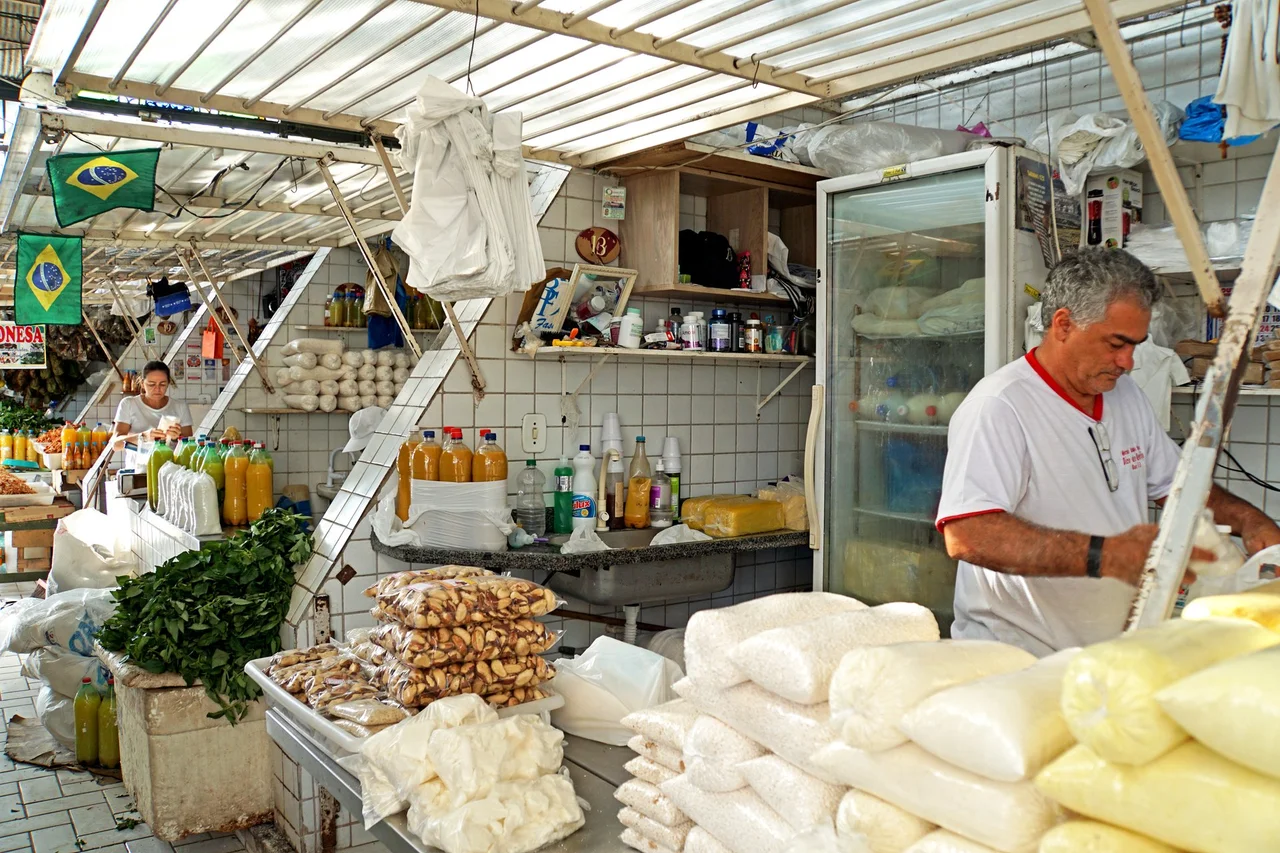

Mercado Adolpho Lisboa
They built it in Glasgow, then took it apart and shipped it up the Amazon. In 1880, with rubber money pouring into Manaus, city officials decided the port needed a proper market - not a row of stalls but a covered pavilion in the European manner, something that would signal to visiting merchants that Manaus had arrived. They looked at the great markets of Europe and chose Les Halles of Paris as their model. The iron skeleton was forged by Walter Macfarlane's Saracen Foundry in Glasgow. Its castings crossed the Atlantic by steamer, crossed the equator, and ascended 1,500 kilometers up the Amazon to a river port where the final assembly happened at the water's edge. The Mercado Adolpho Lisboa opened on July 15, 1883, a Parisian idea rendered in Scottish iron, standing on the banks of the Rio Negro.
The Mayor's Name
Adolpho Lisboa was the mayor of Manaus during the period when the market was built, and so the building carries his name. In a city where rubber barons named opera houses after themselves and streets after their enterprises, naming a public market for a municipal administrator was a quieter gesture. Most Manauenses today know the building as the Mercado Municipal or simply the Mercadao - the big market - and have no idea who Adolpho Lisboa was. The name survives as bureaucratic inertia. He appears on records. The market appears on postcards. Their connection is the sort of thing historians dig out for the brass plaques near the entrances.
Two Facades
The market has two completely different faces depending on which direction you approach it. The river-facing facade addresses boats - a working front of loading areas, awnings, and utilitarian openings that receive fish, fruit, and goods arriving from upstream ports. The street-facing facade is its public self: ornate ironwork, Art Nouveau flourishes, decorative pediments, the kind of elaborate entrance designed to impress pedestrians. One building, two audiences - the river merchant and the downtown resident met the same market from opposite sides, and the architecture acknowledged their different relationships to the space. The central pavilion measures roughly 45 meters long by 42 meters wide, supported by 28 iron columns. Side rooms of stone and brick hold twenty boxes - individual vendor stalls with wooden counters topped in marble.
The Eiffel Myth
A popular legend in Manaus claims Gustave Eiffel designed the Mercado. He did not. The Brazilian National Institute of Historical and Artistic Heritage has listed the actual builders on its website: Bakus and Brisbit of Belem, Francis Morton Engineers of Liverpool, and Walter Macfarlane of Glasgow. Macfarlane's Saracen Foundry was one of the largest architectural iron producers of the nineteenth century, exporting elaborate castings across the British Empire and beyond. Its work on the Mercado is characteristic - the fine ornamental grillwork, the curved brackets, the decorative column capitals all read as Glasgow output of the 1880s. But Eiffel was the famous name of European ironwork in the period, and so Eiffel got the credit. The myth persists. The Saracen Foundry, long defunct, does not.
Iron Pavilion and Expansion
The original 1883 central pavilion was followed by additions. In 1890, two side pavilions of roughly the same size went up, built with the same iron-and-zinc-roof logic. In 1908, during the twilight of the rubber boom, an entirely iron pavilion was added - this one dedicated to selling Amazonian spices, lit by kerosene lamps in a style that matched the main building. The market grew with the city it served. In its peak years, the complex handled fresh fruit, fish straight off the boats, regional spices found nowhere else in the world, and a riot of other goods that reflected Manaus's position as the commercial heart of a region the size of Western Europe. The rubber barons might have built the opera house, but the city's commerce flowed through the Mercadao.
Restoration and Return
By 2006 the building had deteriorated badly enough that the municipal government closed it for restoration. The work took seven years - longer than planners announced, which is the usual fate of historic restorations in Brazil. On October 23, 2013, the market reopened. The restored building looks now much as it did in the 1890s, with its ironwork cleaned, its roofs repaired, its stalls rebuilt. Vendors sell what markets in Manaus have always sold: regional fruits like cupuacu and acai, fresh fish from the river, tambaqui and pirarucu cuts on ice, jars of tucupi sauce, baskets of farinha, Amazonian herbs used in traditional medicine, and souvenirs for the cruise-ship visitors. It is now classified as a national heritage site. The Glasgow iron has outlasted the rubber boom that paid for it, the mayor it was named after, and the city it was built to serve. It remains what it was built to be: a place where the Amazon's commerce and culture meet, under a roof that came from halfway around the world.
From the Air
Located at 3.1400 S, 60.0236 W, on the Rio Negro waterfront in downtown Manaus. Manaus Air Force Base (SBMN, former Ponta Pelada Airport) is about 4 km south; Eduardo Gomes International Airport (SBEG/MAO) is 20 km north. The market is a long iron-and-masonry building along the river, with characteristic pitched roofs and ornate Art Nouveau ironwork visible from downtown. Recommended viewing altitude 2,000-4,000 feet for the riverfront context - the market anchors Manaus's historic port district and sits close to other landmarks including the Amazon Theater. Best appreciated alongside a view of the Rio Negro port and floating docks nearby.
Nearby Stories
- Manacapuru 30 km away
- Biological Dynamics of Forest Fragments Project Area 45 km away
- Novo Airao 57 km away
- Amazon Tall Tower Observatory 88 km away
- Anama 107 km away
- 2019 Amazon rainforest wildfires 253 km away
- Alto Maues Ecological Station 294 km away
- Parintins 302 km away