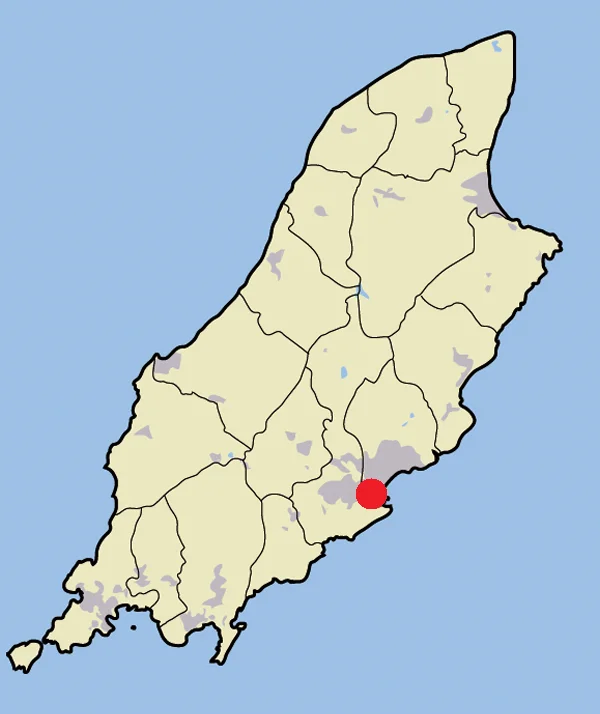

Metropole Internment Camp
In the first week of July 1940, seven hundred and forty-three men walked into four converted hotels at the northern end of Douglas promenade and were locked in. Most were Italians who had been living in Britain when Italy entered the Second World War. Some had run cafes in Glasgow, ice cream parlours in Edinburgh, restaurants in London. Many had been British residents for decades. They were now classified as enemy aliens, and the Metropole Internment Camp, officially designated S Camp, would be their address for the next four years.
Wire Around the Promenade
The Isle of Man had become a holding ground for Britain's civilian internees almost overnight. Its seafront boarding houses, designed for summer trippers who were no longer coming because of the war, were perfectly shaped for the new purpose: rows of rooms, communal dining halls, easy fencing. Metropole Camp sat at the northern end of Douglas promenade, just before Strathallan Crescent and Summer Hill, with the rockface below Little Switzerland rising at the back. Four buildings sat inside the wire: the Metropole Hotel, the Alexander (later renamed the Continental), the Waverley, and Dodsworth's. The first three held internees. Dodsworth's was the infirmary. Outside the wire, the army had its headquarters and, repurposed from a stable that had once kept the horses for the Douglas Bay Horse Tramway, a small prison for special punishments.
The Stable
One internee left an account of that prison cell. It was three feet wide and six feet long, with a manger at one end that could not be sat on or lain across, a single ventilator window, and a cobbled floor that was always damp. There were eight such stall-cells in the row. The last one served as a latrine, so, in the writer's words, the stink was quite a revelation. The smallness of these details, the careful measurements, are how a man writing later remembered what was done to him. Most of the men inside the camp were not violent prisoners. They were waiters and tailors and merchant sailors and priests, picked up after Italy entered the war.
How They Lived
Reveille came at seven in the morning. Roll call, physical exercises, breakfast. Meals were taken communally, which was unusual in the Manx internment camps and possible here only because the hotel dining rooms ran the length of the ground floors. The Metropole had a canteen, a general store, a billiard room, a library, and a bakery in the basement. The Alexander housed the camp office, an assembly room, a music room with a piano, and a room used as a church where Mass was offered and confessions heard by internee priests. The Waverley had a barber's shop, a carpenter's workshop, a welfare office, and a school. A second school, in the Waverley basement, was an Italian elementary school set up for sailors who could not read or write. The other school in the Metropole taught French, English, Latin, German, and Russian. The men produced cabaret performances. They played indoor sports in the dining rooms after meals. They were sometimes allowed out under guard for walks along the promenade and swims in the sea.
Their Own Money
After an initial closed period, internees were permitted to apply to work outside the camp on local farms. Some started small businesses inside the wire. They were paid in a currency they invented themselves: stamped pieces of cardboard, with denominations down to a half-penny, valid only inside Metropole and used as the everyday money of camp life. A few examples survive in collections, small rectangles of card that once bought a cigarette or a meal in the canteen. Family visits were allowed by prior permission from the Home Office, in a designated area, for a limited time. At five each evening, roll call was taken again, and the names were read out of men being released in the morning. That practice had begun in October 1941 with the gradual release of those whom the authorities had reclassified as posing little risk to the Allies.
Escapes, Mostly Pointless
Three men tried to escape from Metropole. One had an English wife visiting him on the island, staying in a private hotel only yards from the camp wire. He broke out to see her, made it to her bedroom, and, in the dry account, only got as far as his shirt before the police arrived. Other guests at the hotel had alerted the authorities. On 21 September 1942, two men cut through the wire, heard a guard approaching, and hid in the Crescent Hotel next door. They were back inside the camp within three hours, most of which they had spent in a hotel bedroom. The third escape involved a marine engineer who spoke no English and had suffered such severe psychiatric distress in the camp that he had been briefly admitted to the island's psychiatric hospital before being sent back. He escaped again, on foot, to walk himself back to the hospital and readmit himself. Discipline among the guards at Metropole was reportedly slack. Thefts from military stores were not uncommon. Guards were occasionally found asleep on duty. Searches of returning work parties were sometimes forgotten.
Closed, but Not Forgotten
The numbers dropped slowly. Seven hundred and forty-three in July 1940, six hundred and fifty by January 1941, four hundred and eighty-two by October 1944. In the first week of November 1944, the camp was closed. The four hotels eventually returned to civilian use. Most of the men had spent four years of their lives behind that wire, with their pre-war jobs, friendships, and routines suspended or destroyed. Some, after release, chose to stay on the island; an Italian who stayed became one of the stories preserved by the BBC's later oral history of the war. The seafront looks ordinary now. Walk north along the Douglas promenade in any season and the row of buildings just before Strathallan Crescent is just a row of buildings. But the men in those rooms had names, had families, and had not done anything to warrant being held. The Manx coastline holds that fact, quietly, alongside everything else it remembers.
From the Air
Located at 54.166°N, 4.466°W at the northern end of Douglas promenade, just before Strathallan Crescent and Summer Hill, with the cliff face below Little Switzerland rising behind. Nearest airport is Ronaldsway (EGNS) about 9 miles southwest. The original four hotels, the Metropole, Alexander (Continental), Waverley, and Dodsworth's, no longer all stand in their wartime form; the modern Loch Promenade waterfront has been redeveloped multiple times since 1944.
Nearby Stories
- St Bees Lighthouse 15 km away
- Celtic Array 22 km away
- Kirkmaiden 23 km away
- Isle of Whithorn 23 km away
- Seascale Lifeboat Station 31 km away
- German submarine U-1024 36 km away
- SS Georgetown Victory 40 km away
- Blackpool Illuminations 56 km away