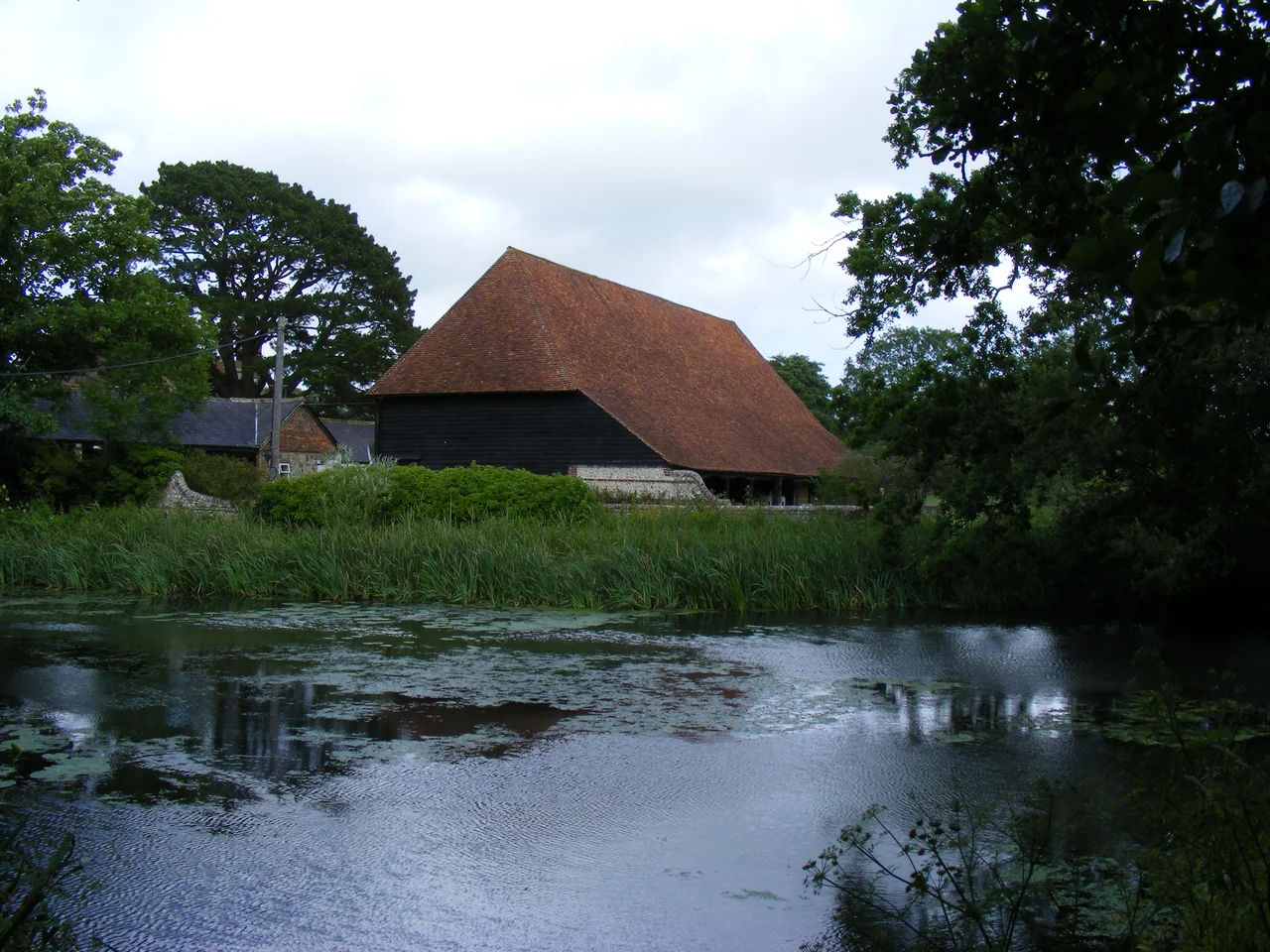

Michelham Priory
The moat is nearly a mile around. It was dug in the 13th century, fed from a tributary of the Cuckmere, and it still holds water today - which puts Michelham Priory in possession of the longest water-filled medieval moat in England. Inside that oval ring of slow brown water sit eight acres of garden, a Tudor barn, a working watermill, a Grade I gatehouse fifty feet tall, and a T-shaped stone priory with the bones of an Augustinian house still visible inside its later rebuilds. King Edward I stayed here in 1302. Canadian soldiers trained here in 1941 before the Dieppe Raid. And in 2026, a sandstone refectory built around 1300 is still serving tea to visitors who paid at the gate.
Gilbert's Foundation
Gilbert de Aquila founded the Augustinian Priory of the Holy Trinity at Michelham in 1229. He came from a family - the L'Aigles of Normandy - that had been distributing pious donations across southern England since the Conqueror's time; his father had endowed Bayham Abbey in Kent and had been involved with Otham, just a few miles north. Michelham was set up as a daughter house of Hastings Priory, on a site cradled in the Cuckmere flood plain. The Augustinians (or Austin Canons) were not monks in the strict Benedictine sense but ordained priests living under a shared rule, expected to serve nearby parishes as well as keep the canonical hours. About a dozen canons lived here at most times. Gilbert lost everything in 1235 - lands and honours forfeited for crossing to Normandy without King Henry III's licence - but the priory he had founded continued.
Visitors and Disputes
On 26 June 1283 something unusual happened at Michelham: John de Kyrkeby, who had just been elected Bishop of Rochester, formally renounced the office in the priory itself, in the presence of John Peckham, Archbishop of Canterbury. King Edward I stayed overnight on 14 September 1302. The priors of Michelham seem to have had a knack for trouble of a small administrative kind: one was fined in 1278 for exercising privileges he wasn't entitled to, another in 1287, and in 1353 a prior was fined the not-inconsiderable sum of 40 pence because a bridge his community was supposed to maintain at Rickney had collapsed and blocked the river. By 1398 the buildings themselves were reported "in a ruinous condition." Robert Reade, Bishop of Chichester, helped out by granting Michelham the right to nominate the priest at Alfriston and Fletching, which raised income for repairs.
Dissolution and Survival
Henry VIII's commissioners arrived in 1537. The priory was seized, the canons turned out, and the property handed first to Thomas Cromwell, then - after Cromwell's execution in 1540 - to Anne of Cleves. The story of Michelham over the next two centuries is one of constant resale. Henry Earl of Arundel swapped it back to Queen Mary in 1544. It sold for £1,249 in 1556, then again, then again, with parts of the church demolished between 1599 and 1601. In 1601 the entire site went to Thomas Sackville, 1st Earl of Dorset, for £4,700, and the Sackvilles held it for two centuries. The great church was the casualty. Its five bells, weighing more than two tonnes between them, were sold for £26 13s 4d. By the 19th century the priory had become a working farmhouse with a Tudor great barn, the medieval gatehouse still in use, and a sandstone Augustinian refectory now divided into rooms.
The Gatehouse and the Mill
Step through the early-15th-century gatehouse - built around 1410, when John Leem was prior - and you cross a stone bridge added a century later over that long moat. The gatehouse rises fifty feet on four storeys including a basement cellar at moat level, sometimes described as a prison; certainly a place no medieval visitor wanted to spend a night. It is the priory's most complete medieval survival, Grade I listed along with its bridge. South of the priory the great Elizabethan barn, built between 1587 and 1610, stands on a timber frame clad in tarred weatherboards under a queen-post roof of clay pegtiles. Beside the river an 18th-century dovecote (now the tearoom) sits opposite a working watermill restored in 1996 with help from a £42,000 National Lottery grant. The wheel turns again. The grindstones turn flour. Children put their hands under the wooden hopper and feel the warm dust drift through their fingers.
From Soldiers to Stewardship
In the winter of 1941-42, the priory served as a billet for Canadian troops preparing for the Dieppe Raid - that costly amphibious operation in August 1942 that lost so many Canadian lives on the French coast. After they shipped out the buildings became headquarters for the Auxiliary Territorial Service, the women's branch of the British Army. In 1958 Mrs R. H. Hotblack, known as Stella, bought the property explicitly to save it. The following year, with an endowment from Kenneth Mackay, 3rd Earl of Inchcape, given in memory of his friend John Fletcher Boughey who had died in the Second World War, she gave the entire priory in trust to the Sussex Archaeological Society. They have run it ever since. The Augustinian church is long gone, but a thirteenth-century moat still rings eight acres of garden, and the watermill still grinds flour by water-power, which is more than most religious foundations of 1229 can claim.
From the Air
Located at 50.86°N, 0.21°E, in the Cuckmere valley near Upper Dicker, between Hailsham and Hellingly. The moat is the most striking feature from the air - an oval ring of water around the green priory enclosure, with the long Elizabethan barn and watermill visible to the south-west. Nearest airfield is Deanland (EGCD) about 5 km east. Best viewed from 1,500-3,000 ft AGL; the South Downs rising to the south make a useful contrast with the low Cuckmere flood plain.
Nearby Stories
- Chiddingstone Castle 4.4 km away
- Kent 4.6 km away
- Camber Castle 5.4 km away
- Surrey 13 km away
- Amberley Museum & Heritage Centre 13 km away
- Swanage Lifeboat Station 113 km away
- Le Paradis Massacre 137 km away
- Wellington Clock Tower 150 km away