
Military Sealift Command
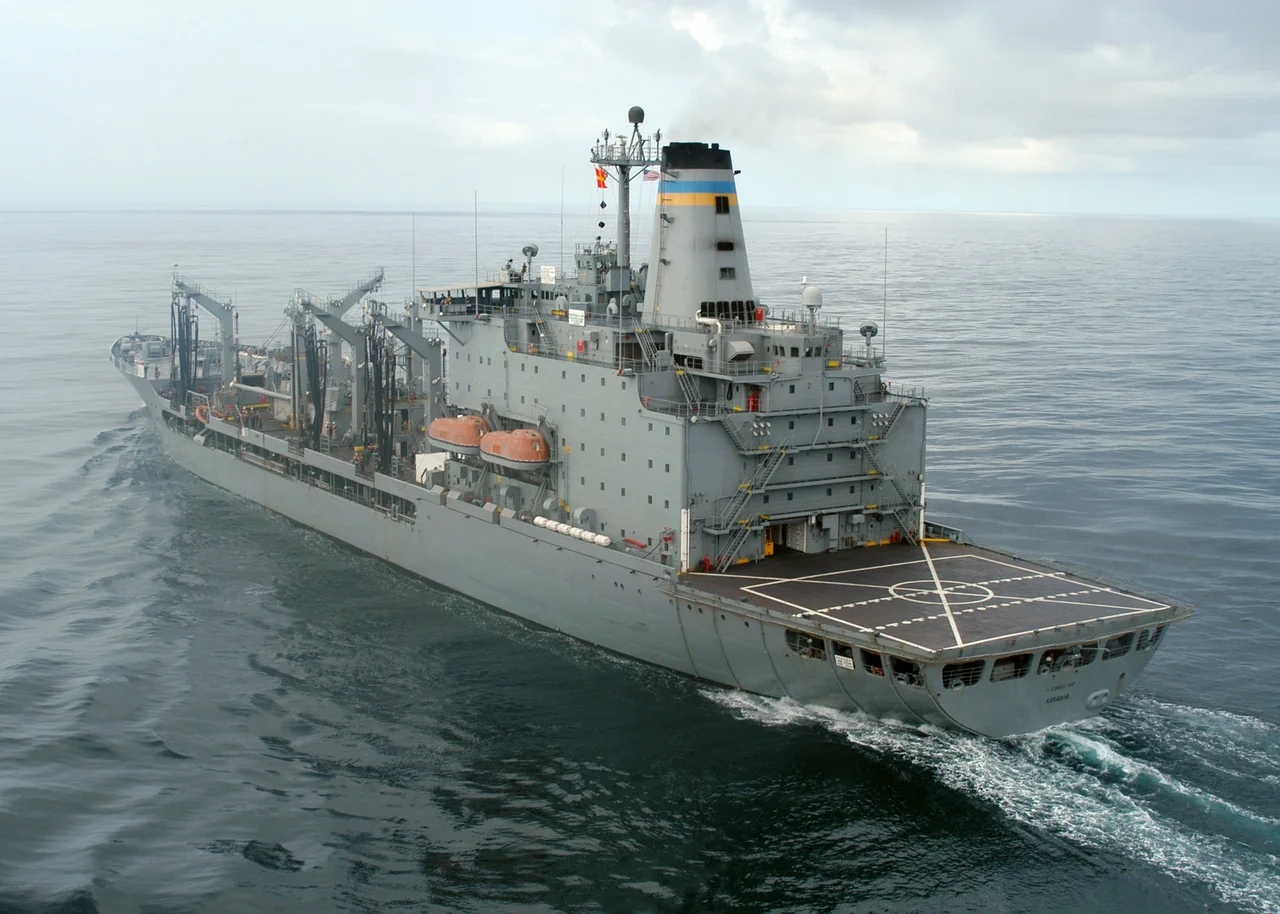
Look at any photo of a U.S. Navy carrier strike group at sea. The flattop dominates the frame. Destroyers and cruisers screen the formation. Off to one side, almost forgotten, sits a long gray ship with blue-and-gold horizontal bands wrapped around her single smokestack. She is not a warship. She does not carry sailors. Her crew is civilian — merchant mariners — and her hull number begins with T. Without her, the carrier goes nowhere. She is the oiler, the dry cargo ship, the ammunition platform. She belongs to Military Sealift Command, headquartered here at Naval Station Norfolk. And she is part of why the United States can fight wars on the other side of the planet.
The Birth of MSTS
Until 1949 the Army and the Navy each ran their own sea transportation. Army transports moved soldiers; Navy ships moved sailors and Marines; both branches argued over who should do what. In World War II four separate agencies handled military sealift, with the Joint Chiefs trying to coordinate from above. Secretary of Defense Louis Johnson ended the chaos with a memo on July 12, 1949. The Military Sea Transportation Service — MSTS — became the single agency for all DoD ocean transport. Nine months later, North Korean troops crossed the 38th parallel. On July 6, 1950, MSTS deployed the 24th Infantry Division from Japan to Pusan. The service was tested on its first birthday and never stopped.
Civilians in Haze Gray
In 1972, with the all-volunteer Navy facing a sailor shortage, a study posed an uncomfortable question: did fleet support ships really need uniformed crews? The answer was no. The oiler USS Taluga was decommissioned, repainted with blue-and-gold stack bands, and re-entered service as USNS Taluga (T-AO-62) with a crew of 105 civilian merchant mariners and a sixteen-member naval detachment. The experiment worked. By 1986, most of the Navy's underway replenishment fleet had transitioned to MSTS — renamed Military Sealift Command in 1970 — and the savings were real. The civilian mariners are part of the U.S. Merchant Marine: skilled, often unionized, sailing for the government but not in uniform.
Eight Programs, About 110 Ships
MSC organizes its fleet into eight programs. The Fleet Oilers refuel warships underway. The Combat Logistics Force delivers ammunition, food, and parts. Strategic Sealift positions Army and Marine Corps equipment on ships parked in the Indian Ocean and the Mediterranean, ready to support a contingency anywhere. The Special Mission program runs the strangest ships: oceanographic survey vessels, the floating Sea-Based X-band Radar that tracks missile tests, submarine support ships, and the Cobra-class missile range instrumentation vessels that watch test launches from the Pacific. Hospital ships Comfort and Mercy deploy for disaster relief. Expeditionary Fast Transports race troops and cargo between theaters at 35 to 45 knots. About 110 ships, 9,800 employees — and 88 percent of those employees are civilians.
What They Carried
Numbers tell the story of why MSC matters. From 1965 to 1969, MSC moved 54 million tons of combat equipment and supplies, plus eight million long tons of fuel, to South Vietnam. During Desert Shield and Desert Storm, more than 230 government-owned and chartered ships delivered over 12 million tons of vehicles, helicopters, ammunition, and fuel — the largest sealift operation of any nation involved. By the end of the first year of the 2003 Iraq War, MSC had delivered 61 million square feet of cargo and 1.1 billion gallons of fuel. Air transport gets the attention; sealift moves the weight. Roughly 90 percent of the tonnage required to sustain a major overseas campaign travels by sea, and most of that travels on MSC bottoms.
Norfolk Headquarters
MSC moved its headquarters from the Washington Navy Yard to Naval Station Norfolk in 2015, putting the command in the same place as Atlantic Fleet operations. The choice made sense: Norfolk is the largest naval base in the world, the eastern hub of MSC's worldwide network. From the cockpit, the Hampton Roads waterfront sprawls below: piers, drydocks, the gray hulls of warships, and — sprinkled among them — the slightly different gray hulls of MSC ships with their distinctive stack bands, waiting to take the fleet to war.
From the Air
Military Sealift Command headquarters at Naval Station Norfolk sits near 36.94°N, 76.28°W. From 3,000 to 5,000 feet AGL the Norfolk waterfront resolves into the unmistakable cluster of carrier piers, destroyer berths, and MSC's distinctive haze-gray hulls with blue-and-gold stack bands. Nearest airport: Norfolk International (KORF), 5 nm east-northeast. The area is dense controlled airspace: KORF Class C, Naval Station Norfolk (KNGU) Restricted Area R-6606, and NAS Oceana (KNTU) flight operations all overlap. Contact Norfolk Approach (124.55) and expect routing well clear of the piers themselves. The best overhead view of Norfolk's MSC ships comes from a northbound transit at 4,500 feet on the western edge of the harbor under VFR Flight Following.
Nearby Stories
- Capitol (Williamsburg, Virginia) 4.7 km away
- Battle of the Chesapeake 5.7 km away
- Chesapeake Bay Impact Crater 8.8 km away
- Battle of Great Bridge 11 km away
- James River Reserve Fleet 13 km away
- Blackwater River (Virginia) 33 km away
- SS Monroe (1902) 50 km away
- Bodie Island Lighthouse 102 km away