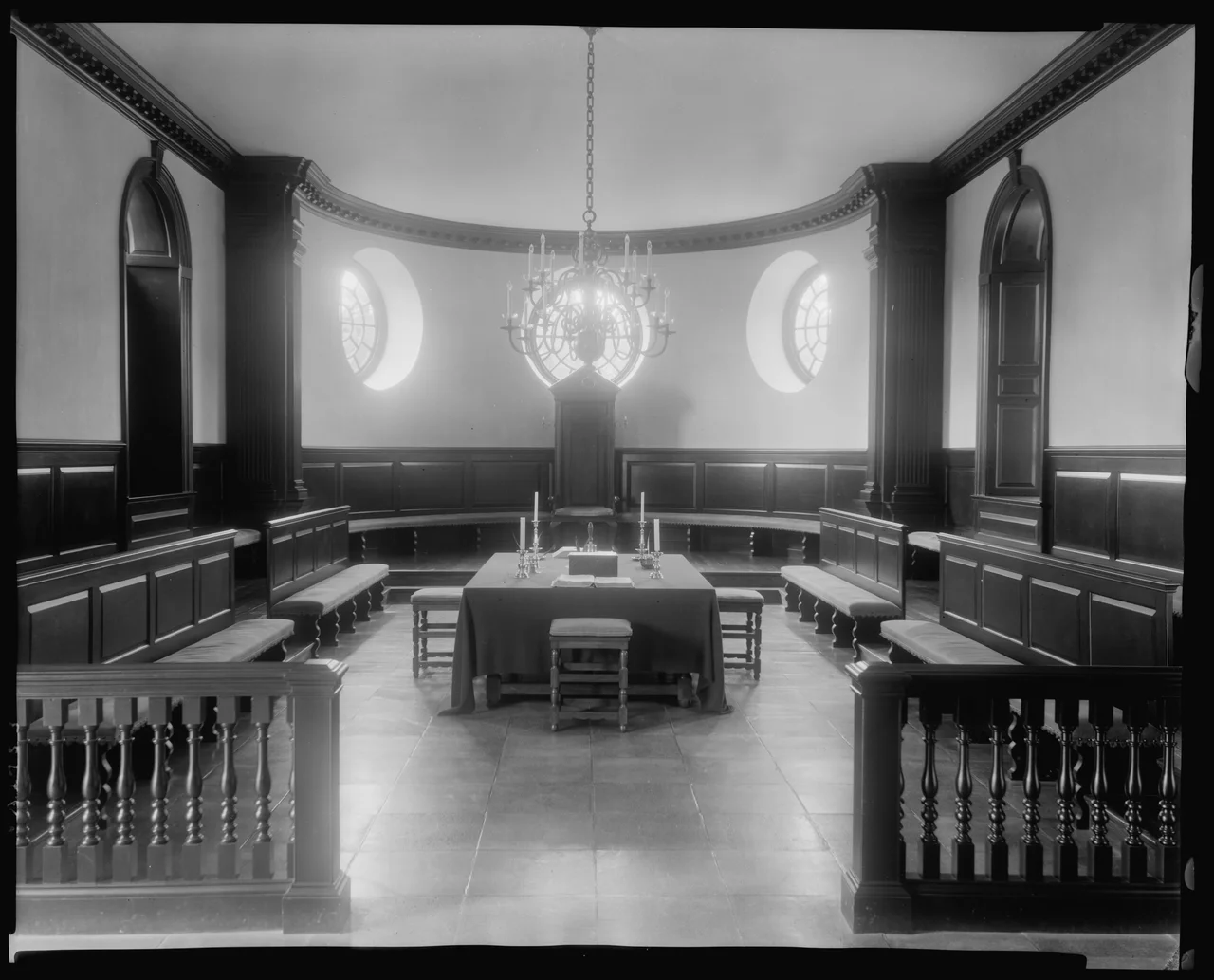

Capitol (Williamsburg, Virginia)
On May 29, 1765, a twenty-nine-year-old Hanover County lawyer named Patrick Henry stood up in the chamber of the House of Burgesses and gave the speech that became known as the Caesar-Brutus speech. He was attacking the Stamp Act. According to legend, when shouts of "Treason!" interrupted him, he answered: "If this be treason, make the most of it." The room where he stood is a reconstruction, completed in 1934, on the foundations of the original Capitol that burned in 1747. But the chamber's dimensions, its proportions, even the heavy panels of dark wood, follow the original. Stand inside today and the air carries the strange double weight of a building that has been destroyed twice and rebuilt to remember the words that were spoken in it before the destruction.
Out of the Swamps
In 1698 the State House at Jamestown burned for the third time. Virginia's legislators decided enough was enough. The swampy ground at Jamestown had been malarial and disease-ridden from the beginning, and the colony needed a capital on higher ground. James Blair and five William & Mary students proposed Middle Plantation, a small inland settlement that already had the new college (founded 1693) and Bruton Parish Church. A month later the burgesses agreed. Middle Plantation was renamed Williamsburg in honor of King William III. Henry Cary, the contractor who had just finished the Wren Building at the college, was given the contract for the new Capitol. Work began in 1701. To prevent a repeat of the Jamestown disasters, Cary designed the building without fireplaces. The legislature moved in during 1704. The Capitol was officially complete in 1705.
The First Capitol, 1705 to 1747
For four decades, the building Cary built without fireplaces held the colony's government. In 1723 chimneys were added because the structure was so damp the records were rotting. On January 30, 1747, the building burned anyway, leaving only walls and foundations. A second Capitol rose on the same site by 1753. In that second building, the famous speeches happened. Patrick Henry attacked the Stamp Act there in May 1765. George Washington, George Mason, George Wythe, Richard Henry Lee, and Thomas Jefferson all served in the House of Burgesses or its successor revolutionary conventions in those chambers. The Virginia Declaration of Rights, written by Mason, was debated there. Jefferson's first attempt at a bill for religious freedom was debated there. On June 29, 1776, four days before the Continental Congress voted on Jefferson's draft Declaration of Independence in Philadelphia, Virginia delegates meeting in the Capitol declared the colony's own independence and adopted the first state constitution in the new United States.
Abandoned for Richmond
The Capitol's prominence did not survive the Revolutionary War. Williamsburg, perched on the peninsula, was militarily vulnerable. Governor Thomas Jefferson urged that the capital be moved inland to Richmond for security reasons. The General Assembly adjourned at Williamsburg for the last time on December 24, 1779, and reconvened in 1780 at the new capital. The building sat unused. Over the next half-century it served by turns as a court, a school, and an open ruin. The east wing was removed around 1800 because it had become dangerous. The west wing stood alone for thirty more years until 1832, when a fire destroyed it too. By the late 19th century there was nothing on the site but the outline of the foundations in the grass.
A Third Capitol, Standing Longer than Both Originals
The building that stands at the east end of Duke of Gloucester Street today is the third Capitol on the site. It is a reconstruction completed in the early 1930s as part of the Colonial Williamsburg restoration funded by John D. Rockefeller Jr. and led by the Reverend W.A.R. Goodwin of Bruton Parish Church. The architects chose to reconstruct the first Capitol (1705-1747) rather than the second, because better documentation survived. A 1929 discovery called the Bodleian Plate, an 18th-century engraving found at Oxford's Bodleian Library, depicted the first Capitol's distinctive architecture in detail. The result has now stood for more than ninety years, longer than the first and second Capitols combined. Together with the reconstructed Governor's Palace and the restored Wren Building of William & Mary, it forms the three architectural anchors of Colonial Williamsburg. The chamber where Henry made his Stamp Act speech is open daily, and the actor playing Henry sometimes makes it himself.
From the Air
The Capitol sits at 37.27 N, 76.69 W at the east end of Duke of Gloucester Street in Colonial Williamsburg's Historic Area, three blocks east of Bruton Parish Church and the Wren Building. From the air, look for the distinctive H-shaped brick footprint of the reconstructed Capitol at the eastern terminus of Duke of Gloucester Street, the long arrow-straight axis through the historic district. The whole 301-acre Historic Area is easy to identify as a tight grid of brick buildings and white-fenced gardens surrounded by modern Williamsburg. Nearest field is Williamsburg-Jamestown (KJGG) 4 nm west-northwest, Newport News/Williamsburg International (KPHF) 12 nm east, Felker Army Airfield (KFAF) at Fort Eustis 12 nm southeast. Best viewed at 1,500-2,500 feet AGL with afternoon sun lighting the west facade.
Nearby Stories
- Battle of Trent's Reach 2.7 km away
- Mathews County, Virginia 7.4 km away
- Lewis Ginter Botanical Garden 11 km away
- Ocean View Amusement Park 16 km away
- USS Texas (1892) 21 km away
- Christopher Newport University 29 km away
- Menokin 44 km away
- Fort Christanna 63 km away