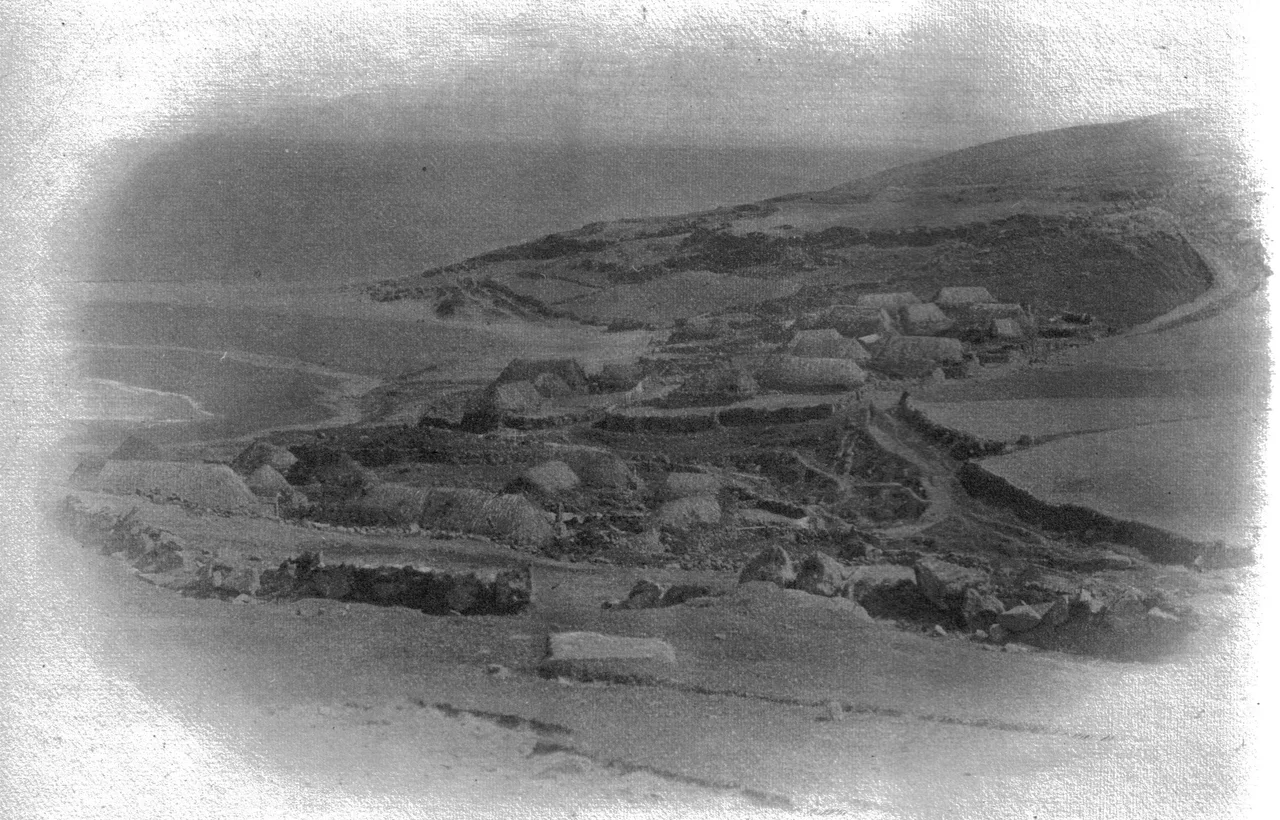

Mingulay
The most famous song about Mingulay was composed in 1938. Its haunting verses have been sung by Robin Hall and Jimmy MacGregor, by Richard Thompson, by Kris Delmhorst, by countless folk performers who imagine boatsmen pulling oars to its melody. But the song was written twenty-six years after the islanders left. The people of Mingulay never sang it. They could not. By the time the Mingulay Boat Song existed, the Village stood empty, the schoolhouse and the chapel house alone amid wildflowers, and two thousand years of Gaelic life on this island had ended.
Bird Island
Mingulay lies twelve nautical miles south of Barra, the second-largest of the Barra Isles. The cliffs are among the highest in the British Isles. Hecla rises 219 metres. Macphees Hill reaches 224 metres. Carnan crests at 273 metres. The name, W. H. Murray wrote, appropriately means Bird Island. Nearly ten thousand pairs of razorbills nest here, 6.3 percent of the European population. Eleven thousand pairs of guillemots. Almost three thousand pairs of black-legged kittiwakes. Puffins, storm petrels, fulmars, gulls, terns, and great skuas crowd the sea cliffs. A natural arch at Gunamul opens 150 metres tall in the western rampart, big enough on calm days for boats to sail straight through the cliff.
Norsemen, MacNeils and the Bishop's Isles
Iron Age remains mark Dun Mingulay on the southwestern promontory. Christianity arrived early. The Vikings came around 871 and left names if not graves, a Norse vocabulary etched onto every prominent feature. After the Treaty of Perth in 1266, the islands returned to the Scottish crown. In 1427 the Lords of the Isles granted Barra and its associated islands to Clan MacNeil. The MacNeils held it for centuries, paying rent to the laird in shearwater chicks called fachaich. After acts of MacNeil piracy, King James VI transferred some of the southern archipelago, including Mingulay, to the Bishop of the Isles. These islands became known as the Bishops Isles, and the name lingers in old charts.
The Absentee Landlords
In 1840, the MacNeil estates passed to Colonel John Gordon of Cluny, an Aberdeenshire landlord whose attitude during the potato famines became a byword for cruelty. Across the Hebrides he cleared tenants and replaced them with sheep. Strangely, this increased Mingulay's population. Families evicted from Barra chose to resettle on remote Mingulay rather than board emigrant ships to Nova Scotia. The island's isolation was, briefly, an advantage. Rents fell from 1840 to 1845. In 1878 Lady Gordon Cathcart inherited the estate. Over fifty-four years of ownership, she visited Mingulay exactly once. The islanders dealt with an empty title and the consequences of it. They had no landlord to appeal to and no advocate to speak for them.
The Decision to Leave
The reasons accumulated like silt. In 1897 a Pabbay boat was lost off Barra Head with five men, more than half of Pabbay's adult males. The fishermen of Mingulay watched and remembered. The lack of a sheltered landing meant the island could be cut off for weeks. Buxton tells of two men who left together. One went visiting on Barra, the other emigrating to New York. The New York emigrant returned three months later, the venture having failed, and met his friend again in Castlebay. The friend explained that he had been unable to return to Mingulay since their farewell, the sea conditions making it impossible. In 1868 a wave washed over Geirum Mor, a fifty-one-metre-high islet, and carried the sheep away. The Congested Districts Board installed a derrick in 1901 to help with landings. It failed. By 1912, the islanders had chosen. They left of their own accord, not in a single dramatic evacuation but in a slow, painful drain. The schoolhouse closed. The chapel house emptied. The Village stood quiet.
Empty Yet Singing
After the evacuation the island passed through several owners. Jonathan MacLean from Barra bought it in 1919. John Russell, a sheep farmer with experience in Australia and Montana, bought it in 1930 and lived alone all autumn and winter with pet ferrets and cats, joined by shepherds only in spring and summer. Peggy Greer from Essex bought it next and rarely visited. In 1955 a local crofters' syndicate, the Barra Head Isles Sheepstock Company, purchased the island. The National Trust for Scotland took it over in 2000. Only the schoolhouse and the chapel house still stand. Yet the songs that the islanders actually wrote also survive. Neil MacPhee, the Vatersay raider, composed Oran do dh'Eilean Mhiulaidh, the Song to the Isle of Mingulay, after the abandonment. Father Allan MacLean wrote Turas Neill a Mhiughlaigh, Neil's Trip to Mingulay. These are the real songs of the island, voices of people who lived and left.
From the Air
Located at 56.8115 N, 7.6375 W, the second-largest of the Barra Isles, 12 nm south of Barra. The Village ruins on the eastern bay are the most identifiable structure. The cliffs rise sharply on the western and southern sides, with Hecla, Carnan and Macphees Hill as prominent peaks. Recommended altitude 2,500-4,500 ft. A south-to-north pass along the western cliffs captures the natural arch at Gunamul and the seabird colonies. Nearest airports: Barra (EGPR) 12 nm north, Benbecula (EGPL) 60 nm north. The Sound of Berneray to the south is known for strong tidal currents.
Nearby Stories
- German submarine U-722 7.3 km away
- Cladh Hallan 10 km away
- HMS Sturdy (1919) 13 km away
- SS Polonia 28 km away
- Canna 36 km away
- SS Athelstane (1941) 78 km away
- St Kilda, Scotland 82 km away
- German submarine U-516 102 km away