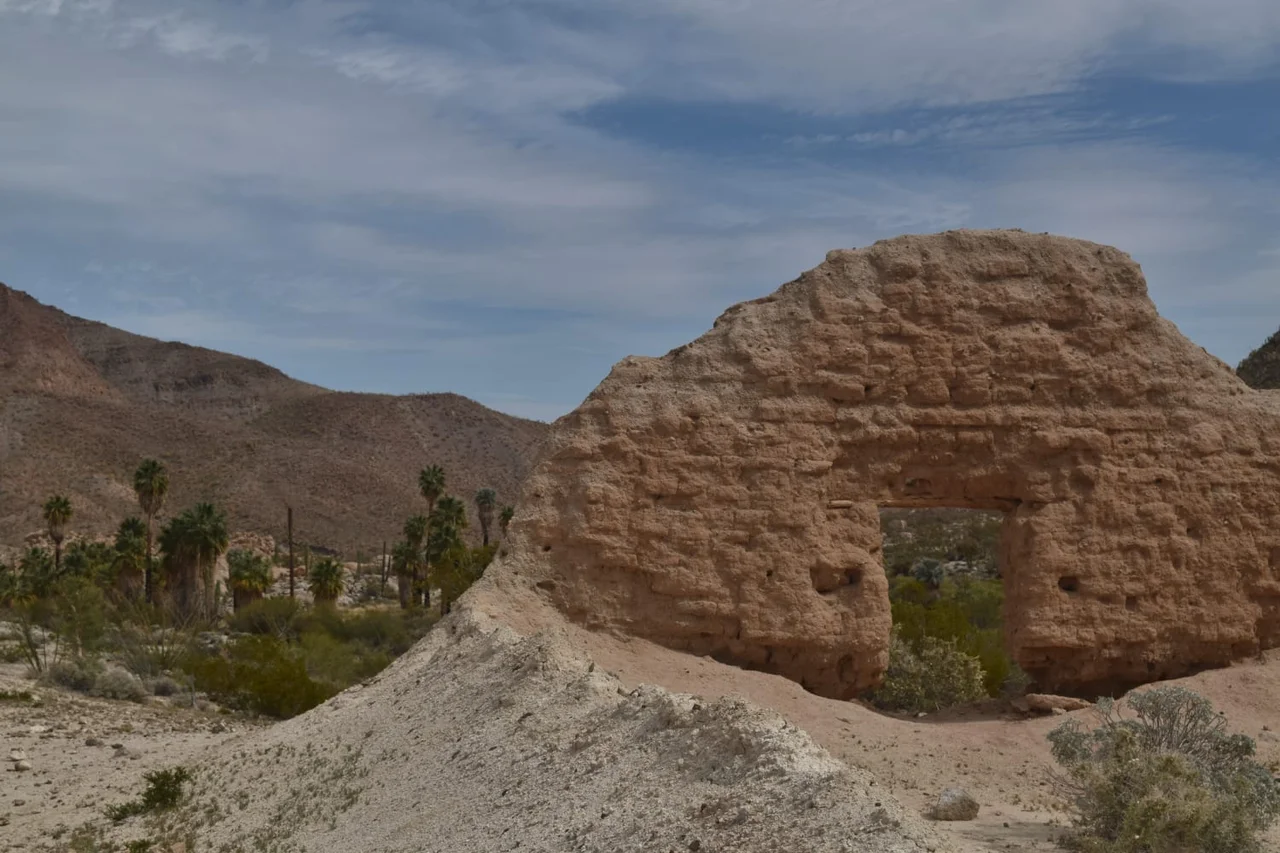

Misión Santa María de los Ángeles
Timing is everything in history, and the timing at Misión Santa María de los Ángeles was almost comically cruel. Founded in 1767 as a replacement for a failed mission site, it became the last Jesuit mission ever established in Baja California — not because the Jesuits had run out of territory or ambition, but because months after its founding, King Carlos III expelled the entire Society of Jesus from all Spanish territories. The mission the Jesuits had barely begun was handed over to strangers.
An Aristocrat's Gift, a Priest's Labor
The mission's full name honors two figures. Saint Maria of the Angels gave the religious dedication. But the second name in the mission's genealogy belongs to Maria Ana Antonia Luisa de Borja-Centelles y Fernández de Córdoba, Duchess of Gandía, who donated funds to the Baja California missions in 1747. This was how the mission system worked: aristocratic benefactors in Spain and the Americas funded the physical establishment of missions, while the religious orders provided the labor. The site at Santa María was identified through the work of Jesuit explorers Ferdinand Konščak and Wenceslaus Linck, who had mapped much of the peninsula's interior. Victoriano Arnés founded the mission in 1767 to replace the earlier Calamajué site, which had proven unsatisfactory for lack of reliable water.
The Expulsion and Its Aftermath
The Jesuit expulsion of 1767 was one of the most dramatic administrative acts in colonial history. Across Spanish America, the order's properties were seized and its priests were escorted to ships and deported. In Baja California, a generation of mission-building was abruptly transferred to the Franciscans. They, in turn, had little time for Santa María — they were already focused on the more urgent task of expanding north into Alta California. When Mission San Fernando Velicatá was established by Junípero Serra in 1769, Santa María was relegated to the status of a visita: a subordinate station, visited periodically rather than permanently staffed. In 1818, the visita was abandoned entirely. The site lacked sufficient land for crops and cattle, the same problem that had been identified at Calamajué years before. Some things do not improve with time.
A Ruin at the Edge of the Map
Today, Misión Santa María de los Ángeles is among the most remote of all Baja California mission ruins. Reaching the site requires leaving the highway for rough desert tracks. What remains is characteristic of the lesser-known Baja missions: ruined structural walls, the outlines of stone corrals where livestock were kept, the quiet geometry of a settlement that once organized people's lives. There are no interpretive signs, no visitor centers, no parking lots. The mission exists at the edge of the usable map, for those willing to seek it. Its isolation is perhaps fitting — it was always a marginal place, founded too late and abandoned relatively early, a footnote in a mission system more famous for its California chapters.
The Last of a Line
To understand Santa María, it helps to hold the entire Baja mission sequence in mind. The Jesuits worked their way down the peninsula over nearly a century, starting at Loreto in 1697 and pushing ever further into unknown territory with each new foundation. Santa María, established in 1767, was the final step of that patient southward march — and also the final Jesuit step anywhere in the Californias. The Franciscans then stepped over this last mission and pushed north. The Dominicans, who took over the Baja missions in 1773, inherited Santa María along with the rest. Three different religious orders held this ground in less than sixty years. What they left behind are walls, corrals, and the kind of silence that only truly remote places possess.
From the Air
Misión Santa María de los Ángeles is located at approximately 29.73°N, 114.55°W in the interior of central Baja California, east of the main highway. The terrain is rugged and the site is not visually distinct from altitude. Nearest airport is San Felipe International (MMSF), approximately 100 km to the northeast. Best approached at 3,000–5,000 feet AGL for terrain orientation.
Nearby Stories
- Misión San Fernando Rey de España de Velicatá 33 km away
- Puertecitos 38 km away
- Misión San Pedro Mártir de Verona 82 km away
- San Lorenzo Marine Archipelago National Park 122 km away
- Cedros Island 152 km away
- Gulf of California 273 km away
- Battle of Ambos Nogales 317 km away
- El Boleo 324 km away