
Puertecitos
The road to Puertecitos is part of the experience. Ninety kilometers south of San Felipe, the pavement narrows, the GPS loses confidence, and the Gulf of California appears in flashes between rocky hills. The town itself — a few hundred homes and mobile homes spread across a low hill between open gulf and sheltered bay — was permanently settled only in 1949, when Rafael Orozco recognized something worth staying for. What he found, and what keeps visitors returning, are the hot springs.
Springs on the Shore
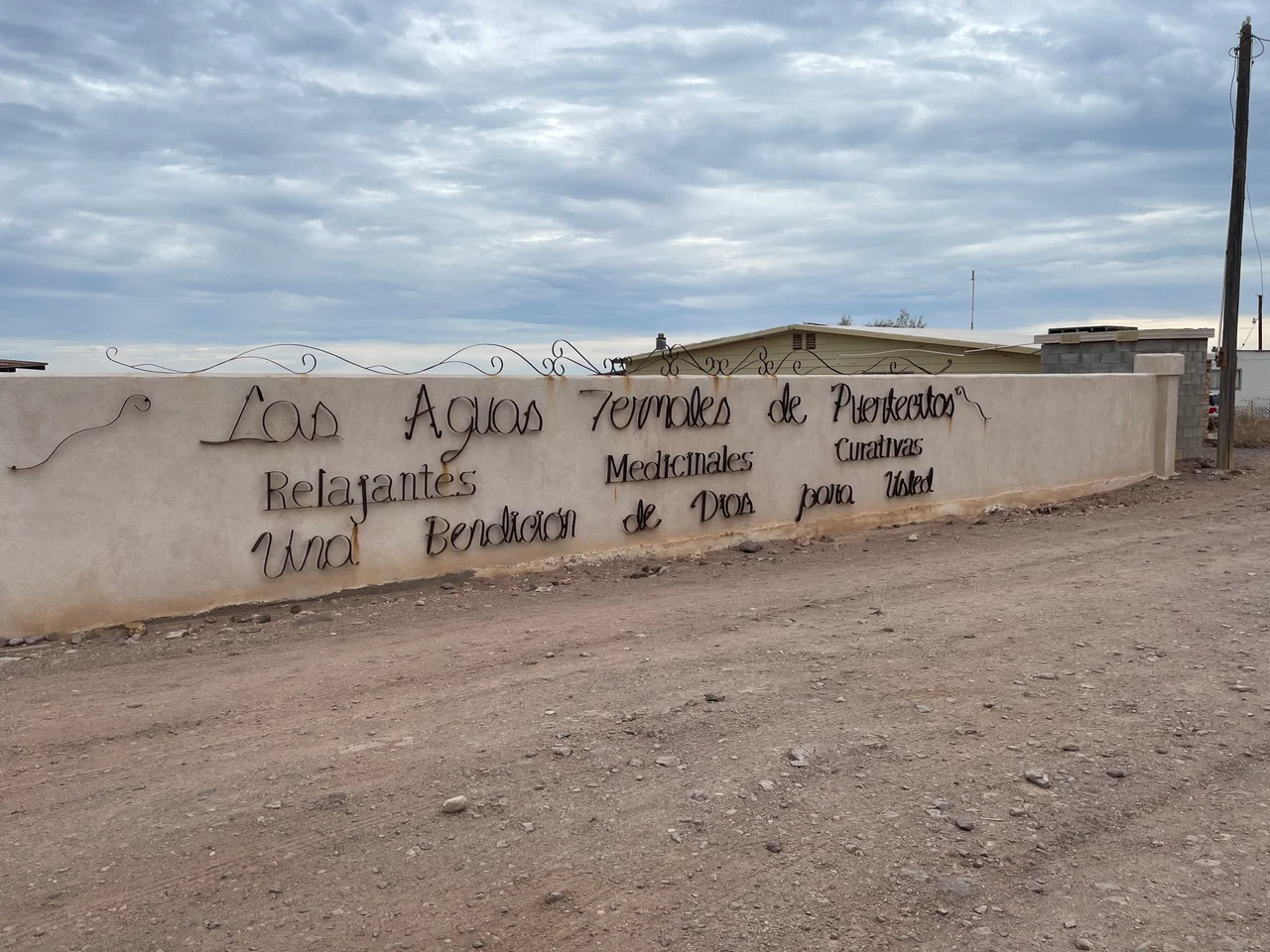
The hot springs at Puertecitos are not spa-smooth affairs but raw geothermal seeps in the rocky coastline, where heated water from the earth meets the tidal fluctuation of the Gulf of California. The temperature varies with the tides: at low tide, the pools are hot enough to require caution; as the tide rises, cooler seawater mixes in and the temperature drops toward something comfortable. This tidal rhythm dictates the social schedule of Puertecitos. Visitors time their soaks accordingly, gathering on the rocks at the right hour, steam rising from the pools against the desert air. There is a fee to use the springs. No hotel exists — camping is the primary accommodation — and the Pemex station's reliability is not guaranteed. Experienced visitors fill their fuel tanks in San Felipe before making the drive.
A Desert Sea Community
Puertecitos receives an average of two inches of rain per year, the same extreme aridity as San Felipe. The climate is fierce: summer temperatures regularly exceed 40°C, and the lack of reliable shade or services means the town empties somewhat in the worst months. Spring and autumn are when Puertecitos comes alive, when the heat is manageable and the fishing is good. The community is a mix of permanent Mexican residents and expatriates — primarily American — who have built second homes or parked mobile homes on the hillside lots. This kind of quiet, fuel-your-own-generator, haul-your-own-water life has a particular appeal for people who find ordinary amenity structures constraining.
The Gulf at Your Doorstep
The Gulf of California is one of the world's most biologically productive marine environments, and Puertecitos sits directly on its upper reaches. The northern gulf's extreme tidal range — among the highest in the Pacific Ocean basin — means that the shoreline changes dramatically between high and low tide, exposing rock shelves and tidal pools that reward patient exploration. South of town, Bahía Cristina, about 6 kilometers away, offers a restaurant; farther south, Bahía Encantada provides running water and a sheltered bay with calmer conditions for swimming. These small bays extend the appeal of the area for campers working their way down the coast.
The Road Beyond
Puertecitos is not quite the end of the paved road — from here the Baja highway eventually continues south, though the route becomes increasingly rough and requires high-clearance vehicles. This positioning, at the edge of what ordinary vehicles can comfortably reach, gives the town its character. It is far enough from San Felipe to feel genuinely remote, close enough to be a reasonable day trip or weekend destination. For those pushing further south into Baja's less-traveled interior coast, it is a last reliable provisioning point. For those who have arrived and find what they need — the springs, the gulf, the silence — it can become a destination in itself.
From the Air
Puertecitos is located at approximately 30.35°N, 114.64°W on the western shore of the upper Gulf of California. The small settlement and its bay are visible from low altitude. Nearest airport with any services is San Felipe International (MMSF), approximately 90 km north. The Gulf coastline presents good visual reference at 3,000–5,000 feet AGL. Surface winds can be gusty in the afternoon.
Nearby Stories
- Peninsular Ranges 14 km away
- San Felipe International Airport 38 km away
- San Lorenzo Marine Archipelago National Park 188 km away
- 2012 Boeing 727 Crash Experiment 200 km away
- Laguna Salada 229 km away
- Battle of Stanwix Station 274 km away
- Guadalupe Island Biosphere Reserve 306 km away
- Mission San Jose de Tumacacori 336 km away