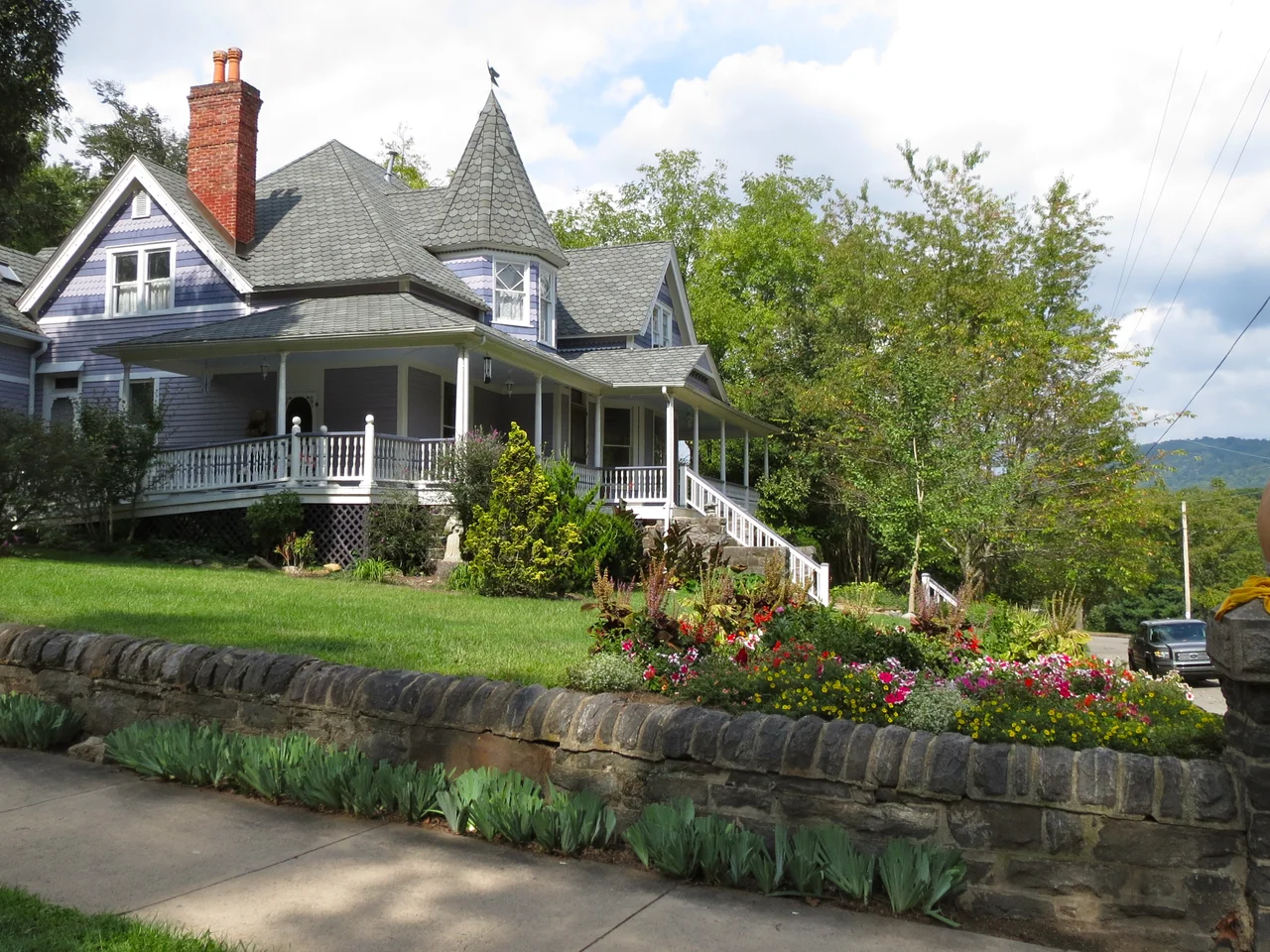

Montford Area Historic District
Nina Simone once practiced piano in a Montford parlor. The teacher was the wife of Dr. Robert S. Carroll, who ran the psychiatric hospital up the street, and the young Eunice Waymon - not yet renamed for the stage - was studying the music that would eventually carry her out of Tryon and around the world. That parlor still stands. So does most of the neighborhood that surrounded it: a half-square-mile suburb just north of downtown Asheville where the architecture of an entire turn-of-the-century moment was somehow preserved more or less intact.
A Suburb Built on a Boom
Montford's full development began in 1889, the same year George Vanderbilt started buying up land south of town for the estate that would become Biltmore. Asheville was riding a wave of railroad money and tuberculosis tourists, and the neighborhood reflected that prosperity. The dominant style was Queen Anne - corner turrets, irregular massing, gables stacked on gables - but Montford's builders were unusually well-read for a Southern mountain town. They knew the work of Bruce Price, Bernard Maybeck, even Frank Lloyd Wright, and they borrowed freely. The oldest house in the district predates the boom: the Rankin House at 192 Elizabeth Street, a Greek Revival residence built around 1846 with Italianate flourishes added later, a survivor from before the railroad changed everything.
The Architect from Biltmore
When Richard Sharp Smith arrived from England to supervise construction of the Biltmore House, he had no intention of staying. But Asheville's building boom convinced him to open a private practice, and his fingerprints are scattered through Montford. He liked gambrel roofs and hipped gables, pebbledash and stucco walls, heavy porch brackets, simple Colonial Revival details. The result was a neighborhood that looked nothing like the rest of the state - shingled, earth-toned, informally composed. The Shingle style houses are particularly numerous here, reflecting both the wealth of the original buyers and the presence of architects who knew what the East Coast tastemakers were doing. By the 1920s a sub-division called Montford Hills extended the same vocabulary into a new generation of homes.
Highland Hospital and a Fire in 1948
Dr. Carroll opened his sanitorium in Montford in 1909, renamed it Highland Hospital in 1912, and gave it to Duke University's Neuropsychiatric Department in 1939. The institution treated mental illness with what was, for its time, a relatively humane approach - exercise, music, work therapy. Zelda Fitzgerald was a patient there in 1948. On the night of March 10, a fire broke out in the central building and spread quickly through the wooden structure. Zelda and eight other women died in the blaze. She was 47. The building Carroll once lived in - the one where Nina Simone's piano lessons happened - still stands as Highland Hall, a stop on the Asheville Historic Trolley Tours.
Riverside Cemetery, 87 Acres of Stories
On a wooded ridge at Montford's western edge, the Asheville Cemetery Company laid out Riverside Cemetery in 1885, partly as a burial ground and partly as a public park - a Victorian idea that had become fashionable in northern cities. Thirteen thousand people are buried there now. Thomas Wolfe, the novelist who turned Asheville into Altamont in *Look Homeward, Angel*, lies a short walk from O. Henry, who chose the city as his final resting place though he'd lived there only briefly. Zebulon Vance, the Confederate-era governor whose monument downtown was dismantled by court order in 2021, is buried here with his two wives. So is his mother Mira, a farmer and slaveholder. So is Lillian Exum Clement, the first woman elected to the North Carolina legislature. And so is George Masa, the Japanese-born photographer whose images of the Blue Ridge Mountains helped persuade Congress to create Great Smoky Mountains National Park. The cemetery holds the whole tangled history of western North Carolina in one shaded hillside.
Living Neighborhood
Montford was designated a National Register historic district in 1977 and a local historic district by the City of Asheville in 1981. The B&Bs came next - dozens of them, occupying the larger Victorians along Montford Avenue, Pearson Drive, and Cumberland Circle. The neighborhood is still residential, still walkable, still surprising at every corner. The Lion & The Rose, the Black Walnut, the Ambassador Apartments - addresses that read like an inventory of a different America. Just south, downtown Asheville continues to reinvent itself. Up here, the streets have looked more or less the same for a hundred and twenty years.
From the Air
Coordinates 35.6028° N, 82.5647° W, just north of downtown Asheville. Nearest airport is Asheville Regional (KAVL) about 12 nm south; Hickory Regional (KHKY) lies about 65 nm east, Greenville-Spartanburg International (KGSP) about 55 nm south. Recommended viewing altitude 3,500-5,000 ft AGL; expect ridge turbulence on west winds. The neighborhood is a small grid of tree-lined streets between I-240 and the French Broad River - Riverside Cemetery occupies the prominent western ridge.
Nearby Stories
- Hendersonville, North Carolina 2.2 km away
- Forest City, North Carolina 4 km away
- North Carolina Mountains 7.7 km away
- Chattooga River 27 km away
- Grandfather Mountain 30 km away
- Joara 30 km away
- Great Smoky Mountains National Park 41 km away
- Knoxville: The Gateway to the Smokies Where Tennessee Began 87 km away