
Mount Ecclesia
On the winter solstice of 1910, Max Heindel — founder of the Rosicrucian Fellowship — reported receiving a vision through what he described as 'Jupiter Consciousness': a precise image of a location he did not yet know, somewhere along the California coast between Los Angeles and San Diego. He spent months searching. On April 30, 1911, while traveling by horse and buggy toward the old Franciscan mission at San Luis Rey, he and his wife came upon a high mesa that matched the vision exactly. The land was for sale. The real estate office was closed. They returned on May 3, 1911, and at 3:05 in the afternoon, Max Heindel signed the deed. That evening he named it Mount Ecclesia — the Mount of the Church.
A Vision Takes Shape
The Rosicrucian Fellowship, which Heindel had founded in 1909, was a spiritual organization committed to two intertwined purposes: spreading esoteric Christian teachings rooted in Rosicrucian philosophy, and healing the sick through spiritual means. The 40-acre property in Oceanside was intended as its permanent headquarters — a place for both spiritual work and physical healing.
The dedication ceremony on October 28, 1911 involved planting a large cross bearing the initials C.R.C. — representing Christian Rose Cross — with gilt letters on the trefoils and a climbing rose around the base. Six months later, the Heindels and their community arrived to begin building. An administration building followed in 1913. A chapel in 1914. A printing press, established in 1912, grew so productive that the federal government built Oceanside's first post office on Seagaze Drive in 1936 just to handle the Fellowship's mail volume.
The Ecclesia
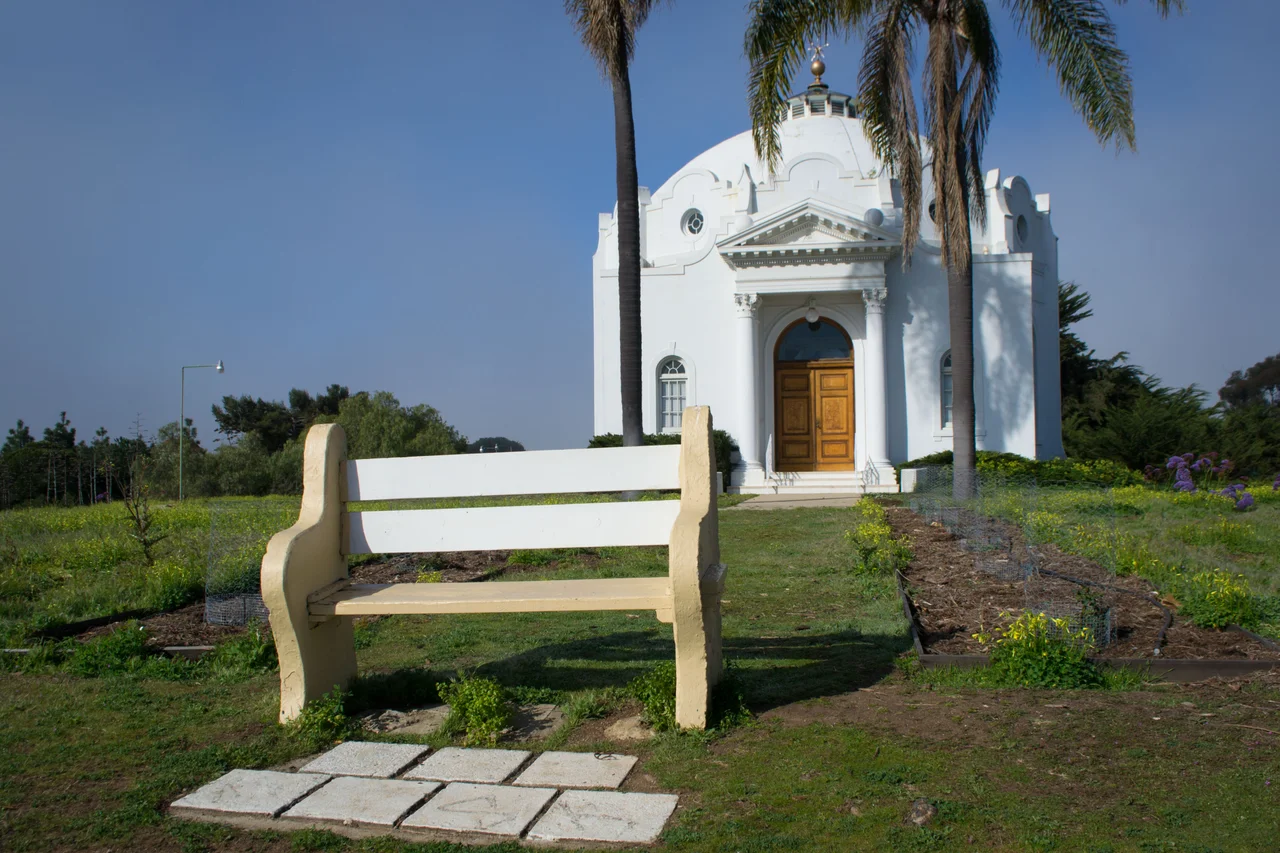
The centerpiece of Mount Ecclesia is the Healing Temple — The Ecclesia — a round, 12-sided building dedicated on December 25, 1920. Heindel died in 1919 and never saw it completed. His wife, Agusta Foss Heindel, continued his civic work in Oceanside until her death in 1949.
The architect was Lester A. Cramer. The building faces east, toward the rising sun, as solar temples traditionally do. Two palm trees stand before the portal, which is framed by a triangular pediment with an equilateral triangle — symbol of Trinity — at its center. The columns fuse Greek and Roman styles. The great dome carries a golden globe crowned with a finial of lights. Inside, alchemical and astrological symbols cover the walls. Daily healing meetings are held here by Probationers who have committed their lives to this work. The temple is dedicated, in the Fellowship's language, to the coming Age of Aquarius.
A Historic Community
On April 7, 1995, Mount Ecclesia was added to the National Register of Historic Places as the Rosicrucian Fellowship Temple. The designation recognized not just the architecture but the remarkable preservation of the grounds — natural gardens offering meditative walking paths, a guesthouse opened in 1938, cottages added through the 1970s.
The Fellowship operates on a financial model that Max Heindel established as fundamental: no price should ever be put on its teachings. No fees for membership, education, or healing. The organization sustains itself through voluntary donations, book sales, housing rentals, and cafeteria income. It has always, as its literature notes, 'balanced along the edge of the subsistence level' — a spiritual community in one of Southern California's most expensive coastal counties, choosing principle over profit for more than a century.
Mesa Above the Mission
The location Heindel chose sits on a promontory overlooking the San Luis Rey River Valley — the same valley where the 18th of California's 21 Spanish missions was founded in 1798. From Mount Ecclesia's high ground, on a clear day, the white towers of Mission San Luis Rey de Francia are visible to the west. The physical relationship between the two institutions captures something about Oceanside's layered spiritual history: the Franciscan mission below, founded through conquest; the Rosicrucian temple above, founded through vision.
The historic district today remains active, welcoming visitors for garden walks and offering vegetarian accommodation during winter and summer school activities. After more than a century, the Fellowship continues its work precisely as Heindel intended — quietly, without seeking temporal power, on a mesa above a river valley where a mystic once stood beside a horse and buggy and recognized the place from a dream.
From the Air
Mount Ecclesia sits at 33.21°N, 117.36°W on a mesa overlooking the San Luis Rey River Valley in Oceanside, California. The distinctive domed Ecclesia building and surrounding grounds are recognizable from altitude. Mission San Luis Rey de Francia is visible approximately 1.5 miles to the southwest. Nearest airport: McClellan-Palomar (CLD) approximately 8 miles southeast. Elevation approximately 200 feet above sea level.
Nearby Stories
- Where Hollywood Came Home to Make Theater 0.5 km away
- Viejas Band of Kumeyaay Indians 3.4 km away
- Santa Ysabel Asistencia 3.8 km away
- Cahuilla Band of Indians 14 km away
- Tenaja Fire 15 km away
- Laguna Art Museum 16 km away
- Balboa Island Ferry 54 km away
- USS Agerholm 165 km away