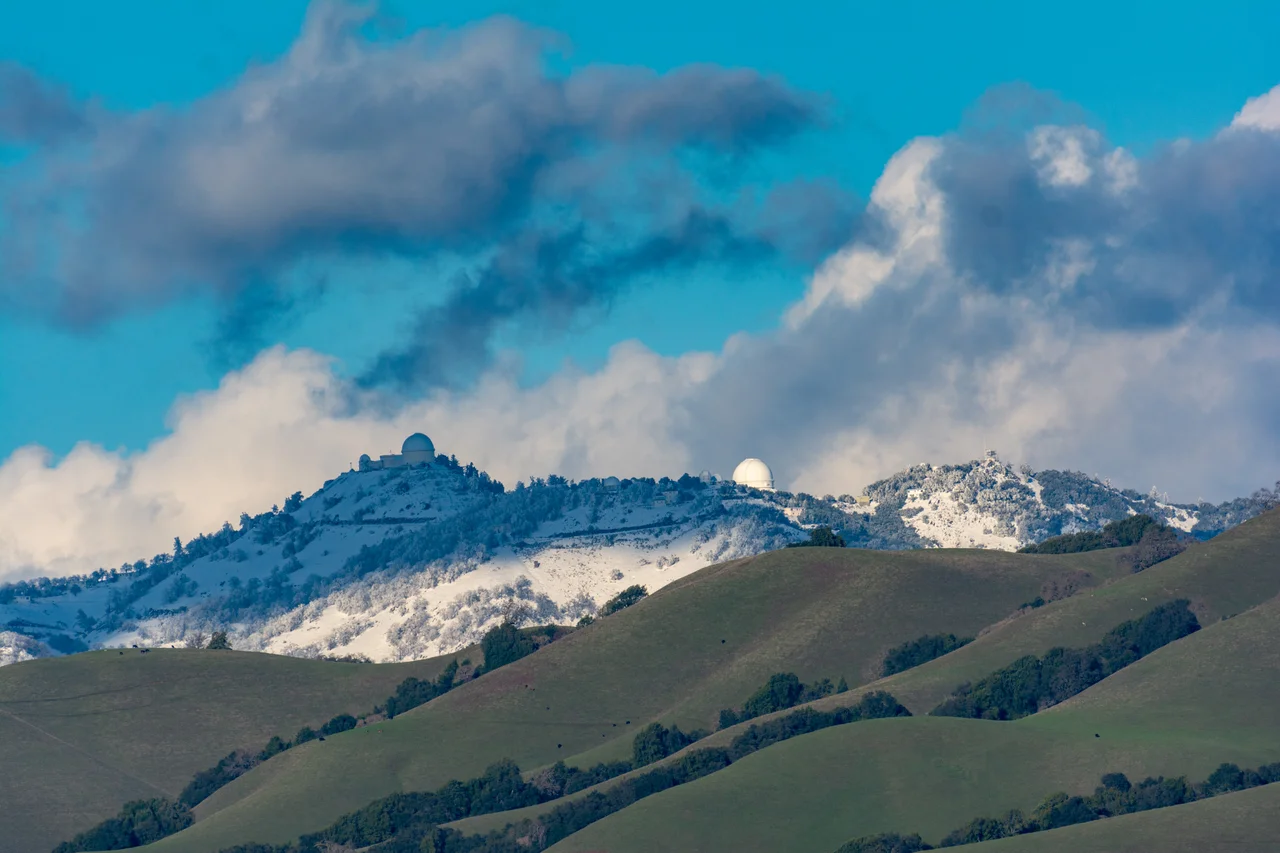

Mount Hamilton (California)
On August 26, 1861, a Presbyterian minister named Laurentine Hamilton scrambled ahead of a California Geological Survey party, reached a summit in the Diablo Range east of San Jose, swung his hat in the air, and shouted back: "First on top -- for this is the highest point." He was wrong about the highest point, as it turned out, but his enthusiasm earned the mountain his name. A generation later, a different kind of ambition would mark the same ridge. James Lick, the richest man in California, chose Mount Hamilton as the site for the world's largest telescope and asked to be buried beneath it. Both wishes were granted.
A Ridge of Astronomical Names
Mount Hamilton is one summit along a mile-long ridge in the Diablo Range. The highest point is actually Copernicus Peak, at 4,360 feet, located eight-tenths of a mile to the northeast. Copernicus is the true high point of Santa Clara County, with a topographic prominence of 3,080 feet. The other peaks along the ridge bear names drawn from the history of astronomy: Kepler, among them. This naming convention reflects the ridge's identity as an observatory complex rather than a simple mountain. From the summit, on clear days, the view extends from the Monterey Peninsula to the Sierra Nevada, a sweep of California geography that helps explain why astronomers chose this spot to study the sky.
A Fortune Buried Under Glass
James Lick arrived in San Francisco from Peru in 1847 with $30,000 in gold and a talent for real estate. By the 1870s he was the wealthiest man in California. In 1874, persuaded by astronomers at the California Academy of Sciences, he bequeathed $700,000 to build the world's largest telescope on Mount Hamilton. Construction of the observatory ran from 1876 to 1887, requiring a new road to be carved up the mountain. Lick died in 1876, but his body was later interred beneath the pier of the 36-inch Great Refractor, marked with a brass tablet reading: "Here lies the body of James Lick." When the telescope saw first light in 1888, it was the largest refracting telescope on Earth. Lick Observatory became the first permanently occupied mountaintop observatory in the world, and its 36-inch refractor remained a premier research instrument for half a century. Today, the main building offers free 15-minute guided tours of the Great Lick Telescope.
The Long Climb
Cyclists know Mount Hamilton as one of the Bay Area's great endurance tests. The ride from the Alum Rock Avenue junction covers just over 19 miles, but the route is not a simple ascent. Two descents interrupt the climb, first dropping into Grant Ranch County Park and then crossing Smith Creek, meaning riders must earn back elevation they have already gained. Quimby Road offers a shorter approach from San Jose but is considerably steeper. On Thanksgiving Day, hundreds of cyclists converge on the mountain for what has become an annual tradition, and the climb frequently serves as the final stage in the Low-Key Hillclimb Series, attracting some of the region's strongest riders.
Condors, Elk, and a Tiny Flower
The mountain's ecology holds surprises. The Mount Hamilton jewelflower, Streptanthus callistus, grows here and nowhere else on Earth. In June 2011, five juvenile California condors landed on Lick Observatory, the species' first sighting in the area in at least 30 years. Tule elk roam the surrounding Diablo Range, reintroduced after a 1978 effort championed by state game warden Henry Coletto. The Nature Conservancy's Mount Hamilton Project has placed 100,000 acres under conservation easement, working toward a goal of 500,000 acres within a 1.2-million-acre area encompassing much of eastern Santa Clara County. Beneath it all, Miocene-age sandstone of the Briones formation underlies the foothills, and the Calaveras and Hayward earthquake faults traverse the slopes.
Population: 35
Mount Hamilton has its own zip code, 95140. In the year 2000, it had a population of 35. A small one-room schoolhouse, Mount Hamilton Elementary, served the community until it closed in 2006. It is a place defined more by what surrounds it than by any human settlement: open grassland, oak woodland, the observatory domes on the ridge, and a darkness at night that most of Silicon Valley lost decades ago. That darkness is the mountain's gift to science. While the valley below glows with the light of a million screens, the summit still offers astronomers something increasingly rare in California: a view of the stars.
From the Air
Located at 37.342N, 121.643W in the Diablo Range, east of San Jose, California. Copernicus Peak nearby reaches 4,360 feet, the highest point in Santa Clara County. The white observatory domes on the ridgeline are highly visible from the air and serve as an excellent visual landmark. The winding Mount Hamilton Road (SR 130) is visible climbing the western slopes. Nearest airports: Reid-Hillview (KRHV, 12nm W), San Jose International (KSJC, 17nm W), Livermore Municipal (KLVK, 18nm N). Best viewed at 5,000-6,000 feet MSL. Be aware of mountain weather conditions, turbulence along the ridgeline, and restricted airspace near Moffett Federal Airfield to the west.
Nearby Stories
- Pan Am Flight 843 3.2 km away
- San Gregorio, California 4.8 km away
- The Mystery Spot: Where Gravity Takes a Vacation 18 km away
- Altamont Free Concert 26 km away
- From Aluminum to Ammunition to Aviation Fuel 35 km away
- Kesterson National Wildlife Refuge 37 km away
- Panoche Hills: California's Last Desert Refuge 70 km away
- ʻAkaka Falls State Park 3707 km away