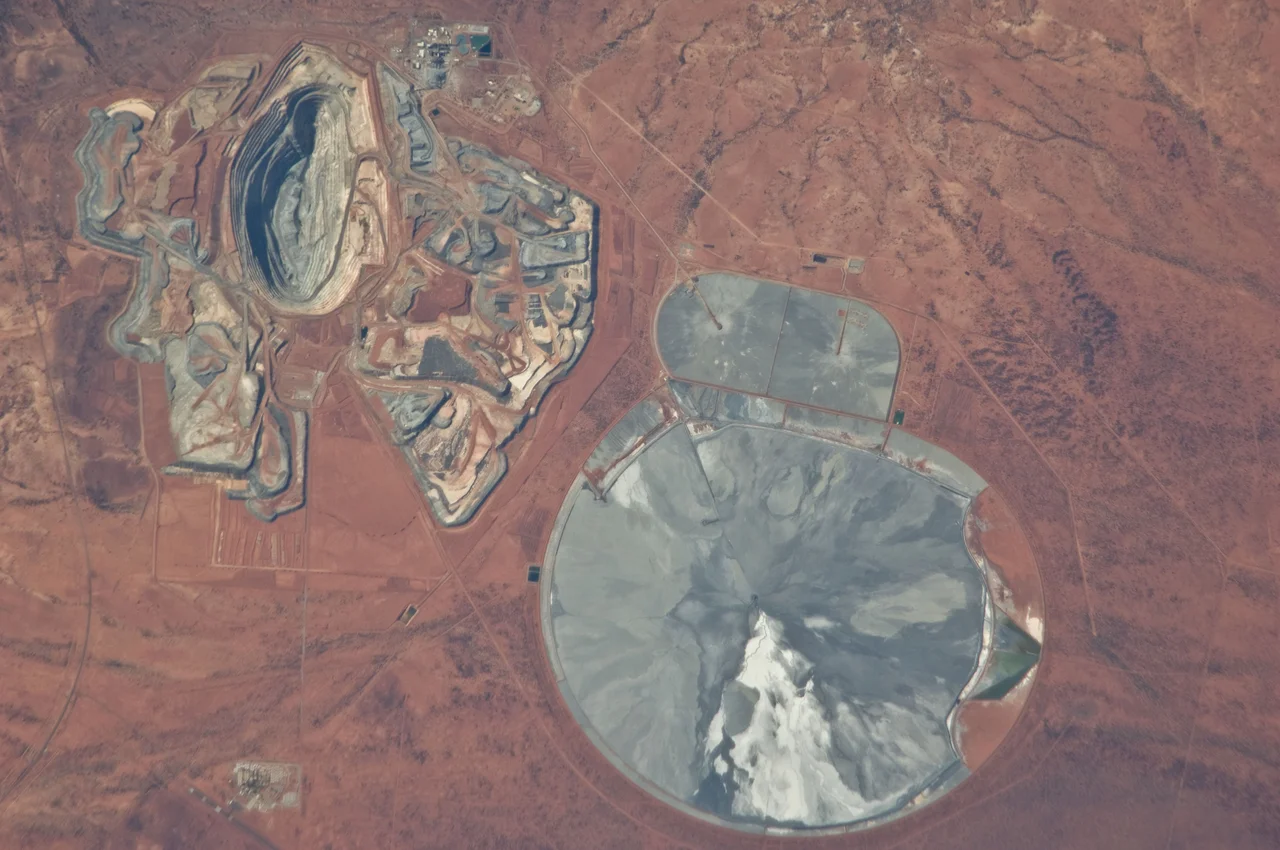

Mount Keith Mine
From the air, it looks like a wound that engineering opened on purpose: a grey-green amphitheatre 2.4 kilometres long and 300 metres deep, terraced in concentric benches that spiral toward a floor where haul trucks the size of houses crawl like beetles. This is Mount Keith, one of the largest open-pit nickel mines on the planet, gouged into some of the oldest rock on Earth. There is no city here, no river, barely a tree. The nearest town, Wiluna, sits 85 kilometres to the north. Everything else is the flat red silence of the Western Australian outback, and into that silence the mine pours the steady industrial roar of an operation that once supplied metal to the whole world.
Reading Rock Two Billion Years Old
The nickel at Mount Keith was laid down long before there were animals, plants, or breathable air. It sits in ultramafic rock roughly 2,700 million years old, part of the 800-kilometre Norseman-Wiluna greenstone belt that snakes across the ancient Yilgarn Craton. These deposits formed from komatiites, rare volcanic rocks so hot when they erupted that nothing like them has been produced on Earth in billions of years. As the molten flows cooled, droplets of nickel-bearing sulphide settled and concentrated. The orebody strikes for about two kilometres and runs at least 500 metres deep, making this one of the world's great komatiite-hosted nickel bodies - and one of the largest low-grade open-pit nickel mines anywhere. It is also frustratingly dilute: the ore grades around 0.6 percent nickel, which is why Mount Keith is a giant that only pays its way by moving rock at colossal scale. To find the metal, you must be willing to move mountains of the stuff that is not.
The Mine That Waited a Quarter-Century
Geologists drilling for Metals Exploration Limited found the deposit in 1969. By 1971 some believed it could supply a tenth of the world's nickel. Then it sat, untouched, for almost twenty-five years. Nickel prices were too low through the 1970s, and the cost of building a mine and a town in such remoteness was crushing. What finally changed the equation was not geology but logistics: the shift to fly-in, fly-out work in the 1980s meant no town needed building at all. Workers could be flown to camp and home again. Australian Consolidated Minerals revived the project in 1988, partnered with Finland's Outokumpu, and the pit finally opened in 1995. By then a 1992 estimate had pegged it at 270 million tonnes of ore - roughly twenty years of digging.
Concentrate, Then a Long Road South
Mount Keith does not produce finished nickel. It crushes and processes ore on site into a concentrate, which is then trucked roughly down the Goldfields to Leinster for drying, and onward through BHP's Nickel West chain - the Kalgoorlie smelter, the Kwinana refinery near Perth. WMC Resources had assembled this network, and in 2005 BHP bought WMC, folding the mines into a single brand that became the state's largest nickel producer. At the time of the takeover, Mount Keith alone employed 950 people. For three decades the pit deepened, the benches widened, and the trucks never stopped.
When the World Stopped Needing the Metal
The end, when it came, came from a glut. A wave of cheap Indonesian nickel flooded global markets, prices collapsed, and on 11 July 2024 BHP announced it would suspend all of Nickel West - Mount Keith included - placing the operations into care and maintenance from October. The decision touched around 1,600 workers; BHP pledged redeployment or redundancy to everyone affected and committed to keep spending hundreds of millions a year to preserve the option of a restart, with a review pencilled in for early 2027. So the great pit now sits quiet, its haul roads still, a paused machine in the desert. The nickel is still down there. Whether the world will want it again is a question of price, batteries, and patience.
From the Air
Mount Keith Mine lies at 27.21 degrees south, 120.55 degrees east, in the northern Eastern Goldfields of Western Australia, roughly 85 km south of Wiluna along the Goldfields Highway corridor. The open pit is an unmistakable landmark from altitude - a pale grey-green terraced bowl over two kilometres across, with adjacent tailings dams and processing infrastructure breaking an otherwise featureless red plain. Best viewed at 6,000 to 10,000 feet AGL in the clear, dry air typical of the region. The nearest sealed airstrip serving the area is Leinster Airport (ICAO YLST) to the south; Wiluna Airport (YWLU) lies to the north, and Meekatharra Airport (YMEK) is the larger regional field to the west. Daytime visibility frequently exceeds 50 km; watch for heat shimmer and dust over the workings.
Nearby Stories
- Wiluna uranium mine 8.4 km away
- Cosmos Nickel Mine 24 km away
- Wiluna Railway Line 67 km away
- Banjawarn Station 74 km away
- Sandstone, Western Australia 85 km away
- Western Australia 100 km away
- Yarrabubba 109 km away
- Mulga Queen Community 118 km away